


If you publish on Steam, you already answer to Valve on everything from store page requirements to Gold Master builds. So when Valve’s own Steamworks documentation sets out how developers should evaluate a localisation vendor, it’s worth treating it as more than a footnote.
6-minutes read
It is, in effect, the closest thing the industry has to an official buyer’s checklist, written by the platform every PC developer has to satisfy regardless of who they eventually hire.
Valve’s guidance boils down to five questions: which languages, at what cost, with or without independent QA, how complex is the content, and can the vendor prove what they actually did on past titles.
Below, we walk through each one and what “good” looks like in practice, so that whether you land on us or on someone else, you are asking the right questions.
1 – Target languages and regional specialisation
Valve recommendation: “Determine your target languages. Some agencies focus on specific regional languages or have specialised expertise in certain areas over others.”
How 1Stop Translations delivers:
Not all markets behave the same way. Whether your priority is expanding into FIGS (French, Italian, German, Spanish), mastering CJKT (Simplified Chinese, Traditional Chinese, Japanese, Korean, Thai), or targeting emerging high-growth regions across LATAM, CEE, and MENA, we do not rely on generalist linguists.
- Gaming-native translators: Every language pair is handled by native-speaking linguists who actively play video games in your genre.
- Genre-specific matching: An RPG with complex branching lore requires a different linguistic skillset than a fast-paced FPS or a tactical RTS. We match your script with translators who know the terminology and player expectations of your specific genre.
2 – Transparent pricing and budget flexibility
Valve recommendation: “Compare quotes to get an idea of service costs.”
How 1Stop Translations delivers:
Navigating localisation budgets shouldn’t feel like a guessing game. Indie studios working with micro-budgets and global publishers managing live-ops titles need clear, predictable, and scalable pricing models.
- No hidden fees for code and file formats: We natively integrate with your localisation files (.json, .po, .xml, .csv, String Tables) without charging extra overheads for file handling or parsing.
- Granular quotes: Our proposals clearly break down costs per word, per audio minute, and per QA testing hour, so you know exactly where every part of your budget goes.
- Scalable scope: Launching in Early Access? We help you prioritise high-ROI languages first (e.g., Simplified Chinese + FIGS) and scale up as your community grows.
3 – Localisation, independent QA and community feedback loops
Valve recommendation: “Consider whether you need both localisation and quality assurance (QA)… If you want unbiased checking, you can contract localisation to one agency and QA to another. Alternatively, build feedback channels for your player community.”
How 1Stop Translations delivers:
We offer full flexibility depending on your internal QA pipeline and studio preference:
- End-to-end or modular services: You can hire us for full turn-key localisation + LQA, or engage our team solely for independent 3rd-party Linguistic Quality Assurance (LQA) to audit work completed elsewhere.
- In-game testing and UI context: Our LQA testers inspect the build directly in-game to catch truncated text, broken variables, unlocalised strings, and overlapping UI elements.
- Community integration (Player Reach): Through our Player Reach team, we assist studios in setting up and monitoring language-specific Steam Discussion Hubs and Discord channels, turning player feedback into actionable continuous updates.
4 – Narrative depth vs. technical UI complexity
Valve recommendation: “Consider the difficulty of localising your game. Is it text-heavy, rich in lore, or relatively straightforward? This can dictate which translation provider is best suited for specific languages.”
How 1Stop Translations delivers:
We split our localisation pipeline based on the nature of your content:
- Lore and narrative transcreation: For story-heavy RPGs and narrative adventures, our creative writers adapt humour, idioms, cultural references, and world-building lore to resonate naturally in every target culture without losing the creator’s voice.
- UI/UX and system Localisation: For UI-heavy titles, simulators, and strategy games, our technical linguists focus on spatial constraints, variable integrity ({player_name}, %d gold), consistency in technical terms, and clear player navigation.
5 – Verified portfolio transparency
Valve recommendation: “Request a pitch or list of games the provider has handled, asking them to specify the exact work done on those games. The provider will point you to their top clients, but may not specify whether they handled game content, technical manuals, or were limited strictly to marketing materials. These text types differ substantially, so it will be up to you to dig deeper and gather more information to conduct your own research.”
How 1Stop Translations delivers:
We believe in 100% operational transparency. When we showcase our track record, we never obscure the exact scope of our work. We clearly differentiate between in-game dialogue, UI/UX strings, Steam Store page localisation, and QA testing, so game developers know precisely what capabilities were deployed for every single title.
Here is a transparent breakdown of recent projects across our portfolio:
| Game title and developer | Genre / type | Target languages | Scope of work | Key impact and milestones |
| Shelldiver (Gagonfe) | Indie Hit | ES, FR, DE, RU, PL, JA | Full in-game localisation | #1 most-downloaded indie title on the Steam Store in 2025. |
| Big Hops (Luckshot Games) | 3D platformer | ES, PT-BR, ZH, RU | Full game localisation and culturisation | High player retention and 78/100 Metacritic score. |
| Sliding Heroes (Silent Chicken) | Puzzle-adventure | ES, FR, ZH, JA, KO | Steam Store: ES, FR, ZH, JA, KO In-game: ES, FR | Dual-tier strategy driving rapid international adoption across Western & Asian markets. |
| The Zibbo Show (Tessera Studios) | Multi-market title | DE, ES, FR, IT, PT-BR | Full-cycle FQA and LQA | Single connected QA pipeline covering UI, controls, edge cases, and in-context text. |
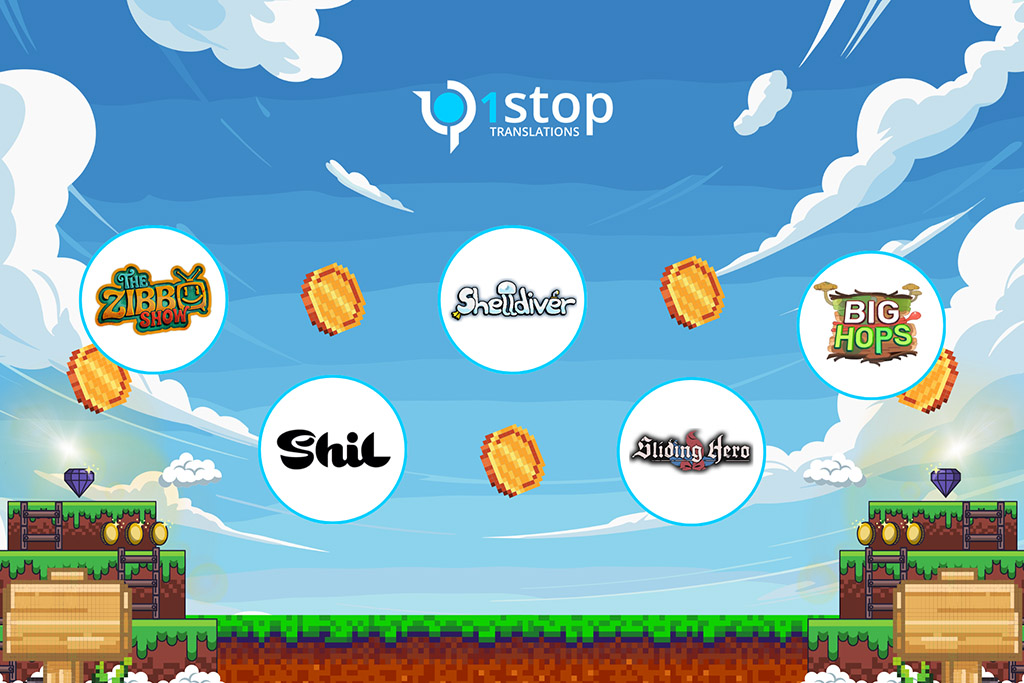
Portfolio breakdown: scope and delivered value
- Shelldiver (by Gagonfe)
- Scope: Complete game localisation into 6 key global languages (Spanish, French, German, Russian, Polish, and Japanese).
- Impact: Our seamless multi-language rollout played a pivotal role in driving rapid global ascent and deep player engagement, helping Shelldiver become the most-downloaded indie title on the Steam Store in 2025.
- Big Hops (by Luckshot Games)
- Scope: Culturally attuned game localisation into Spanish, Brazilian Portuguese, Chinese, and Russian for this vibrant 3D platformer.
- Impact: Tailored translations enhanced long-term player retention and cross-market performance, contributing directly to the game achieving a standout 78/100 Metacritic score.
- Sliding Heroes (by Silent Chicken)
- Scope: A targeted, dual-tier localisation strategy, adapting the Steam Store page into 5 major markets (Spanish, French, Chinese, Japanese, and Korean) to maximise store discoverability, paired with full in-game localisation for Spanish and French.
- Impact: Helped this puzzle-adventure title connect instantly with culturally diverse audiences while accelerating international adoption within budget.
- The Zibbo Show (by Tessera Studios)
- Scope: Single-source, full-cycle Functional Quality Assurance (FQA) and Linguistic Quality Assurance (LQA) across 5 European and LATAM markets (DE, ES, FR, IT, PT-BR).
- Impact: Rather than splitting QA across multiple vendors, our unified testing pipeline covered UI integrity, control schemes, edge cases, and in-context linguistic validation, identifying critical issues that only surface when translated text meets actual live gameplay.
Where this leaves you
None of this is really about us. It’s Valve’s own framework, and it holds up regardless of which agency you end up briefing. What we’d suggest is using the five questions above as your actual vendor scorecard, and scoring anyone you talk to, including 1Stop Translations, against it directly.
If you want to have that conversation with a team that specialises exclusively in games, our consultancy service can help you scope target languages, decide on the right QA structure, and prepare a vendor evaluation framework, whether or not that ends with us. Or, if you already know what you need, get a quote and put the questions above to us directly.