Category: News

The Linguistic Nuances of "Responsible Gaming": Navigating Compliance with Empathy - 1Stop Translations

The Linguistic Nuances of “Responsible Gaming”

Responsible gaming represents a vital framework for promoting safe gaming practices, preventing addiction, and ensuring compliance with local regulations in the iGaming industry. In regulated markets, platforms must integrate accessibility controls and deposit/affordability checks as part of their operations.

6 minutes – read

In the global market of iGaming, messages of responsible gaming are not only legal requirements but also an essential tool to support player welfare and public confidence, rather than a marketing advantage.

For example, in high-stakes jurisdictions like the United Kingdom, the UK Gambling Commission (UKGC) requires very strict accessibility measures and deposit limits. However, if such measures come across as “robotic” or negative, they may well deter the user.

Professional iGaming translations bridge this gap by delivering compliance with empathy, ensuring that a message about a deposit limit comes across as a helpful facility rather than a digital warning.

The Linguistic Nuances of "Responsible Gaming": Navigating Compliance with Empathy - 1Stop Translations

Understanding Global Variations in Responsible Gaming Regulations

Navigating the fragmented regulatory landscape requires more than a dictionary; it requires a deep understanding of local sentiment.

A generic translation could lead to fines from gaming regulators, as it might not accurately express the subtle meaning intended in responsible gaming laws, such as self-exclusion or deposit limits.

Empathetic localised translations, on the other hand, adjust to local culture, so responsible gaming tips are perceived as helpful rather than mandatory.

This approach helps reduce regulatory risk and supports safer player interactions across online gaming platforms.

Analysing real-life examples will help us understand how specific regional regulations make customised iGaming localisation necessary.

Europe: Navigating a Fragmented Landscape

Europe’s regulatory framework is very fragmented, with strict regulatory bodies such as the UKGC, the Malta Gaming Authority (MGA), and specific country regulations in Sweden, Germany, and Finland.

  • Kindred Group (Sweden/UK/Europe): Partnering with NGOs like GamCare, Kindred adapts its messages culturally. In the UK, a prompt like “Take a break if it’s no longer fun” is localised to sound supportive rather than judgemental. This sensitivity to mental health reduced stigma and lowered complaint rates.
  • Bet365 (UK/Gibraltar/Germany): Bet365 successfully integrated reality checks across 20+ languages. Under Germany’s strict OASIS self-exclusion system, they used empathetic phrasing such as “We’re here to help protect you and your loved ones” with the stated aim of supporting safer player behaviour rather than promoting play.
  • Betsson Group (Nordic Region): In Nordic cultures, well-being is heavily community-focused. Betsson tailored its messaging to reflect this (“Gambling should enhance life, not overshadow it”), and reported reductions in high-risk player escalations following those changes.
  • Enforcement examples: From a public regulatory action against Mr Green to the record fine levied on William Hill Group, show consequences for tone-deaf implementation. These actions prompted platform changes that combined UX, monitoring, and empathic copy.

North America: Balancing Disclosures and Approachability

In the US and Canada, the regulations are wildly different from state to state and province to province.

  • FanDuel (US): By launching “The Comeback” series, FanDuel integrated recovery stories into app prompts (“Hear real stories – gambling can be addictive, help is available”). Localised for states like New Jersey, this empathetic approach was accompanied by reported increases in helpline engagement in certain deployments.
  • Ontario Operator Fine (Canada): An unnamed firm faced a C$2.5 million fine for ignoring high-roller red flags. This incident highlighted the need for enhanced, localised alerts (“We’ve noticed increased activity – want support in your language?”) and underlined the operational importance of multilingual support for compliance.

Asia-Pacific and Emerging Markets: Addressing Stigma

  • Trust Networks Inc. (Japan): In Japan, cultural stigmas around addiction require highly indirect messaging. Subtle hints like “Consider your well-being” achieved high player approval ratings in targeted studies, showing how culturally adapted phrasing can improve acceptability.
  • LOTBA (Argentina): By expanding to iGaming, they achieved WLA certification by deploying Spanish-localised alerts with a supportive tone (“Toma un respiro – el juego responsable es clave”), setting a benchmark for Latin American markets.
Understanding Global Variations in Responsible Gaming Regulations - 1Stop Translations
Balancing legal requirements with empathetic, localised copy is essential for reducing regulatory risk, building player trust, and enhancing safety.

Cultural Factors Influencing Responsible Gaming Compliance

The above points show that a universal approach to responsible gambling advertising is simply not possible.

Western markets might be receptive to direct communication about control, while collectivist societies, found in Asia, will need communication about harmony and the family.

To provide effective, responsible gambling advice, operators must view compliance through a lens of cultural fluency. These influences make iGaming localisation essential, ensuring messages align with local values for better adherence and trust.

Overcoming Linguistic Challenges in iGaming Localisation

The biggest challenge in RG sportsbook language localisation is the translation of generic, legal-sounding terminology into accessible, empathetic language. Words such as “self-exclusion” or “affordability checks” have very negative, serious undertones. If directly translated, they may come across as threatening or preachy.

For instance, in Sweden, responsible gambling tips and messages must be completely neutral. If they come across as paternalistic, they will not be in line with cultural values of autonomy. On the other hand, in Japan, a direct translation of Western regulatory messages may come across as deeply insulting or patronising.

In collectivist societies, it may be more effective to have the dialogue revolve around the protection of the family unit, rather than the individual’s financial loss.

To help illustrate these points, we have assembled a visual representation of linguistic challenges and requirements around the world:

JurisdictionRG Message ExamplesLinguistic Challenges
United Kingdom (UKGC)Accessibility controls, deposit limits, reality checks (e.g., “You’ve been playing for 30 minutes – want a break?”).Must sound empathetic and not moralistic; translate “affordability checks” culturally to avoid stigma.
United States (states like New Jersey)Responsible marketing codes, addiction risk disclosures (e.g., “Gambling can be addictive – call the helpline”).Varies by state; localise for regional sensitivities, avoiding paternalistic language.
BelgiumMandatory self-exclusion, delays between bets (e.g., 5 seconds), and AI for risk detection with personalised messages.Integrate player education; translate into French/Dutch with a welcoming tone.
Malta (MGA)Self-exclusion tools, activity monitoring, and age verifications.Focus on multilingual compliance; adapt to Mediterranean cultures for empathy.
PortugalPersonalised alerts (e.g., “You’ve played 3 hours – take a break?”), shared self-exclusion databases.Make UX educational, not imposing; localise for emotional resonance.
Africa (e.g., Kenya, Nigeria)Voluntary support for RG organisations, modest ads emphasising risks without exaggeration.Adapt to local contexts; avoid messages seen as “Western”.
Overcoming Linguistic Challenges in iGaming Localisation - 1Stop Translations
Global reach, local resonance: Mastering the art of empathetic translation to overcome linguistic challenges in the international iGaming landscape.

How to Avoid Common Translation Pitfalls in Multilingual Markets

Some common translation traps in multilingual iGaming markets include literal translations that lack cultural sensitivity, which can lead to compliance problems or low engagement rates.

For example, a sportsbook’s translation effort in Germany failed when “responsible gambling advertising” came across as critical, attracting regulatory complaints. Case Case studies illustrate the importance of localisation with empathy: escalations decreased by 15% for Betsson’s Nordic localisations, and helpline calls increased for FanDuel’s US story-based prompts.

Hypothetically, a robotic translation in Japan may come across as patronising, leading to a retention rate decline; instead, nuanced, community-focused language helps build trust, such as in Trust Networks’ 70% approval ratings.

In conclusion, to avoid common translation pitfalls in multilingual markets, the following points must be considered:

  • Literalism: Direct translation of warning or help text messages lose tone.
  • Over-formality: Using legal language lowers empathy and trust.
  • Inconsistent terminology: Using inconsistent terms in the RG causes confusion among players, and using glossaries and translation memories solves this problem.
  • Poor UI integration: Using long legal strings that violate the layout makes critical controls less visible.

Best Practices for Empathetic and Compliant RG Content Creation

To reach the best possible level of responsible gaming communication, the need to go beyond automated tools arises. What is responsible gambling if not a promise to the human being behind the screen?

To achieve the perfect balance between strict regulatory compliance and player empathy, a sophisticated linguistic strategy is required. Here are the best practices for structuring your iGaming translations:

  • Prioritise Native iGaming Linguists: Translators need to be aware of the target language, as well as the terminology, player psychology, and regulations of the iGaming industry.
  • Develop Comprehensive Glossaries: Create translation memories (TM) exclusively for RG terminology. This will help maintain consistency in all communication channels, including pop-up notifications and terms and conditions.
  • Conduct In-Country Compliance Testing: Before launching, have lawyers and native speakers of the target country test the content for compliance with both regulations and cultural norms.
  • Keep Sensitive Messaging Human: Do not use machine translation for primary RG messaging, as human editors maintain empathy and tone nuances that machines lack.

Why Not Use Pure AI Translations for Responsible Gaming Content?

Although AI software is very useful for replicating generic copy on a large scale, it doesn’t possess the emotional intelligence necessary for responsible gambling content.

Pure AI translations tend to rely on very clinical, direct language that fails to convey the level of empathy necessary to defuse a distressed gambler. Human translation is imperative to ensure that the tone remains authentic and empathetic.

This is where the value of a specialised partner comes into play. At 1Stop Translations, we utilise our deep knowledge of the industry to assist iGaming operators in overcoming the same issues in more than 100 languages.

For example, in the Latin American market, a rapidly regulating region, an operator that adjusted Portuguese translations for Brazil to reflect local cultural norms reported improvements in retention metrics while also strengthening compliance controls.

Collaborating with native speakers to modify promotion-adjacent messages and deposit-limit notifications for cultural fit can convert a compliance requirement into a practical tool for safer player communications.

Best Practices for Empathetic and Compliant RG Content Creation - 1Stop Translations
Why the ‘human touch’ is indispensable for Responsible Gaming. Native linguists ensure that sensitive messaging remains empathetic, culturally nuanced, and fully compliant.

FAQ

  1. What is responsible gambling in iGaming?
    Responsible gambling refers to policies and tools designed to help players manage their gaming behaviour safely, including deposit limits, self-exclusion and reality checks.
  2. Why is iGaming localisation important for responsible gaming compliance?
    Localisation ensures RG messaging aligns with cultural expectations and regulatory requirements in each market, improving compliance and player trust.
  3. Can AI be used for responsible gambling translations?
    AI can support workflows, but human linguists are recommended for responsible gambling content to ensure empathy and cultural accuracy.

Conclusion: Compliance, Reputation, Player Protection

In the iGaming industry, responsible gaming terminology is both a compliance safeguard and an operational tool for player protection. Empathetic localisation turns dry legal requirements into player-focused communications that support safer play and regulatory adherence.

Potential benefits include improved regulatory alignment and measurable improvements in player protection outcomes, such as increased help-seeking and reductions in problem behaviour indicators.

If you are launching across multiple markets, focus on local RG linguists, comprehensive glossaries, regulatory checks, and human review of any AI-generated content.

A sensible starting point: review your player-facing RG content in each target language, tone, prominence, and local support links, and refine with local experts.


Need a quote? Click here
DEI Translations: Making Digital Content Inclusive Across Languages - 1Stop Translations

DEI Translations: Making Digital Content Inclusive Across Languages

As a result, video game localisation emerges as a key tool in creating a feeling among all gamers  that they have been acknowledged and accepted, irrespective of their physical, gender and cultural differences.

9 minutes – read

Integrating DEI translations (Diversity, Equity, and Inclusion) is no longer a peripheral “nice-to-have” and no longer seems to be a corporate buzzword.

With over 3 billion people playing games globally, an important demographic needs special features for accessibility to effectively participate in digitally constructed worlds.

For the Localisation Manager and the Localisation Leads, the challenge lies in embedding inclusivity at the very core of the localisation pipeline.

This article acts as a comprehensive guide to help you navigate the intricacies of inclusive content translation, and ensures your titles are not just translated, but accessible as well.

DEI Translations: Making Digital Content Inclusive Across Languages - 1Stop Translations

Why does Accessibility and DEI Matter in Video Game Localisation?

The drive towards inclusive gaming stems from a powerful combination of ethical arguments and market realities. From a business perspective, the “purple dollar” (the financial expenditure of people with disabilities) represents a significant market opportunity that is often under-served.

Additionally, where the title emphasises the need for accessibility localisation in games, it opens the doors for millions of players who might not otherwise be included. Moreover, by focusing on ensuring there is diversity, equity and inclusion, there will be an improved brand reputation and therefore a loyal following.

Regulatory Pressure and Industry Standards

Additionally, apart from the ethical considerations, there are increasing regulatory and platform-based influences. A case in point is legislative developments such as the European Accessibility Act and the CVAA in the United States.

Even the leading platforms, such as Xbox and PlayStation, have introduced strict guidelines on accessibility, which must be adhered to by game developers to attain featured status. The leading industry associations, such as the IGDA (International Game Developers Association), are now treating inclusive localisation as a competitive prerequisite and not as a bonus feature.

Defining Accessibility in the Gaming Context

On a practical level, accessibility in localisation will involve a number of key elements which need to be addressed in the actual translation process, including:

  • Subtitles & Captioning: This goes beyond dialogue. It includes SDH (Subtitles for the Deaf and Hard of Hearing), which takes into consideration timing, readability, and localisation of idioms without direct equivalents.
  • Audio Descriptions (AD): The audio description of cinematic cutscenes and the narrated UX for visually impaired players requires a script that is both descriptive and fits within the scene pacing.
  • UI/UX Text Localisation: Also, the facilitation of user interfaces to be screen-reader friendly, with text legible on screen even when their size or contrast is adjusted.
  • Input Remapping & Tutorials: Localised descriptions for control remapping and help menus are necessary for players that use adaptive controllers.
Why does Accessibility and DEI Matter in Video Game Localisation? - 1Stop Translations
By prioritising DEI Translations, developers can meet strict regulatory requirements like the EAA while building long-term brand loyalty within under-served gaming communities.

DEI Translations versus Traditional TEP

While the standard TEP (Translate, Edit, Proof) process focuses on linguistic accuracy, DEI translations add a layer of cultural and social sensitivity. This includes:

  • Cultural sensitivity reviews: A way to identify potential tropes or offensive imagery, which can vary across different regions.
  • Inclusive Language Glossaries: Providing living, breathing documents that define how to handle non-binary pronouns or sensitive terminology.
  • Lived-Experience Input: This would involve testing by native speakers who have disabilities that are native to the region in which the software is to be distributed, providing valuable feedback on the accuracy and functionality of the localised experience.

The multi-disciplinary approach reduces rework, preserves player voice, and prevents costly post-launch remediation.

Resources on the intersection of localisation and accessibility from academic and industry perspectives include Videogame Localisation and Accessibility: Fun for All review that explores user-centred methods.

Adapting Content: From Inclusive Scripts to Accessible UI

Execution is strategy meeting reality. To provide premium gaming translation services, a provider must understand the technical nuances of how content is used. This is where inclusive content translation moves from theory to technical implementation.

Visual and Audio Rendering

Adapting SDH from subtitles is a specialised skill. SDH differs from standard subtitles because it’s there to make sure to convey the atmosphere with non-speech information such as the creaking of a door, an ominous swell of music, or muffled shouting. Export burnable captions and separate timed files: SRT/ TTML to pipelines.

1Stop Translations underlines that all these cues need to be localised: a “thud” in English can have quite a different feel and dimension when translated into Japanese or Brazilian Portuguese, for example. Similarly, Audio Descriptions (AD) have to be crafted so the proper narrative “beats” are heard without conflicting with important dialogue.

Linguistic Nuance and Gender Neutrality

One of the biggest challenges encountered with regard to grammatical gender in any game within the category of DEI video games is that, in a language like Spanish, French, or Polish, the verb and adjective agree with subject gender.

To address the variety of player brands that the games might have within localisation, it is necessary to think creatively about linguistic solutions that ensure dialogue appears neutral with respect to gender without compromising the normal flow of conversation.

Localisers should use inclusive language glossaries and raise awareness for locales where neutral language is not available, including proposing UI changes and/or alternatives for micro-copy. This level of nuance is what differentiates between an inclusive translation and just another generic translation.

Adapting Content: From Inclusive Scripts to Accessible UI - 1Stop Translations
Bridging the gap between inclusive storytelling and technical accessibility to ensure every player, on every platform, feels seen and heard.

User Interface (UI) Challenges

The technical implications of game localisation can conflict with the needs of accessibility. For instance, if a “dyslexia-friendly font” is used or “high-contrast mode” is enabled, more screen space is often required. An increase of 30% or more in English text can result from using European languages like German or Italian.

Expert video game localisation services help avoid this by planning the expansion of texts during the design stage through the effective use of “string wrapping,” ensuring that the texts are easily readable on all screens ranging from smartphone screens to 4K screens.

Mobile versus Console differences: The mobile version requires larger touch targets, as well as integrating captions and accommodating system-level screen readers. The experience may include game narration or controller remapping in the console version.

Best Practices for Implementation of DEI Translations in Video Games

A scalable localisation partner must also represent process depth in terms of language support, accessibility knowledge, and in-country testing support. We already publish advice on video game workflows.

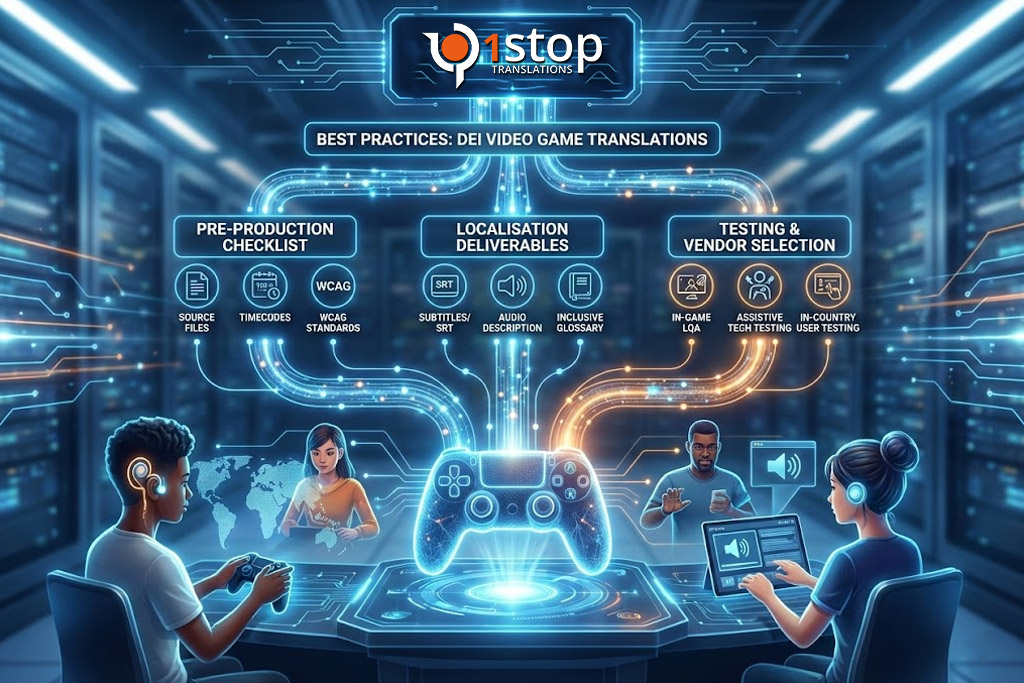
Pre-production Checklist

The following should be passed to your localisation team before translating the first string:

  1. Source files with contextual details: Consider including screenshots and videos showing the UI in action.
  2. Timecodes: This feature is vital to ensure proper synchronisation with subtitle and audio description cues.
  3. Accessibility requirements: If appropriate, reference specific accessibility standards such as the WCAG (Web Content Accessibility Guidelines). Include information such as character limitations or right-to-left flags.

Localisation deliverables to request from vendors

  • Localised subtitles + Burnable Captions, each one having its own SRT/TTML file.
  • Audio description scripts and VO source-ready.
  • Localised UI strings with context notes, as well as accessibility-related tags such as “screen reader label” or “short label”
  • Inclusive Language Glossary and DEI notes per locale.
  • Accessibility QA report with remediation recommendations and priority fixes.

Testing Checklist

  • In-game LQA with full builds (timing, overlap, truncation).
  • Assistive tech testing: screen readers on supported platforms, caption rendering, controller remap curves.
  • In-country user tests, including gamers with disabilities (lived experience feedback rather than QA).
Best Practices for Implementation of DEI Translations in Video Games - 1Stop Translations
From inclusive glossaries to assistive tech testing, a robust approach to DEI Translations ensures that your game is accessible, respectful, and culturally resonant for players across the globe.

Testing and Vendor Selection

The final bridge to inclusivity is testing. This comprises:

  • Assistive Tech Testing: Testing how the screen reader interacts with localised strings on mobile and console.
  • In-Country User Testing: Playing with people with disabilities within the target country.

When choosing a vendor, ask about their particular experience with regards to video game localisation. Request case studies to prove their management of accessibility projects and ask about their ISO qualifications.

A partner with extensive experience across multiple industries as well as specialisations in console and mobile game development, as seen with 1Stop Translations, would be best suited to satisfy the transparency and technical expertise now demanded with DEI projects of this calibre.

Quick wins vs. long-term strategies

Micro-copy and Phrasing Examples

Inclusive wording means thinking differently. For instance, instead of the literal translation of “Master / Slave”, like in some older technology, it is better to think in terms of “Primary / Secondary”. Instead of posing the question, “Are you a boy or a girl?”, one should think, “Choose your appearance.”

The reality is, keeping the player’s voice consistent and respectful, no matter which of over 100 languages we’re talking about, is what helps build a global community.

Conclusion: Inclusivity as a Partnership

True inclusivity in the digital age demands more than just a vendor, it demands a strategic partner who understands that video game translations is an act of empathy as much as it is an act of technology.

By incorporating DEI translations into your pipeline, not only are you satisfying a checklist, but you’re making sure your game is an inclusive space for all your players, no matter where they are or how they interact with the world.

We at 1Stop Translations leverage the latest technologies and linguistic expertise to successfully overcome the challenges of modern localisation. This is whether you’re launching an indie mobile title or a global AAA video-game blockbuster.

Ready to take your content to the next level of inclusivity? Contact us to find out how our teams of experts can take your next project to the next level of excellence with our top-notch DEI localisation services.


Need a quote? Click here

Building Successful iGaming Affiliate Partnerships in Multilingual Markets - 1Stop Translations

Building Successful iGaming Affiliate Partnerships in Multilingual Markets

The global expansion of the iGaming sector is deceptive. It looks like a numbers game, more licences, more markets, more potential players, but the reality is far more complex. We are currently witnessing a shift where growth is no longer local, it is aggressively international. However, this expansion has exposed a critical fracture in the ecosystem: the “Affiliate-Localisation Gap“.

6 minutes – read

This gap represents the disconnect between operating a high-potential affiliate programme and failing to resonate with local audiences because the cultural bridge is missing. For Digital PR and Affiliate Managers, the harsh truth of modern online casino marketing and Sportsbook advertising is that success is no longer defined purely by the number of partners you onboard. It is defined by the cultural relevance of the traffic they drive.

If your affiliate in Brazil is promoting your sportsbook using European Portuguese terminology, or if your partner in Japan is using aggressive Western-style calls-to-action that alienate local players, your traffic isn’t just low quality, it’s non-existent.

Building Successful iGaming Affiliate Partnerships in Multilingual Markets - 1Stop Translations

Key Takeaway: Why Multilingual Affiliates Matter

  • Trust Signals: Trust Signals: Users are more likely to engage with platforms that present content in their native “gaming language” fluently.
  • SEO Authority: Localised content drives lower bounce rates, signalling to search engines that your site is relevant in that specific GEO.
  • Regulatory Safety: Accurate localisation ensures affiliates don’t accidentally violate strict local advertising laws (e.g., UKGC vs. KSA).
  • Conversion Velocity: Cultural adaptation reduces friction, improving the user journey from an “Affiliate Bridge Page” to further engagement with the operator’s site.

The Strategic Complexity of Global Affiliate Management

Scaling an affiliate programme across markets is not “copy-paste and translate.” Standard one-size strategies fail because search behaviour, payment preferences, legal frameworks, and gaming terminology vary greatly between countries.

Strategies that dominate in the UK often fail spectacularly when applied to emerging markets like LatAm or established, insular markets like Japan. This is where the complexity of iGaming SEO becomes a major hurdle for Affiliate Managers.

The Evolution of iGaming SEO Across Borders

Ranking factors are not universal. In the UK, search intent might be driven by “fast withdrawals” and “trust.” In Brazil, the search intent might skew heavily toward “Pix payment acceptance” and “welcome bonuses.” If your affiliate partners are not equipped with keywords and content strategies that reflect these local nuances, they cannot rank. Consequently, your brand remains invisible.

Furthermore, iGaming linkbuilding becomes significantly more difficult when content isn’t localised. High-authority local sites (newspapers, niche blogs) will not link to an affiliate review that reads like a machine-translated press release. To build a robust backlink profile in a new territory, the content must possess native fluency. Without it, you are generating “toxic” or low-value links that offer no authority transfer to your main money website.

The Strategic Complexity of Global Affiliate Management - 1Stop Translations
Strategic Localisation vs. Translation: A comparative analysis of global iGaming search intent.

Regulatory Nuances and the “Language Trust Factor”

Beyond SEO, there is the legal minefield. A partner in Ontario must adhere to completely different compliance standards than a partner in Sweden.

  • Compliance: Affiliates must adapt their content to meet local jurisdictional requirements. A mistranslated term regarding “free spins” or “risk-free bets” can lead to hefty fines from regulators like the MGA or UKGC.
  • Trust: This brings us to the “Language Trust Factor.” Players are inherently skeptical. If they click a link from an affiliate site and land on a bridge page where the terminology feels “off”, perhaps using “Soccer” instead of “Football” in a UK context, or “Pokies” outside of Australia, trust evaporates. The user assumes the platform is a scam or an unregulated offshore entity, and they bounce.

Premium Localisation: The Engine of High-Conversion Partnerships

To close the gap, managers must stop viewing translation as a commodity and start viewing it as a conversion engine. There is a distinct difference between generic translation and true iGaming localisation.

Beyond Translation: Cultural Adaptation

Generic translation tools do not understand the psychology of the gambler.

  • Terminology: In sportsbook content localisation, the difference between “odds,” “lines,” and “spreads” varies wildly by region. In casino gaming, “wagering requirements” might be known as “playthrough” or “rollover” depending on the market.
  • Impact: Using the correct, industry-specific terminology is a subtle psychological trigger that tells the player, “We understand this game, and we understand you.”

The Business Case for iGaming Translations

Premium iGaming translations do more than just make text readable, they directly impact your bottom line. Data suggests that localised content can boost Click-Through Rates (CTR) by upwards of 40%. More importantly, it can improve key conversion metrics that indicate higher user engagement.

The Business Case for iGaming Translations - 1Stop Translations
How premium iGaming localisation transforms generic translation into a high-conversion engine by aligning cultural nuances with EEAT authority.

Empowering the Affiliate with “Ready-to-Use” Kits

You cannot expect every affiliate to be a linguist. To maximise ROI, Affiliate Managers must take a proactive role by providing “Ready-to-Use” localised marketing kits.

  • Banners: Culturally relevant imagery (e.g., Cricket for India, Football for Brazil).
  • Landing Pages: Pre-translated HTML templates that affiliates can host.
  • E-mail Templates: CRM sequences that respect local formality levels.

EEAT and Brand Authority

Google’s EEAT (Experience, Expertise, Authoritativeness, and Trustworthiness) guidelines are strictly applied to “Your Money or Your Life” (YMYL) industries like iGaming. Maintaining a consistent expert voice across 100+ languages is essential for EEAT. If your English content is expert-level but your Spanish content is sloppy, Google assesses your domain as less authoritative. Premium localisation preserves your expert status globally.

Actionable Strategies for Optimising Multilingual Affiliate Networks

For Digital PR and Affiliate Managers, theory must eventually turn into practice. Here is how to operationalise localisation within your partnership network.

  1. The Content Toolkit Strategy
    Develop a centralised, localised asset library. Instead of waiting for affiliates to request content, provide a dynamic folder categorised by language and region. This ensures that the message deployed by your partners is always on-brand and grammatically perfect.
  2. GEO-Specific SEO Coordination
    Align iGaming SEO efforts between the brand and the affiliate.
    • Keyword Sharing: Provide your affiliates with the high-value keywords you are targeting in their specific region.
    • Cannibalisation Prevention: Coordinate so that your main brand site and your affiliates are dominating the Search Engine Results Pages (SERPs) together, rather than fighting for the same terms.
  3. Performance Tracking by Region
    Move beyond global KPIs. Analyse which linguistic markets require more “localisation polish.” If traffic from Germany has high volume but low conversion, it’s rarely a product issue, it’s usually a language or trust issue.
  4. Communication Protocols
    Managing relationships with partners who speak different languages and operate in different time zones is challenging. Establish clear protocols. Ensure that updates on odds, bonuses, or compliance changes are communicated in the affiliate’s native language whenever possible to ensure clarity.
Strategic framework for optimising multilingual affiliate networks in iGaming, featuring a 5-point localisation audit and GEO-specific performance tracking. - 1Stop Translations
A Unified Framework for Localised Affiliate Management. To scale effectively, Digital PR managers must standardise quality while diversifying content.

Manager’s Checklist: Auditing Localised Content

Before onboarding a new partner or launching a campaign, run this 5-point audit:

  1. Terminology Check: Are they using “Betting Slip” or “Coupon”? Does it match the local norm?
  2. Compliance Scan: Are responsible gaming disclaimers present and legally accurate for that specific GEO?
  3. Cultural Tone: Is the tone appropriate? (e.g., Formal for Japan, casual/excited for Australia).
  4. Currency & Format: Are currencies, dates, and odds formats (Decimal vs. Fractional vs. American) correct?
  5. Mobile Responsiveness: in some markets (like Africa and parts of LatAm), mobile data is expensive. Is the localised creative optimised for lightweight loading?

Conclusion: Bridging the Linguistic Gap

In the hyper-competitive world of iGaming, the winners won’t be the brands with the biggest ad budgets, but those who successfully bridge the linguistic gap. Successful sportsbook advertising and online casino marketing depend on a partnership ecosystem that feels local everywhere.

When you treat localisation as a strategic asset rather than an operational cost, you empower your affiliates to become true ambassadors of your brand. You improve your EEAT signals, you secure your iGaming linkbuilding efforts, and ultimately, you drive sustainable engagement and growth. If you are ready to audit your current affiliate assets or scale your iGaming platform into new markets with confidence, you need a partner who understands the stakes.

1Stop Translations offers professional localisation services in over 100 languages, specifically tailored for the iGaming sector.

Contact us today to optimise your global reach.


Need a quote? Click here
Optimising Localisation Workflows for Video Games Large-Scale Projects - 1Stop Translations

Optimising Localisation Workflows for Video Games Large-Scale Projects

In the era of AAA blockbusters and sprawling live-service ecosystems, the stakes for video game localisation have never been higher. For massive open-world RPGs or competitive multiplayer platforms, the days of treating translation as a post-production afterthought are long gone. Today, a “one-off” translation approach for large-scale projects is a recipe for delayed releases, budget blowouts, and disjointed player experiences.

7 minutes – read

To launch simultaneously across multiple territories without compromising quality, studios require bespoke, integrated workflows. It’s about more than just converting text, it is about engineering a pipeline that supports continuous delivery, cultural nuance and technical stability. Optimising these workflows results in faster time-to-market, a consistent player experience that drives retention, and significantly lower rework costs.

Below, we detail the best practices for structuring a high-performance linguistic localisation workflow, designed for the rigorous demands of the modern gaming industry.

Optimising Localisation Workflows for Video Games Large-Scale Projects - 1Stop Translations

Build a scalable localisation foundation: kits, assets & terminology

The difference between a seamless launch and a “crunch-time” crisis often lies in the groundwork. For large-scale projects, you must establish a Scalable Localisation Foundation before a single word is translated. This prevents the costly “churn and burn” of reworking assets later in development.

The Localisation Kit (L10n Kit)

Your Localisation Kit is the blueprint for your vendors. A robust kit reduces query volume and ensures accuracy from day one. It should include:

  • String Extraction Guidelines: Clear instructions on how text is pulled from the code.
  • Contextual Assets: Screenshots of UI menus, character bios and inventory items.
  • Engine Integration Notes: Specifics on how the Unity, Unreal, or proprietary engine handles text imports.
  • Platform Constraints: Character limits for PlayStation, Xbox, Nintendo Switch and mobile notification bars.

Source Asset Management & String Engineering

To maintain a “Single Source of Truth,” integration with version control systems (like Git or Perforce) is essential. We recommend a dedicated branch strategy for localisation to prevent merge conflicts with core development.

Furthermore, String Engineering is critical for game localisation readiness:

  • Stable String IDs: Never key off the source text; use unique, immutable IDs.
  • Avoid Concatenation: Do not build sentences with code (e.g., “Player” + “hit” + “Monster”). Grammar varies wildly across languages; this breaks immersion in German, French, and Japanese.
  • Hard Limits & Expansion: UI fields must account for text expansion (up to 40% for German/Russian) and support bi-directional text for Arabic or Hebrew.
  • ICU Formatting: Use standard placeholder syntax for variables (dates, numbers, gender) to allow linguists to reorder them grammatically.
Build a scalable localisation foundation: kits, assets & terminology - 1Stop Translations
A robust localisation foundation is the key to avoiding “crunch-time” crises and ensuring a seamless global launch.

Translation Memory (TM) & Glossaries

Efficiency in translations for the video game industry relies on data reuse.

  • Structured TMs: Build separate Translation Memories for UI, Dialogue and Marketing to prevent tone contamination. This ensures consistency across sequels and DLCs.
  • Termbases (Glossaries): Define “Do Not Translate” (DNT) lists for proprietary terms, weapon names, or spell names to ensure IP protection.
  • Style Guides: detailed tone guides per locale, specifying the register (formal/informal) and cultural notes.

Tools & Integrations: Utilise Computer-Assisted Translation (CAT) tools that support deep TM leverage. Connecting a Translation Management System (TMS) directly to your repository (CI/CD) allows for automated string hand-offs, justifying the investment by drastically reducing administrative overheads and accelerating turnaround times.

Scaling teams and quality at pace: workflows, MTPE & LQA

Once the foundation is set, the challenge shifts to throughput. How do you process millions of words while maintaining the “soul” of the game? The answer lies in orchestrating your human talent and technology effectively.

Vendor Selection & Team Models

For large-scale projects, a hybrid approach often works best.

  • Centralised PM vs. Distributed: A centralised Project Manager (PM) is vital to act as the bridge between developers and linguists.
  • Specialist Linguists: Avoid generalists for narrative-heavy games. Use fantasy experts for RPGs or military experts for shooters.
  • In-House Reviewers: Having internal Language Leads to audit vendor output ensures the brand voice remains intact.

Workflow Orchestration

Localisation should run in parallel workstreams. Dialogue, UI, Subtitles and Audio Scripts should have distinct pipelines. Aligning localisation sprints with development sprints allows for “sim-ship” (simultaneous shipment).

Machine Translation + Post-Editing (MTPE)

As a premier video game translation company, we understand the nuance of AI. MTPE is a powerful tool for scaling, but it must be applied strategically:

  • When to use: Ideal for bulk text, item descriptions, or pre-localisation for early Beta builds to test UI functionality.
  • Risk Mitigation: Never use raw MT for creative dialogue or marketing copy.
  • Quality Thresholds: expert human post-editors must review all MT output to ensure it meets the “human quality” standard required for player immersion.
Scaling teams and quality at pace: workflows, MTPE & LQA - 1Stop Translations
From expert human post-editing to functional LQA, a robust localisation framework ensures your game’s narrative remains intact.

Localisation Quality Assurance (LQA)

Quality assurance is the safety net.

  • Linguistic QA: Checking for grammar, spelling, and tone.
  • Functional QA: Checking for text overflows, broken tags, and unlocalised assets.
  • In-Context Testing: There is no substitute for playing the game. LQA testers must verify text within the game build to catch context errors (e.g., “Chest” translated as human anatomy instead of a box).
  • Bug Triage: Establish a clear severity ranking (Class A: Crash/Blocker, Class B: Meaning error, Class C: Cosmetic) to prioritise fixes before launch.

Audio & VO Pipelines

For dubbed titles, the script workflow is complex. Scripts must include strict timing constraints for lip-sync and detailed direction notes (mood, intensity). Integrating voice assets back into the build requires a rigorous file naming convention to match the localised string IDs.

Security & IP Handling

Leaks can ruin a marketing campaign. Ensure your video game localisation services provider adheres to strict NDAs, uses secure file transfer protocols (SFTP), and limits access to early builds via IP whitelisting.

Continuous localisation post-launch: patches, DLC, player feedback & GEO/AEO

Modern games are living services. The workflow does not end at version 1.0; it transitions into a continuous cycle of improvement and content delivery.

The Continuous Localisation Pipeline

For Live Service games, you need a pipeline capable of handling small, frequent updates (Hotfixes).

  1. Automation: Automate the extraction and import process for every build. This reduces the risk of human error during weekly patches.
  2. Version Control: meticulous versioning of strings ensures that an update to the “Battle Pass” doesn’t revert previous text fixes.
Continuous localisation post-launch: patches, DLC, player feedback & GEO/AEO - 1Stop Translations
Navigating the complexities of DLC content, player feedback loops, and evolving search engine requirements in the modern gaming landscape.

Handling DLC & Seasonal Content

DLCs often introduce new themes. Update your Glossaries and Style Guides to reflect these changes. Reuse your existing Translation Memory to keep costs down and consistency up. Seasonal content (e.g., Lunar New Year events) requires specific cultural sensitivity checks to ensure the content resonates with the target demographic.

Player Feedback Loop & Analytics

Your community is your best LQA team.

  • Crowdtesting & Bug Reports: Monitor local forums and Discord channels for translation errors reported by players.
  • Telemetry: Use data to prioritise fixes. If 80% of your revenue comes from South Korea, prioritise the Korean LQA pass for the next patch.

Store Presence, ASO & AEO/GEO

Visibility in search engines and app stores is governed by Localisation. This is where SEO meets AEO (Answer Engine Optimisation) and GEO (Generative Engine Optimisation).

  • Localised Store Pages: Translate keywords, descriptions, and even screenshots (showing localised UI) to maximise conversion rates.
  • AEO & AI Friendliness: When writing updates, FAQs, or patch notes on your official site/wiki, structure the content with clear H-tags, short summaries and bullet points. This helps AI Overviews (like Google’s AI Overviews or ChatGPT search) parse and present your game as the authoritative answer for queries like “Game X release date in Brazil” or “Game Y patch notes German.”
  • Schema Markup: Implement schema.org markup on your multilingual pages to help search engines understand the regional context of your content.

Crisis Management

In the event of a regulatory change (e.g., loot box laws in Belgium or China), you need a “Crisis Workflow” capable of pushing legal text updates across all territories within hours, not days.

FAQ

  • What is included in a video game localisation kit?
    A localisation kit typically includes extracted string files (with stable IDs), context screenshots/video, UI character limits, style guides and tone notes, a glossary/termbase, translation memory (TM) export, file-format and engine integration instructions, build/version notes, contact details for queries, and QA/test-account access for in-context checks.
  • How do you handle localisation for voiceover and lip-sync?
    Scripts are adapted (not just translated) for timing and mouth movement, with phonetic notes and syllable-aware phrasing. We supply time-coded scripts, direction briefs, casting guidance per locale, sample recordings, and in-studio review. Final VO goes through in-context QA (lip-sync/ADR checks) before integration.
  • How do you keep localisation consistent across updates and DLC?
    Maintain centralised TMs, up-to-date glossaries and style guides, and a TMS that syncs with your version control. Use modular TMs per module/season, automated extraction/import pipelines, regression LQA on updates, and clear changelogs so translators reuse approved terminology and tone consistently.
  • What turnaround times and SLAs can I expect for large-scale projects?
    Timelines depend on language count, content type and QA depth. Typical expectations: hotfix/localised patches, 24–72 hours (prepped TMs); regular DLC/major releases, weeks to months. SLAs should cover response times, TM leverage targets, QA pass rates and delivery windows, tailored per project after scope review.

Optimising localisation for large-scale video games is a balance of art and engineering. It requires a robust technical foundation, an agile team structure and a forward-thinking approach to post-launch support and search visibility. By implementing these workflows, you ensure that your game is not just translated, but truly culturally adapted for a global audience.

Ready to scale your game’s global reach?

Don’t let inefficient workflows slow down your release. Contact us today for a bespoke project assessment, or explore our comprehensive Video Game Localisation Services to see how we can support your next AAA title.


Need a quote? Click here
Multilingual SEO and GEO for Sportsbook - Localised Content Strategy - 1Stop Translations

Multilingual SEO and GEO for Sportsbook – Localised Content Strategy

Sportsbook websites compete on trust, speed and, crucially, relevance. A “one-size-fits-all” English site won’t capture local search intent for football in Brazil, American football in the US, or tennis in Europe

8 minutes – read

In the end, great multilingual SEO fuses GEO-targeted keyword research with exacting technical signals, hreflang and URL strategy, along with market-aware content, translation versus transcreation, so that each sport and territory converts.

Below is a practical, step-by-step playbook you can apply to sportsbook silos, from keywords down to ongoing audits, plus how specialised multilingual SEO services and a dedicated multilingual SEO agency such as 1Stop Translations support rollout and scale.

Multilingual SEO and GEO for Sportsbook - Localised Content Strategy - 1Stop Translations

The Importance of Multilingual SEO, GEO and Localisation for Sportsbooks

Sportsbooks that operate on a global level need to reach out through a mosaic of languages, cultures, and regulatory environments to truly connect with their audiences. Multilingual SEO is more than a nice-to-have; it’s essential for being found by users who search in their preferred languages and making sure content matches local search intent.

Consider Europe, where football queries are dominant in various languages, including Spanish and German, while in the US, baseball enthusiasts may be searching for terms in English using regional slang. Without content in these local dialects, Sportsbooks risk alienating them, leading to reduced engagement and lower rankings.

The impact on organic traffic recovery for iGaming platforms is profound. According to industry insights, keywords like “iGaming SEO” and “Sportsbook localisation” show significant search volumes, with related terms in the gambling sector often exceeding tens of thousands of monthly searches in key markets.

This underlines the possibility of traffic uplift: platforms that apply GEO (Generative Engine Optimization) and SEO can show improvements in local search results, as search engines give more importance to content that is geographically relevant. For instance, a sportsbook focusing on Latin America might localise their football-related content, embedding cultural nuances to help elevate click-through rates.

The Importance of Multilingual SEO, GEO and Localisation for Sportsbooks - 1Stop Translations
Multilingual SEO, GEO and localisation help global sportsbooks speak the local language, boosting search visibility, engagement and compliance.

Beyond traffic, the benefits extend to increased user engagement and compliance. Localised content builds trust, encouraging longer site sessions and higher conversion rates, which in turn signal quality to algorithms. In AI-driven search results, GEO best practices help content show up in featured snippets or overviews, where exploratory queries like popular football-related searches in Spain are directly answered.

What’s more, adherence to local regulations, such as EU data privacy laws, becomes far easier with tailored approaches that reduce legal risks.

By optimising for multiple languages, these services amplify PR efforts through region-specific campaigns and drive referral traffic, further strengthening affiliate partnerships. Agencies specialising in iGaming ensure that Sportsbook localisation is done in a manner that not only regains lost organic visibility but also positions platforms for long-term dominance in competitive niches.

Step-by-Step Guide to Implementing Multilingual SEO and GEO Best Practices for Sportsbooks

Multilingual SEO and GEO for Sportsbooks require a structured approach that incorprates technical precision along with cultural insight. This guide outlines actionable steps to create SEO for sportsbook content that’s optimised for global reach, ensuring the natural integration of strategies like the hreflang strategy and transcreation.

Step 1 – 3: Foundation – GEO keyword research, taxonomy & technical setup

Step 1 – GEO-driven keyword research
Start by mapping priority GEOs (by market size, regulation and commercial opportunity): e.g., LatAm (Brazil, Mexico), Nordics, DACH, Eastern Europe. For each GEO, build sport-level keyword sets (seed → local variants → intent): commercial queries (“football odds [pt-BR]”), informational queries (“how do fractional odds work [locale]”), and navigational queries (league names, local teams). Use a mix of global and local tools to surface true volume and intent per language, then tag terms by sport, intent and page type.

Step 2 – Content taxonomy: sport silos & page types
Design silos by sport (football, basketball, tennis, e-sports), then by content purpose, including conversion pages like odds & market pages, mid-funnel guides such as how to bet and odds formats, and evergreen regulatory/FAQ pages. Prioritise pages that match commercial intent for affiliates such as odds comparisons and promotions, and PR managers (local guides and news hooks).

Step 3 – Technical SEO & GEO signals
Choose a URL strategy that fits your growth plan; ccTLDs, subfolders, or subdomains, each has pros/cons regarding branding and geo-targeting. To indicate language/region pairs, implement hreflang correctly, using an x-default fallback for anything left unspecified. Audit canonical tags, language meta, server proximity, and mobile speed in priority GEOs regularly. Google’s guidance on localised page versions and hreflang is the minimum recommendation; treat hreflang as non-negotiable for multi-country sportsbook sites.

Step-by-Step Guide to Implementing Multilingual SEO and GEO Best Practices for Sportsbooks - 1Stop Translations
A structured, step-by-step framework for implementing multilingual SEO and GEO best practices in the sportsbook industry.

    Step 4 – 5: Create GEO-oriented localised content – from translation to transcreation

    Translation vs Transcreation: choosing the right tool
    Match service to purpose: technical/legal pages and odds copy demand accurate translation, while marketing copy and headline messaging often need transcreation: creative adaptation to preserve tone, intent and conversion cues in the target culture. Transcreation is not “loose translation, it’s a market-driven rewrite that preserves persuasive power. Use translation for accuracy (terms, disclaimers) and transcreation for conversion and branding.

    AEO: AI/Generative Engine Optimisation and Structured Content
    To win AI overviews and “people also ask” placements, structure content into entity-rich, scannable modules: short hero, odds snapshot, “popular local topics in [GEO]”, quick rules, and an FAQ with explicit Q→A phrasing. Add structured data (Article + FAQ + other relevant structured data types, where appropriate) and use clear entity references (team, league, player names, odds formats). AEO-friendly content is factual, structured and context-aware, perfect for assistants that surface answers.

    Sports-by-sports local signals
    Localise microcopy (date formats, currency, odds format – decimal/american/fractional), examples (local clubs, league schedules), and reference local regulatory notes. These micro signals increase relevance for GEO search and reduce bounce from mismatched UX.

    Quality assurance
    iGaming-specific linguists and SEO copywriters use terminology glossaries for betting-related terms in each language. Store pre-approved legal phrasing and establish a QA workflow that involves MT with human post-editing for volume and full human transcreation for high-value pages.

    Step 6 + Ongoing: Measurement, scaling & the agency playbook

    KPIs that matter
    Short term: impressions, clicks, hreflang errors fixed and crawl coverage. Medium/long term: organic sessions per GEO, keyword rank improvement by sport, affiliate CTRs and revenue per GEO. Test localised marketing messaging and landing layouts to lift conversions.

    Scaling & governance
    Create a content calendar keyed to seasons and tournaments. Governance docs should include tone-of-voice, glossary of betting terms per language, legal-approved phrasing, and an SLA for match-day or tournament-time content (use hybrid workflows: MT + post-edit for rapid updates; human + transcreation for high-value pages).

    Agency support (what to outsource)
    A specialised multilingual SEO agency can execute the full stack: multilingual SEO services (research, hreflang, URL strategy), iGaming SEO services (content creation, link outreach), Sportsbook localisation (translation + transcreation + QA) and ongoing audits/reporting. For complex rollouts across 20+ languages and strict compliance, partnering with a vendor experienced in the iGaming vertical will reduce risk and accelerate speed to market. 1Stop’s two-decades of experience in iGaming focus, 100+ languages and ISO-certified processes are designed for exactly this use case.

    Conducting a Multilingual SEO and GEO Audit for Optimal Sportsbook Performance

    A comprehensive multilingual SEO and GEO audit helps in uncovering hidden issues that hold back Sportsbook performance across borders.

    Start with site structure analysis: subdomains es.sportsbook.com or subdirectories /es/ are considerations. Weigh the pros (like better geotargeting) of using a particular option with the cons (like diluted domain authority). Screaming Frog will help map the right path for smooth navigation in cases of multilingual setup.

    Perform technical checks, including crawl errors and loading speeds in different regions. Use Google’s PageSpeed Insights to identify GEO-specific bottlenecks, since slower loads in the emerging markets can tank rankings. Validate GEO compliance for AI engines by testing how content appears in localised searches; incorporate features like schema markup for sports events to enhance visibility in overviews.

    Conducting a Multilingual SEO and GEO Audit for Optimal Sportsbook Performance - 1Stop Translations
    A multilingual SEO and GEO audit is essential for maximizing sportsbook performance across international markets, uncovering technical, structural, and content issues that limit visibility and growth.

    Next come content audits, which review relevance by sport: analyse keyword performance using Google Analytics to identify gaps in localisation, including lacking transcreation of cultural sports preferences.

    Common pitfalls include duplicate content across languages, which can be mitigated by canonical tags and unique, value-added adaptations rooted in EEAT, expertise through authoritative sources, experience via case studies, authoritativeness with backlinks, and trustworthiness via transparent disclosures.

    Partnering with Experts to Elevate Your Sportsbook’s Global Strategy

    To put it all together, the route to revitalising organic presence in your sportsbook means optimising multilingual SEO and GEO. This runs the gamut from painstaking keyword research to wide-spanning audits. Such practices serve to meet diverse user intents while keeping your platform competitive across various evolving search landscapes.

    If you are a Digital PR or Affiliate Manager ready to recover or scale organic traffic, start with a focused GEO audit and a pilot sport (e.g., football in one priority market).

    Contact us for a multilingual SEO audit or pilot localisation to test the playbook in one GEO and a tailored roadmap.


    Need a quote? Click here
    Best Practices for Localising Dialogues and Narratives in Video Games - 1Stop Translations

    Best Practices for Localising Dialogues and Narratives in Video Games

    Localising dialogues and narratives in Video Games is no longer an added feature; it’s essential for providing an immersive, native experience across varied international gaming markets.

    6 minutes – read

    Game localisation goes way beyond literal translation of video games line-by-line. It’s about adapting jokes, idioms, tone, character voice and lore so that players feel the story was made for them.

    Did you know that 76% of gamers prefer to play in their native language, and surveys show that localised games significantly boost purchase intent and engagement? These are the commercial imperatives behind a rigorous video game localisation process, right from glossary creation to in-game testing.

    This article walks Localisation Leads through actionable strategies and best practices for localisation of dialogues and narratives, with practical tips, microexamples, and trusted vendor solutions that make for a native, low-friction player experience.

    Best Practices for Localising Dialogues and Narratives in Video Games - 1Stop Translations

    Why Dialogue & Narrative Localisation Matters: Player Experience, Brand, and Revenue

    True game localisation differs from literal translation by embedding cultural nuances into every aspect of the game’s content. This preserves immersion, ensuring players feel the story is tailored for them rather than awkwardly imposed.

    Without it, cultural mismatches can shatter suspension of disbelief and increase player churn as gamers disengage from unrelatable narratives.

    Consider the following micro-example: A character says, “That’s the icing on the cake!”, a common idiom for an added bonus, in a western-developed game. If that is literally translated into Japanese, it will cause players to be confused because the phrase does not bear the same weight.

    Instead, localisation could rewrite it as “That’s the cherry on top of the sundae!” or a culturally equivalent expression like “That’s the finishing touch!” to maintain humour and flow. Such adaptations keep the dialogue punchy and relevant.

    Professional localisation companies use in-context checks and ISO-backed workflows (ISO 17100, ISO 9001, ISO 18587) and perform in-game live checks to validate tone, timing, and UI fit before launch. This is best practice to ensure successful global rollouts.

    For professional assistance, we offer video game localisation, live in-game testing, and ISO-certified project management in more than 100 languages.

    Why Dialogue & Narrative Localisation Matters: Player Experience, Brand, and Revenue - 1Stop Translations
    Video game localisation goes beyond literal translation by embedding cultural nuances throughout a title to preserve immersion and make the story feel native to players.

    Immediate Benefits of Professional Localisation:

    The Video Game Localisation Process: From Concept to Cultural Fit

    Video game localisation is a step-by-step journey of change in which the initial form of the game gets transformed into a culturally attuned product.

    It involves familiarisation, whereby linguists get themselves thrown into the world, story, and mechanics of the game to understand contexts. Thereafter comes glossary creation, compiling key terms like character names, items, and lore to consistency across languages.

    Translation follows, adapting text while preserving intent, succeeded by editing and proofreading to refine tone and flow. Finally, quality assurance, including in-game testing, ensures everything is running smoothly-from subtitles right through to voice-overs-and master-up & sign-off, with final validation and release.

    The Video Game Localisation Process: From Concept to Cultural Fit - 1Stop Translations
    Video game localisation is a step-by-step transformation that adapts a game into a culturally attuned product.

    Actionable tips can streamline this:

    • Internationalise early: avoid hard-coded strings, use placeholders and enable UTF-8 and variable length fields.
    • Supply context: provide character bios, relationship maps, tone notes, and reference videos, translators need more than isolated strings.
    • Use a single source of truth: maintain glossaries and TFMs so the whole team (dev, QA, localisation) aligns.
    • Regulatory Considerations: evaluate local age ratings and cultural sensitivities upfront, identifying potential issues with iconography, symbols, and the use of historical references.
    • Choose partner with PM rigour: select vendors with dedicated project managers, ISO-backed processes, and in-context testing like 1Stop Translations (20 years’ experience, 100+ languages, in-game live checks).

    Key Strategies for Localising Dialogues in Video Games

    Localising dialogue requires specificity in order to maintain the character voice and cultural resonance. Notes on best practices call for making lines intentional and concise, avoiding wordiness that may cause hiccups in voiced scenes.

    Preserve tone according to dynamics, formal for authority figures and friendly for allies, while steering clear of literal translations that flatten humour or idioms.

    Here are 7 actionable tips:

    1. Provide Full Context: Share backstory, visuals, and audio clips with translators to capture nuances.
    2. Develop Style Guides: Outline character-specific speech patterns, slang levels, and taboo topics for consistency.
    3. Run In-Game Live Checks: Test dialogues during gameplay to ensure lip-sync, timing, and immersion.
    4. Native Reviewer Iterations: Engage cultural experts to get feedback on resonance and sensitivity.
    5. Balance conciseness with expressiveness: tighten up lines, without losing emotional depth.
    6. Handle Voice Acting Adaptations: Match dubbing to local accents where applicable.
    7. Use Tools for Collaboration: Leverage platforms for real-time edits to to reduce iteration time.
    Key Strategies for Localising Dialogues in Video Games - 1Stop Translations
    Localising dialogue needs precision to preserve character voice and cultural resonance.

    Real-world examples video game localisation demostrate these strategies. In Dragon Quest XI, the localisation team adapted tones with regional accents, Italian-inspired for Gondolia and Scottish for Dundrasil, enhancing immersion and earning praise for its brilliant writing.

    On other hand, Pokémon faced challenges with cultural mismatches, like redesigning Jynx to address sensitivities or localising foods (e.g., onigiri as “jelly donuts”) to avoid confusion.

    Final Fantasy titles have long-standing examples of re-localisation efforts to align narrative tone with international audiences.

    These cases show why combined linguistic and cultural expertise matters.

    Adapting Narratives: Best Practices and Cultural Considerations

    Adapting complex stories requires techniques like transcreation, creatively reworking stories for cultural fit, while addressing sensitivities such as religion, politics, or history.

    Localise images, audio, and even gameplay elements to comply with regional rules, like modifying outfits for modesty or altering plots to meet censorship standards. Ensure narratives align with age ratings, avoiding content that could lead to bans.

    Best solutions include:

    • Transcreation for Depth: Rewrite lore to evoke the same emotions without direct equivalents.
    • Culturalisation to Avoid Offence: Study taboos and make proactive changes.
      • Tip: Use focus groups from target markets.
      • Example: In Crash Bandicoot, humour and character designs were adapted for regional appeal, softening features and UI to match cultural preferences.
    • Post-Localisation QA: Rigorous testing for coherence and bugs.
      • Tip: Make mock playthroughs in localised versions.
      • Example: The Final Fantasy series often rewrites dialogues for lip-sync and cultural immersion, such as in voice-acted entries where scripts were overhauled for natural flow.
    • Multimedia Adaptation: Subtitling and dubbing with local talent.

    FAQ

    • What is the video game localisation process?
      It involves familiarisation, creation of glossaries, translation, editing, proofreading, and QA with in-game testing to ensure both cultural and technical fit.
    • How do you localise jokes and cultural references in games?
      Use transcreation to to craft the local equivalents that will work, adding context and native reviewers’ input to keep the humor without offending.
    • What QA steps are essential before launch?
      This would include linguistic reviews, in-game checks for functionality, cultural sensitivity audits, and beta testing with target audiences.

    For localisation leads seeking certified partners that successfully combine technical I18N knowledge, creative transcreation, and rigorous in-game QA, a specialist vendor with ISO-certified processes and dedicated PMs is essential.

    1Stop Translations provides professional video game localisation services, transcreation, subtitling and in-game live checks across 100+ languages, an operational fit for AAA and indie projects that need tight coordination and cultural accuracy.

    Contact us today to explore how we can collaborate on your next title and bring your narratives to life across the globe.


    Need a quote? Click here
    Navigating Regulatory Changes in iGaming: the Definitive 2025 Guide - 1Stop Translations

    iGaming Regulations: the Definitive 2025 Guide

    The 2025 regulatory environment for iGaming is anything but static. Consolidated licences, new taxes, payment-blocking enforcement and nation-wide bills (in markets from Germany to India) are changing how operators and marketers launch multilingual campaigns.

    6 minutes – read

    For localisation leads and iGaming marketing managers, the double challenge is clear: interpret the rules in a rush and make content safe, compliant and conversion-friendly in every language.

    This hands-on guide navigates through the most significant 2025 regulatory changes and showcases how iGaming localisation and professional translation services can facilitate smooth compliance and market growth.

    THIS ARTICLE IS FOR INFORMATIONAL ONLY — REFER TO LEGAL/REGULATORY EXPERTS FOR COMPLIANCE.

    Navigating Regulatory Changes in iGaming: the Definitive 2025 Guide - 1Stop Translations

    What is Regulatory Compliance in iGaming?

    Regulatory compliance in iGaming is the adherence to laws, regulations, and standards by authorities that need to be followed to be legal in a jurisdiction. Basically, iGaming regulatory compliance mandates operators to protect players, prevent fraud, and provide fair play, without being subjected to harsher penalties that can ruin businesses. Non-compliance would mean fines, loss of licences, or even criminal charges, highlighting its significance in keeping operations running.

    Compliance in iGaming is essential. It serves to guard player interests by utilising controls like age checks and money laundering protection, which instills confidence in the industry.

    For instance, data privacy regulations like the GDPR, which is enforced in the EU, require stringent handling of personal data, and responsible gaming schemes have provisions for self-exclusion and betting limits. Advertising messages must respect stringent requirements: they must not be misleading, cannot be targeted at minors and, when required by local regulations, must include information on gambling responsibly and references to support services.

    Globally, 2025 has seen severe cases of non-compliance penalties. Industry-wide, over $160 million in fines have been imposed on operators for violatingadvertising and player protection rules, with examples in Europe where illegally operated sites have been shut down. These cases highlight the extreme risks: one offence disintegrates brand credibility and provides an opportunity for regulatory scrutiny.

    What is Regulatory Compliance in iGaming? - 1Stop Translations
    Visual breakdown of iGaming regulatory compliance essentials

    Regulation heavily shapes marketing activity in the iGaming sector. Certain channels are subject to restrictions (for example, watershed/time-of-day bans on TV or targeting limits on social platforms), promotional communications must include clear, non-misleading terms and conditions (including full bonus terms), and affiliate partnerships require transparency and proper labelling of promotional content.

    This is where intelligent iGaming localisation and translation steps in, as disclaimers must be localised into local languages, and responsible gambling prompts require cultural translations to be effective. For example, in multilingual markets, poor localisation can cause misinterpretations, breaking the rules of local jurisdictions.

    Impact Snapshot for Marketing Ops:

    • Delays in Launch: Non-compliant content requires a redo, causing weeks or months of delays in market launches.
    • Ad Rejections: Platforms like Google or social media platforms reject ads with incorrect translations or disclaimers, halting campaigns.
    • Fines: Penalties are in the range of hundreds of thousands for each transgression, bleeding budgets.
    • Brand Reputation Risk: Public enforcement actions undermine trust, triggering player churn.
    • Impact on revenue: promotional restrictions can reduce player acquisition and have a material impact on financial performance in the affected markets.

    Key iGaming Regulatory Updates in 2025

    2025 has brought a wave of iGaming regulatory updates with far-reaching implications, as regulators worldwide ramp up enforcement to address player safety and market integrity. These changes reflect a global push toward stricter oversight, affecting everything from taxation to advertising.

    This section summarises the highest-impact developments of 2025 and what they mean for operators and marketers.

    THIS SECTION IS FOR INFORMATIONAL PURPOSES ONLY — REFER TO LEGAL/REGULATORY EXPERTS FOR COMPLIANCE.

    Germany

    In Germany, regulators intensified enforcement of the 2021 Interstate Gambling Treaty throughout 2025. The Gemeinsame Glücksspielbehörde der Länder (GGL) issued dozens of orders requiring banks and payment providers to block transactions to unlicenced sites, alongside hundreds of fines of up to €50,000 for illegal gambling advertisements.

    These actions build on existing rules, such as the €1 cap on online slot stakes and a €1,000 monthly deposit limit per player across platforms. Pending legal challenges, including European Court of Justice (ECJ) cases on cross-border gambling like the Tipico case, and a 2023 review suggest amendments to the Glücksspielgesetz by late 2025.

    Key points include:

    • Enforcement Crackdowns: The GGL blocked unlicenced sites via payment bans and targeted affiliate ads with cease-and-desist orders.
    • Player Limits: The €1 slot-stake and €1,000/month deposit caps remain, though industry groups advocate for a relaxation to reduce black market activity.
    • Advertising: Highly restricted, with no targeting of minors and bans on radio/TV except after 9pm; 2025 saw fines for illegal affiliate advertisers.
    • Upcoming Changes: German states plan treaty amendments, influenced by an expected ECJ opinion in late 2025.

    Netherlands

    The Netherlands continued to tighten its online gambling regime in 2025. From January 1, the remote-gambling tax rose from 30.5% to 34.2% of gross gaming revenue, set to reach 37.8% in 2026.

    A government review noted market shrinkage due to strict rules like player deposit limits. The Kansspelautoriteit (KSA) enforces these updates rigorously:

    • Tax Increase: Effective January 2025, impacting operator profitability.
    • Advertising Bans: Untargeted ads and sports sponsorships are prohibited; social media influencer promotions without targeting are banned.
    • Licencing Requirements: New rounds from January 2026 require “exit plans,” detailed AML analyses, and clean records.
    • Advertising Compliance: The KSA’s “cyber shield” blocks black market domains, with fines for unlicensed operators.

    Italy

    Italy’s Agenzia delle Dogane e dei Monopoli (ADM) introduced major reforms in 2025 to reduce fragmentation. Effective from 13 November, online operators are limited to a single web brand each, slashing licences from 407 to 52.

    Other highlights:

    • Licence Consolidation: Multi-brand “skin” licences abolished, streamlining the market.
    • Deposit/Wager Limits: Mandatory limits; accounts without them face suspension.
    • Enforcement Tools: A “Cyber Security Shield” blocks foreign sites at DNS level, with €1,500 fines per player connection.
    • Taxation: Winnings taxed at 22% for sports and 24% for slots/tables; enhanced AML and KYC requirements persist.

    Find out more in our articles on new regulations and new licences for the Italian iGaming market and new gambling regulations in 2023 for Italy, Hungary, and Sweden, which provide context for these evolutions.

    Argentina

    Argentina’s decentralised iGaming sector saw growth in provincial licencing amid national debates in 2025. With 22 of 24 provinces offering regulated sports betting and online casinos, updates include Mendoza granting two new licences to operators like Betano and Codere, bringing the total to seven with local taxes and 10-year terms.

    Nationally:

    • Provincial Licencing: Varied by region, with oversight from lotteries.
    • National Debate: A bill passed the Chamber of Deputies in October 2025, focusing on player protection, ad restrictions, and bans for under-18s; Senate hearings emphasise responsible gaming and self-exclusion.
    • Responsible Gaming: Calls for mandatory measures to combat illegal markets.

    India

    India’s federal government overhauled online gaming with the Promotion and Regulation of Online Gaming Act, 2025 (PROGA), approved in August. This bans most real-money online gaming, scrapping skill vs. chance distinctions:

    • Prohibition of Online Betting: Criminalises operations and promotions; advertising banned with penalties of up to two years in jail.
    • Financial Restrictions: Banks prohibited from processing transactions, with fines up to INR 1 crore.
    • New Regulator: The Online Gaming Regulatory Authority oversees compliant platforms.
    • State Impact: States like Goa must adapt; exceptions possible but online real-money gaming largely illegal.
    Key iGaming Regulatory Updates in 2025 - 1Stop Translations
    Global overview of 2025 iGaming regulations: Key updates

    Each iGaming market has its own set of rules and limitations, which evolve constantly. For this reason, content localisation must be handled with sensitivity to linguistic and cultural differences and carried out in close coordination with local legal advisers.

    Strategies for Navigating iGaming Regulatory Changes with Localisation and Professional Translations

    Our team of linguists, specialised in iGaming, ensures that content is carefully adapted to local communication and cultural guidelines, incorporating, where required, the notices and information recommended by responsible gambling best practice.

    Core services for a localised, multilingual content-writing operation:

    • Regulatory-Aware Translations: Native linguists with gambling and regulatory experience deliver localised legal phrasing, preventing misinterpretations in T&Cs or disclaimers.
    • Glossaries & TM Management: Maintain consistent compliant phrasing across markets using translation memories, ensuring uniformity in bonus terms or responsible gambling messages.
    • Transcreation for Ads & Creatives: Adapt promotional messaging to fit local legal constraints while preserving brand voice, ideal for restricted channels.
    • Rapid Update Workflows: Emergency translation processes handle last-minute regulatory changes with 48-hour turnarounds.
    • Quality Assurance & Compliance Checks: Bilingual QA and legal spot reviews verify adherence to rules like GDPR or advertising bans.
    Strategies for Navigating iGaming Regulatory Changes with Localisation and Professional Translations - 1Stop Translations
    Unlock global compliance: localisation and professional translations empower iGaming operators to navigate 2025 regulatory changes

    For example, we helped a major bookmaker rework promotional copy across five European markets within 48 hours, preserving the original meaning while avoiding ad rejections and demonstrating our focus on regulatory compliance.

    Focus first on translating high-impact pages (landing pages, Terms & Conditions, ads, e-mail templates, support FAQs and chatbot scripts) and put geo-blocking and age-verification in place. Every localised version should display responsible-gambling notices and contact information for support services.

    FAQ

    • What is regulatory compliance?
      Regulatory compliance in iGaming involves following jurisdiction-specific laws on licencing, player protection, and operations to operate legally and ethically.
    • How often should I re-check local gambling regulations?
      Re-check at least quarterly, or immediately after announcements from bodies like the Malta Gaming Authority or UK Gambling Commission, as updates can occur unpredictably.
    • How does localisation help prevent fines?
      In general, localisation carried out with the support of legal-linguists helps reduce the risk of misunderstandings or inconsistencies with local communication rules, ensuring that promotional messages and mandatory notices are translated and adapted unambiguously and in line with good communication practice — so they don’t get blocked by local authorities.
    • What does a compliance-ready translation process look like?
      Our approach combines regulatory research, native-expert contributions, glossaries for consistency, transcreation for cultural fit and stringent QA with legal verification.

    Staying flexible and compliant in 2025’s dynamic iGaming landscape helps avoid fines and protect conversions.

    Contact us today for a content audit to ensure your local communications are compliant and fit for purpose.


    Need a quote? Click here

    Online Casino Marketing 2025 Strategies: User Retention and Social Media - 1Stop Translations

    Online Casino Marketing 2025 Strategies: User Retention and Social Media

    Affiliate managers and Digital PR leading the recovery in organic and paid traffic for online casinos and sportsbooks in emerging GEOs (LatAm, Middle East & Africa) are trapped in a double squeeze: booming demand but huge friction due to language, culture and platform alterations.

    8 minutes – read

    Online casino marketing and related search volume is growing in these markets (industry keyword reports 10k+ combined monthly searches in 2025), with short-form social platforms becoming the primary retention channels.

    To drive profitable growth, multilingual campaigns, from iGaming SEO to professional iGaming translations and social localised creative, are no longer optional.

    A cutting-edge setup: This guide is directed at Affiliate Managers, Digital PR and Affiliate Platforms who need immediate actionable multilingual strategies that win back traffic and increase retention. It spells out why multilingual efforts matter, how social-first retention campaigns can be executed, and what localisation and global marketing solutions are achieving measurable success.

    Online Casino Marketing 2025 Strategies: User Retention and Social Media - 1Stop Translations

    Why Affiliate Managers Require Multilingual Strategies for International iGaming Partnerships in 2025

    Cross-border iGaming partnerships are through the roof as operators venture into LatAm, MENA and Africa. Industry reports and market facts show rapid expansion in these GEOs and a platform shift toward discovery and retention via social. Local market short-form social media create discovery and user engagement across sessions in most local markets, so online casino marketing now has to be local, literally and culturally.

    Language disparities are the silent saboteur to online PR efforts. Incongruent cultural sensitivities in promotions, such as tone-deaf humour or a lack of religious sensitivities, may increase churn rates by up to 25%, potentially eroding trust and ROI into online casino marketing campaigns without the correct iGaming translations and localisation.

    In the global economy where international collaborations are the norm, failing to adapt approach exposes partners, especially when high-search-volume terms like iGaming SEO illustrate how a region-specific approach helps salvage stalling traffic.

    Why Affiliate Managers Require Multilingual Strategies for International iGaming Partnerships in 2025 - 1Stop Translations
    Multilingual iGaming strategies boost international affiliate partnerships by overcoming language gaps, enhancing local engagement, and driving higher ROI in LatAm, MENA, and Africa.

    Consider the unique challenges in fundamental areas:

    • LatAm Challenges: It is essential to transcend Spanish and Portuguese subtleties, from São Paulo’s Brazilian slangs to Mexico City’s Mexican colloquialisms, in marketing for sportsbooks. Otherwise, ad copy may underperform, decreasing click-through rates by 20–30% in local tests.
    • MEA Challenges: Arabic Gulf and North African vernaculars need advanced wording to avoid compliance pitfalls, whereas Swahili or Amharic versions in East and sub-Saharan Africa boost interactions with fresh mobile-first users.
    • ROI Effect: Mass, non-localised campaigns ignore these cues, reducing the impact of sportsbook advertising; localized campaigns, however, can significantly improve conversion rates by better aligning with local user intent.

    To illustrate the SEO benefit, here is a sample estimate of 2025 monthly search volumes, demonstrating why aiming for specificity is well worth it:

    Keyword PhraseEstimated Monthly Searches (LatAm)Estimated Monthly Searches (MEA)Global Generic Equivalent
    iGaming Localisation5,000+2,500+Localisation (45,000)
    Online Casino Marketing4,000+3,000+Casino Marketing (28,000)
    Sportsbook Advertising3,500+2,000+Betting Ads (22,000)

    (The above figures are conservative estimates for planning and keyword prioritisation; use your keyword tool (GKP / Ahrefs / SEMrush) for campaign-level bids.)

    These figures demonstrate how crucial location-based search iGaming SEO is, with a special focus on combating churn, anda prepares your affiliations to thrive in the long run.

    Actionable Tips for User Retention and Social Media Success in Multilingual iGaming Campaigns

    Since social platforms are driving 72% of mobile app time spent globally in 2025, and social media and gaming leading the way, affiliate managers must prioritise retention tactics that scale across borders. TikTok’s short video, an African staple, demonstrates this where rapid, culturally relevant content can extend session length by 40%. Below are seven battle-tested suggestions to incorporate iGaming translation and localisation into your social playbook to roll it out quickly to revive web traffic.

    Actionable Tips for User Retention and Social Media Success in Multilingual iGaming Campaigns - 1Stop Translations
    Global iGaming retention strategies: multilingual social media localisation boosts session length, engagement, and user return rates across regions.
    • Leverage Content Calendars with Real-Time Translations: Start by auditing your social queue of most-engaging posts, then layer in iGaming content services for instant adaptations.
      • How-to: Use human translators with iGaming experience to preserve tone and compliance. (See 1Stop’s iGaming translations and AI-assisted workflow).This approach can help improve social sharing metrics in tests.
      • Pro Tip: For MEA, prioritise Arabic right-to-left formatting to avoid visual glitches that kill retention.
    • Run A/B Tests on Localised Ad Creatives: Test dual-language versions of carousel ads on Instagram, pitting generic English against tailored Portuguese for Brazilian audiences.
      • How-to: Track metrics like dwell time; localised variants have been observed to increase retention in some pilot tests (figure varies by market).
      • Pull Quote: “A/B testing isn’t guesswork, it’s the compass for culturally resonant online casino marketing.”
    • Leverage Transcreation for Culturally Resonant Posts: Go beyond word-for-word iGaming translations by transcreating memes or stories that echo local festivals, like Carnival in LatAm.
      • How-to: Partner with native creators to infuse humour, which may reduce bounce rates on landing pages linked from social.
      • Visual Aid Idea: Imagine a simple infographic here: a world map dotted with retention stats, showing +30% uplift from transcreated TikTok reels in MEA.
    • Combine Influencer Linkbuilding with Geo-Targeted Outreach: Collaborate with micro-influencers in niche MEA communities, embedding iGaming linkbuilding into sponsored threads.
      • How-to: Seed backlinks via story highlights, driving authentic traffic – this can lead to higher referral rates in targeted tests.
    • Deploy Compliance Checks via Professional Translations: In regulated spaces like Gulf sportsbook advertising, pre-post translations flag risky phrasing.
      • How-to: Schedule weekly reviews to reduce compliance risk and help maintain campaign continuity.
    • Amplify Short-Form Videos with Subtitle Localisation: Capitalise on TikTok’s dominance in Africa by dubbing 15-second tips with Amharic or Zulu subs.
      • How-to: Aim for 80% view completion; this tactic has been observed to increase return visits in platform analytics in some cases.
    • Monitor Engagement Loops with Multilingual Analytics: Use tools to segment data by language, refining iGaming SEO for underperforming regions.
      • How-to: Set alerts for drop-offs in Arabic feeds, iterating with fresh content to sustain 20% monthly growth.

    These steps, rooted in 2025’s emphasis on agile, user-centric social strategies, empower busy affiliates to deliver quick wins without overhauling budgets.

    Top Solutions: Tapping into iGaming Localisation and Digital Marketing for Sustainable Growth

    For affiliate managers overseeing an array of various partners, high-quality iGaming translations of 100+ languages are a necessity. Reliable partners like 1Stop Translations can provide seamless transitions that bridge LatAm’s Portuguese–Spanish divide or MEA’s Arabic dialects, which can influence user engagement metrics in social campaigns.

    Tapping into iGaming Localisation and Digital Marketing for Sustainable Growth - 1Stop Translations
    iGaming localisation and digital marketing strategies, boost user retention, organic traffic, and sustainable growth.

    Better Retention With Website and App Localisation

    Localised interfaces, for example, currency converters adjusted to Brazilian reais or campaigns adapted to regional cultural preferences, may lower abandonment rates in localized tests. Localisation services from 1Stop Translations make apps native-feeling, turning exploratory browsers into retained players.

    Scaling with Bundled Digital Marketing Strategies

    Combining iGaming SEO and linkbuilding strategies can support substantial organic traffic growth in some cases, according to industry estimates.

    Content Services for Genuine Engagement

    iGaming content services from specialists craft social narratives that resonate, like tailored threads for African TikTok users. For example, a client reported recovering around 35% of paid traffic through localized social pushes in a specific campaign, mirroring broader trends where such efforts drive the sector’s 10.5% global CAGR.

    Building Compliance-Resilient Campaigns

    Finally, wrap translation in localised creative copywriting and digital PR support. Our iGaming-specialised toolset helps produce social and site copy reviewed for local regulatory compliance, ideal for MEA expansion-targeting affiliates.

    To evaluate options, refer to the following comparison for exploratory decision-making:

    ApproachIn-House EffortCost EfficiencyScalability for Global PartnershipsRetention Impact
    In-House LocalizationHigh (DIY tools)Low (error-prone)Limited (language gaps)+10%
    Expert Services (e.g., 1Stop)Low (dedicated PMs)High (ROI-focused)Excellent (100+ languages)+30%

    Scalability note:

    The fastest way for affiliate managers to scale partnerships is bundling localisation + linkbuilding strategies + localised content services.

    FAQ

    • Why does localisation enhance user retention?
      Localisation instils trust by mirroring users’ language and culture, reducing navigation and promotions friction. It boosts repeat visits by 25-30% in multi-cultural markets like LatAm, research shows.
    • How do I keep affiliate creatives compliant with local regulations?
      Start with jurisdiction-by-jurisdiction audits (e.g., Brazil’s betting laws), then translate via professional reviews to ensure that promotional language does not imply guaranteed outcomes, avoiding phrases (such as “instant wins”) which may imply guaranteed winnings.
    • Is AI usable with translations in iGaming?
      Yes, for initial drafts to speed up workflows, but post-editing by professionals in order to match nuances and avoid compliance risks in high-stakes iGaming environments.
    • What social media channels perform best in LATAM compared to Africa compared to MENA?
      • TikTok and Instagram dominate visual storytelling (60% engagement).
      • Africa: WhatsApp and TikTok dominate mobile conversations (70% daily use).
      • MENA: Snapchat and Instagram dominate youth-led retention (55% video views).
    • What KPIs do affiliate managers need to monitor post-localisation?
      Prioritise retention rate (target >40%), local traffic share (>20% increase), churn decrease (<15%), and engagement metrics such as social shares per post.

    As you ready yourself for 2025’s demanding iGaming industry, partnering with a seasoned provider such as 1Stop Translations can help turn multilingual strategies into measurable improvements in engagement and traffic for partner platforms. Get in touch with us today to arrange a free consultation on bespoke iGaming localisation services.


    Need a quote? Click here

    Integrating Cultural Sensitivity into Video Game Localisation - 1Stop Translations

    Integrating Cultural Sensitivity into Video Game Localisation

    In the ever-expanding world of video games, where global audiences span diverse cultures and backgrounds, integrating cultural sensitivity into video game localisation is essential for achieving worldwide success.

    6 minutes – read

    Video game localisation is more than translation; it’s about adapting content to engage with players in different regions without missteps that will drive them away. From indie developers creating niche titles to world-renowned video game producers launching blockbuster franchises, awareness of cultural sensibilities might be the difference between market success and failure.

    This article discusses why cultural mistakes need to be avoided in the video games sector, provides a hands-on method of handling delicate adaptations, and explains how collaborating with expert video game localisation companies like 1Stop Translations can simplify it.

    Integrating Cultural Sensitivity into Video Game Localisation - 1Stop Translations

    The Role of Cultural Sensitivity in Video Game Localisation

    Cultural sensitivity is the most important aspect of successful video game localisation, ensuring that games not only enter foreign markets but also interact constructively with consumers. Essentially, it entails respect for and recognition of target groups’ values, traditions, and social conventions. To illustrate, something in one culture as a mere innocuous allusion can be interpreted differently as offensive in another, inciting outrage that damages a game’s reputation.

    The key attributes are the central objectives: staying authentic while inclusive, enhancing player involvement, and improving access to markets. The only thing preventing even outstanding video game translation from failing is cultural sensitivity, because literal translations inevitably leave out idiomatic language or contextual subtleties.

    Consider how a joke that lands perfectly in English might lose its punch, or worse, become inappropriate, when directly translated into another language without considering local humour styles.

    The Role of Cultural Sensitivity in Video Game Localisation - 1Stop Translations
    Illustrating cultural sensitivity in video game localization: Adapting dialogue, visuals, and gameplay to respect local values, boost player engagement, and expand global market access.

    Techniques and technology that are normally used encompass in-depth cultural research, collaboration with native experts, and multiple testing. Video game localisation companies employ these to adapt elements like dialogue, visuals, and gameplay mechanics.

    For example, adjusting character models or storylines to accommodate the sensibilities of a locale prevents unintentional stereotypes. As industry guides define it, having cultural experts on board from the beginning of development is a best practice to achieve this balance. This not only keeps the game’s original intent intact, but it also enables more intense emotional connection with players, turning an excellent game into an international phenomenon.

    For localisation leads in the video games niche, incorporating these elements means viewing localisation as a creative extension of development. Indie developers, often working with tight budgets, can benefit from scalable solutions offered by specialised firms, while larger producers leverage them for complex, multi-region releases. Ultimately, cultural sensitivity transforms gaming localisation from a technical task into a strategic advantage.

    How Cultural Insensitivities Affect Video Game Markets

    Cultural insensitivities can potentially have a considerable impact on the performance and reception of games across global markets. If ignored, this has most typically resulted in negative reviews, boycotts, or even regulatory disputes, dampening sales and brand loyalty over time.

    Player opinions are instantly impacted; offensive content can lead to widespread condemnation on social media, as it has done in cases where games have approached religious iconography or historical events inappropriately.

    For small independent games developers with few resources, such errors can be devastating, bringing expansion into new markets to a standstill. Mid-game developers can experience damage to reputation that affects partners, but world-class video game producers face multimillion-dollar losses due to pulled releases.

    Key cultural risk areas in games are:

    • Story & characters: Stereotypes, myth, religious icons, and historical references should be carefully vetted. For example, Resident Evil 5 faced accusations of racial insensitivity due to its portrayal of African characters and regions.
    • UI and icons: Colours, gestures, and iconography may hold different meanings across cultures. Red may signify good luck in China but danger in other places.
    • Monetisation & messaging: Pricing vocabulary, time-limited events, and reward metaphors must sound fair and local.
    • Audio & voice: Local oration dialects, slang, and casting choices control believability.
    • Marketing assets & store pages: Trailers and store descriptions reach different levels of acceptability by region; local review is paramount.
    How Cultural Insensitivities Affect Video Game Markets - 1Stop Translations
    Cultural insensitivity in video games can trigger backlash, boycotts, and market losses—highlighting the need for careful localisation and respectful storytelling.

    These effects extend to market dynamics, where poor gaming localisation erodes trust and lowers word-of-mouth advocacy.

    Successful examples, like CD Projekt Red’s careful handling in The Witcher 3, demostrate how thoughtful adaptations boost positive sentiment and sales across borders. The sensitive depiction of folklore and social issues in the game resonated universally without offending local sensibilities.

    Case studies spot reactions: unexpected cultural gaffes, e.g., thoughtless depictions in games like the Yakuza series localisations, have led to controversies, necessitating pre-emptive measures.

    In one such historical assessment, IGN provided a timeline of such insensitivities, noting how they exclude different player bases and harm industry growth.

    Frameworks for Integrating Cultural Sensitivity in Video Game

    A structured framework is needed to inject cultural sensitivity into video game localisation. The step-by-step framework helps developers of all sizes, from independent developers to large producers, create adaptations that are respectful and effective.

    • Step 1: Research & mapping (deliverable: Cultural risk map)
      Start with market research: cultural taboos, regulatory prohibitions, important holidays, and local player archetypes. Sketch high-risk assets (narrative paths, icons, monetisation flows). This first step identifies the potential pitfalls early on so that teams know what to prioritise for changes.
    • Step 2: Stakeholder brief & tone guide (deliverable: Region-specific style guide)
      Create a short guide to tone, naming conventions, taboo lists, and allowed/disallowed symbolism—share it with writers, devs, and external linguists. This ensures consistency and that the entire team is fully aware of the cultural understanding.
    • Step 3: Linguistic adaptation (deliverable: source-contexted translation bundles)
      Get word-by-word game translation to transcreation where intent is paramount (jokes, idioms, UI brevity). Have translators anchored in context (screenshots, video, string-trackers). Transcreation ensures emotional connection, making the game feel local rather than foreign.
    • Step 4: Visual & audio review (deliverable: regional art/voice notes)
      Conduct visual checks on colour schemes, costumes, gestures, and voice casting. Where necessary, create alternative assets or region-specific variations to preserve gameplay without being offensive. This might involve making minute changes, like altering a character’s attire to be conservative according to proper market standards.
    • Step 5: In-game live checks & Cultural QA (deliverable: in-context QA reports)
      Test translations in the live build (strings-in-context, voice sync, UI overflow). In-game live checks performed by native reviewers pick up contextual bugs that string lists miss. Having a partner doing in-game checks and a dedicated Project Manager guarantees reliability and auditability of the process. Localisation companies with a background in in-game live checks and a dedicated staff, are good models to emulate, and they guarantee cultural consistency across console, mobile, PC, and indie games.
    • Step 6: Iteration & post-launch monitoring (deliverable: post-launch incident dashboard)
      Track player feedback, social listening, and telemetry for early signals of confusion. Fix high-severity cultural incidents first and report findings back to the style guide.
    Frameworks for Integrating Cultural Sensitivity in Video Game Localisation - 1Stop Translations
    Step-by-step framework for culturally sensitive video game localisation—covering research, tone guides, translation, visual/audio adaptation, QA, and post-launch monitoring.

    This framework following industry best practices and enables exploratory search intent by offering developers actionable, deliverable-focused steps to take.

    FAQ

    • What’s the difference between video game translation and video game localisation?
      Video game translation focuses solely on converting text from one language to another, often literally. Video game localisation, however, encompasses translation plus cultural adaptation, adjusting elements like visuals, audio, and mechanics to fit local contexts for a seamless player experience.
    • When should I use transcreation?
      Transcreation is optimal where creative meaning is most important, such as in humor, slogans, or storytelling elements where literal translation would be stupid or insulting. It is most beneficial in video game localisation to maintain emotional resonance across cultures.
    • How do I pick a video game localisation agency?
      Look for businesses with proven experience in the gaming industry, like offering in-game checks, project managers assigned to handle each project, and experience in different types of games. They need to be able to handle cultural sensitivity, handle many languages, and perform against deadlines, and businesses like 1Stop Translations fit the bill.

    For producers and developers getting ready to release in new markets or looking for proven partners which is integrating certified procedures with expert gaming expertise, 1Stop Translations presents customised video game localisation and in-game live checks, infusing ISO-supported quality and dedicated project supervision into your launch process.

    Contact us today to discuss how to protect your game’s creative intent while making it resonate worldwide.


    Need a quote? Click here
    Why iGaming SEO is Down After Google Core Updates - 1Stop Translations

    Why iGaming SEO is Down After Google Core Updates

    Google released two wide Core Updates in March and June 2025 that have redesigned the online universe for the iGaming industry, leaving most operators in freefall in their organic visibility.

    4 minutes – read

    Between March 13 – 27 and June 30 – July 17, Google doubled down on its focus on content quality, user behaviour, and E-E-A-T (Expertise, Experience, Authoritativeness, Trust) signals, areas where many iGaming sites were not ready.

    If your iGaming SEO has dipped, you’re not alone. In this article, we’ll unpack what these updates entailed, why iGaming organic traffic suffered, and, most importantly, how to recover with expert Digital Marketing strategies tailored to every GEO and market target.

    Why iGaming SEO is Down After Google Core Updates - 1Stop Translations

    What Are Google Core Updates?

    Google Core Updates are broad algorithmic adjustments intended to improve search relevance and surface the most helpful, authoritative content. They are not aimed at specific sites or pages but rather alter how Google evaluates content quality, page experience, and trust signals on a site-level.

    • March 2025 Core Update (March 13–27): The update concentrated on the quality of content, punishing thin, duplicated, or low-quality pages. It further emphasised the importance of E-E-A-T (Expertise, Experience, Authoritativeness, Trustworthiness), Google’s mechanism for evaluating content and trustworthiness of a website.
    • June 2025 Core Update (June 30–July 17): Following up on March’s foundation, the update relegated Google further towards user experience (UX). Sites with sluggish load times, poor mobile responsiveness, or invasive ads saw their rankings tank, while those with convenient navigation and access as top priorities fell out of favour.

    These updates demonstrate Google’s goal of rewarding sites providing true value. An Italian iGaming affiliate site, which was analysed by SEOZoom, saw its traffic spike by 210% from the March update by focusing on in-depth betting guides and localised content for terms like “scommesse sportive” (sports betting).

    For iGaming platforms, where competition is a bear and trust is paramount, adopting these priorities is no longer optional.

    How Google Core Updates Impact the iGaming Industry

    The 2025 Core Updates have impacted the iGaming industry in an uneven manner. While some websites have witnessed visibility skyrocket, others have been reduced by as much as 40% of their iGaming organic traffic. Here’s why the sector has hit the shock so hard:

    • Quality Over Quantity of Content: Google favours rich, unique content over masses of poor, superficial pages. Many iGaming sites relying on generic game copy or recycled bonus offers have been demoted.
    • Trust Signals Are More Important Than Ever: With E-E-A-T centre stage, websites without expert authors, trusted sources, and authoritative backlinks lag behind. In a regulated industry like iGaming, trust is a deal-breaker for users and search engines alike.
    • User Experience Takes Centre Stage: Though mobile usage is the king, Google has doubled down on UX. Slow sites, clunky mobile layouts, and excessive pop-ups are taking the hit, while user-friendly, efficient designs take the top ranks.
    How Google Core Updates Impact the iGaming Industry - 1Stop Translations
    After Google’s 2025 Core Updates, iGaming sites with stale content and weak trust signals saw traffic plummet, while expert-driven platforms surged ahead.

    The immense reliance of the iGaming industry on SEO and affiliate traffic only makes it more vulnerable. As regulations get tighter and competition gets tougher, survival hinges on adhering to Google’s new standards.

    An affiliate sportsbook site lost 35% of visitors after March 2025 due to stale bonus pages and weak author credentials. Another business, with expert betting advice and solid reviews, saw a 20% boost in traffic.

    Why iGaming is Vulnerable:

    • Controlled markets with heavy regulation cut back on open discussion, leading most sites down the path of formulaic writing.
    • Over-reliance on third-party affiliate link building and aggressive iGaming link building direct spam triggers.
    • iGaming internationalisation demands precise iGaming translation and iGaming localisation, far too commonly overlooked by generic SEO teams.

    Why iGaming SEO is Down?

    The drop in iGaming SEO rankings is due to various generic mistakes that the 2025 updates have ruthlessly exposed:

    • Low-Quality Content: Mass-market game reviews, outdated bonus pages, and keyword-laden articles simply will not cut it. Google algorithms currently favour high value content that provides real value, consider comprehensive guides or player insight-based articles, over churned filler.
    • Weak E-E-A-T Signals: Websites that do not have clear author expertise, credible sources, or trustworthy iGaming link building are unable to make their credibility stand out. In an environment where gamers need transparency, this is a deafening red flag.
    • Technical Failings: Slow loading, non-responsive mobile websites, and insecure connections (HTTP instead of HTTPS) are tanking rankings. Google’s emphasis on technical performance has rendered these weaknesses dealbreakers.
    • Dated Tactics: Dated SEO tactics such as keyword stuffing or spam link schemes are boomeranging. Websites that have been holding on to these schemes have been penalised, denying them more visibility.
    • Inability to Adapt: Disregarding Google’s focus on real-world user value, issue-focused content, and mobile experience metrics (like Largest Contentful Paint and Cumulative Layout Shift) is detrimental to a site’s organic visibility.

    Such errors not only result in rank drops but in extreme cases might even lead to algorithmic de-indexing.

    Why iGaming SEO Is Down? - 1Stop Translations
    Outdated content, poor technical performance, and weak credibility signals: a deadly combo for iGaming SEO in 2025.

    One casino review site saw a 40% drop in traffic after June 2025 due to keyword-filled pages and low-quality backlinks. When they audited using Google Search Console, they discovered 200+ thin pages, which were consolidated into 50 in-depth guides, leading to a partial recovery in July.

    Failing to keep pace with Google’s focus on user value has left the majority of iGaming websites in a bind. The silver lining? It is recoverable with the right strategy.

    Recovery Strategies for iGaming SEO and Organic Traffic

    Reversing the damage inflicted by the 2025 Core Updates requires a strategic reboot. This is how iGaming websites can restore their iGaming organic traffic and rankings:

    • Content Overhaul: Partner with iGaming content services creators to develop top-notch, player-centric content. Replace skinny pages with expert guides, localised betting tips, or in-depth game analysis that engage players and adhere to Google’s quality standards. In addition, you can adopt other strategic steps such as update existing articles with fresh content, internal links, and multimedia.
    • Improve E-E-A-T: Show author credentials with expertise in betting, casino management, or iGaming law under regulatory control, cite authoritative sources (e.g., regulators, academic studies of player behaviour), and gain authoritative backlinks. For global coverage, use iGaming translation and iGaming localisation to establish trust within each country, vital to the appeal for different GEOs.
    • Technical Fixes: Optimise pages and website speed (aim for sub-2 second LCP), mobile responsiveness and accessibility compliance (WCAG 2.1), and shift entirely to HTTPS with robust certificate management. Google’s PageSpeed Insights can point out areas to improve.
    • User-Centric Design: Minimise intrusive ads, prioritise content readability and mobile users, implement clear navigation, breadcrumb trails, and contextual internal links. A smooth UX not only aligns with Google’s standards but also boosts player retention, a win-win for traffic and engagement.

    By combining these strategies, you’ll not only recover lost ground but also future-proof your iGaming SEO against the next wave of algorithmic refinement.

    Recovery Strategies for iGaming Organic Traffic - 1Stop Translations
    Recover from Google’s 2025 shake-up: Boost your iGaming SEO with expert content, trust-building signals, and player-first UX.

    Collaborating with a localisation agency can help bridge the gaps between these efforts. Through iGaming SEO, content creation, and multilingual capabilities, they offer a personalised recovery road map based on the goals of your website.

    The Google Core Updates of 2025 changed the iGaming world, making it difficult for platforms to enhance their iGaming SEO strategies. Quality content, trust signals, and technical performance need to be the focus to regain lost iGaming organic traffic and boost your market ranking.

    1Stop Translations offers you a competitive edge with localised, SEO-optimised content tailored to Google’s standards, allowing you to access global audiences. Get started now, contact us today for a complimentary SEO consultation.


    Need a quote? Click here
    Get a Free and Fast Quote for Your Project, Crypto Payments accepted. Click Here!