


Tokyo Game Show marks its 30th anniversary this year with the longest edition in its history: five days at Makuhari Messe, from 17 to 21 September.
4-minutes read
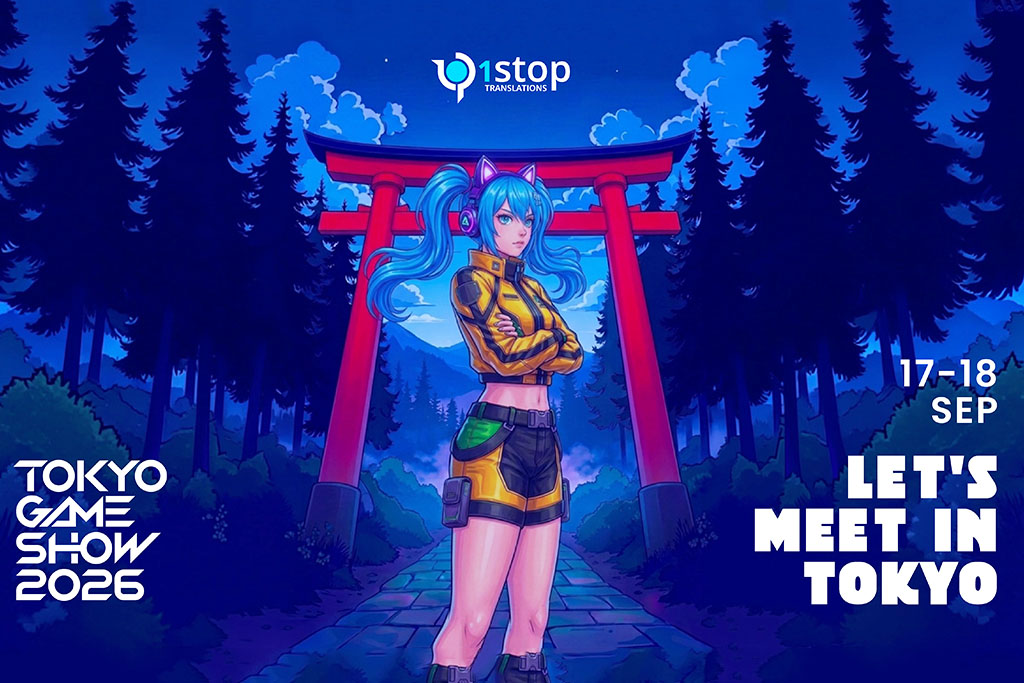
1Stop Translations will be there, from 17 to 18 September, represented by Gaetano Mele, Sales Account, meeting developers, publishers and industry professionals wrestling with the same question: how does a game cross borders without losing what makes it work in the first place?
For studios and publishers, entering a new market is no longer simply a matter of translating a game. It is a question of understanding where, how and why that game can succeed.
Asia and Europe are closer than ever, but not culturally identical
TGS 2026 is expected to draw around 300,000 visitors across roughly 3,500 exhibitor booths, with a stronger international programme than in previous editions and an International Party built for networking between Japanese and overseas professionals.
The scale of the show mirrors a broader shift: overseas sales of Japanese content, games foremost among them, reached close to ¥5.8 trillion in 2023, overtaking the country’s semiconductor exports and confirming gaming as a strategic pillar of the national economy rather than a niche export.
But sharing a trade-show floor, or a balance sheet, is not the same as sharing a culture. Asia and Europe are not simply different language markets, they are different cultural ecosystems. A game can be translated with complete technical accuracy and still fail to land, because humour, storytelling, characterisation, visual references, UI conventions and discovery channels all shift from one region to the next.
| Strategic Domain | Cultural Adaptation Factors |
| Narrative and tone | Pacing, humour, characterisation, dialogue nuance, idiom replacement. |
| User Interface (UI) | Text expansion, font legibility, iconography, menu layout conventions. |
| Player expectations | Onboarding friction, monetisation messaging, difficulty curves, tutorial clarity. |
| Regulatory and metadata | Age ratings, store page compliance, regional content restrictions. |
The bridge is localisation, but localisation is much bigger than translation
This is where localisation becomes a strategic discipline rather than a production step. Culturalisation asks whether references, tone and humour land as intended in a given market, not simply whether the words are correct. Linguistic and functional quality assurance then confirm that every localised element works inside the real build, exactly as a player will experience it.
Handled this way, localisation protects something more valuable than a translation budget: the intent, emotion and identity the original creators built into the game. A title developed in Japan should not need to be rewritten as something Western to succeed in Europe, it needs to be adapted precisely enough that a European player never notices the seams.
Choosing the right market before choosing the right language
Which market should you enter next? Start with the numbers, not the language list.
Global publishing does not mean localising into every language available, it means identifying the markets where localisation is likely to generate the strongest return, weighed against market size, platform presence, genre fit, competition, discoverability, localisation cost and expected revenue.
For a smaller studio, that can mean starting with a localised store page and a single, carefully chosen market, testing the response with the community, and expanding into full in-game localisation once the data supports it, rather than committing to ten languages on day one. We see this pattern often, the sequence differs from title to title, but the principle holds. Language decisions should follow market evidence, not precede it.
From localisation to launch strategy
Localisation does not end when the build goes gold. Store pages, trailers, metadata, community messaging and marketing assets all need to speak the same cultural language as the game itself, or the connection a well-localised build creates can be lost at the very last step, the one closest to the player.
This is the perspective 1Stop Translations brings to Tokyo Game Show: not a vendor delivering strings, but a partner that treats game localisation, culturalisation, LQA, FQA, market entry consultancy and digital marketing as one connected process, under what we call the Red Pill Framework, rather than a chain of separate suppliers.
Great games cross borders, great localisation makes sure their identity crosses with them. If you are attending TGS 2026 and would like to talk through what that looks like for your title, Gaetano Mele would be glad to meet.
Contact us today to book a 1:1 slot at TGS 2026.