


It’s a scenario we see all too often in the indie development space and among mid-tier publishers: the “Invisible Game” syndrome.
9 minutes – read
You have poured your heart, soul, and budget into creating an incredible title. You understood the assignment, investing heavily in professional Video Game localisation so players worldwide can enjoy your UI, dialogue, and lore in their native tongue. Yet your global sales remain stagnant. Why? Because you overlooked app store localisation.
Having a game flawlessly translated into 15 languages means nothing if your storefront is only available in English. This disconnect is where App Store Optimisation and International ASO act as the critical bridge between simply having a great game and actually selling it globally.
Localising not just your in-game content, but your entire digital storefront, from metadata to screenshots, is the definitive strategy for boosting SEO performance, dominating algorithms, and driving organic discovery across diverse global regions.

Why Localise Your Steam and App Store Pages? Beyond Basic Game Translations
It’s the great paradox of modern game publishing: developers often localise the game client into 25 languages but leave the storefront entirely in English.
This partial localisation approach is one of the most common and costly oversights in the industry. It essentially locks your product behind a linguistic paywall before the user even has a chance to hit the “Download” or “Buy” button.
The Pitfall of the “Direct Translation”
Why must game localisation extend to the storefront? Because player discovery begins in the search bar. However, applying a literal translation is a guaranteed way to sabotage your international organic reach.
A direct translation of a video game’s description simply will not rank on Google Play, the App Store, or Steam in highly competitive markets. When a German, Japanese, or Brazilian player searches for a new game, they use region-specific slang, colloquialisms, and highly localised search terms.
When a player in Seoul searches for a “horror co-op” (공포 협동), and your Steam Page only accounts for English keywords, your game won’t even appear in the results. This leads to a massive hit to your Steam Visibility, as the platform’s algorithm assumes your game is irrelevant to that specific demographic.
If your metadata lacks proper keyword research in those foreign languages, your game will not surface in their queries.

Culturalisation vs Localisation in Gaming
To achieve true global discovery, developers must understand the critical difference between Culturalisation vs Localisation in gaming.
- Localisation in gaming focuses on translating text, adapting audio, and converting technical formats (currency, date) for a new region.
- Culturalisation goes deeper, adapting content, storylines, symbols, character designs, and themes to align with the cultural expectations, consumer habits, and emotional triggers of a specific demographic to fit local cultural norms, sensitivities, and values, ensuring it resonates authentically and avoids offence.
Failing to culturalise metadata can hinder visibility, a game with American-centric references might flop in Asia if not adapted. Trusted resources such as Valve’s Steamworks documentation on localisation highlight this, emphasising how adapted pages boost engagement.
In a marketplace where thousands of games are released monthly, algorithms favour relevance. If your storefront copy does not resonate with local search habits, platforms will de-prioritize your game.
By extending game localisation to store pages, you build trust, players see a tailored experience from the first click, improving wishlist conversion rates and overall sales.
The Global ASO Blueprint: Technical Strategies to Dominate Discovery Algorithms
Mastering ASO for global markets strategy requires moving away from generic translations and adopting a highly technical, SEO-driven approach for every region you target.
It’s not just about human readers anymore, it’s about how discovery algorithms and generative AI engines process your data.
Technical Checklist: 4 Essential Best Practices for Localised Store Metadata
To truly optimise for global markets, publishers must implement strict App Store metadata localisation best practices. This involves a meticulous adaptation of every storefront element:
- Titles and Subtitles: Never assume your game’s title resonates the same way globally. While the brand name may remain intact, the subtitle or trailing keywords must be highly localised.
- Short Descriptions: This is your elevator pitch. It must be adapted to feature high-volume, low-competition local keywords.
- Long Descriptions: Structure these for readability and SEO. Use localised headings, bullet points, and keywords naturally woven into the narrative.
- Screenshots and Trailers: Visuals are language, too. A screenshot featuring complex English UI should be replaced with an image showing the UI in the target user’s language.
Generative Engine Optimisation (GEO) and AI Discovery
The search landscape is shifting rapidly towards Generative Engine Optimisation (GEO) and Answer Engine Optimisation (AEO). AI-driven search engines (such as Google’s AI Overviews)) and platform-specific algorithms (such as the Steam Discovery Queue) now read and synthesise storefront metadata to recommend games directly to users.
Structured, localised metadata helps these AI engines “understand” exactly what your game is, what genre it belongs to, and who would enjoy it in their native language.
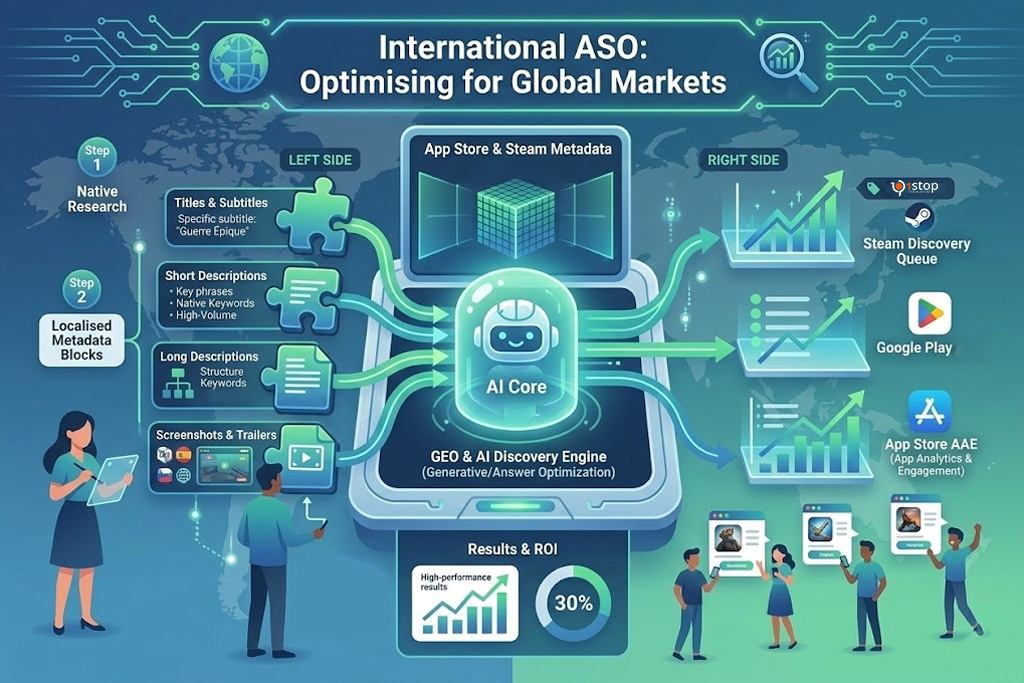
How to Localise Steam Store Page: A Step-by-Step Guide
To ensure your game is optimised for both human users and generative search engines, follow these critical steps:
- Step 1 – Conduct Native Keyword Research: Don’t assume English terms translate directly. In Japan, gamers might search for “cozy puzzle game” as “リラックスパズル” rather than a word-for-word equivalent. Use native speakers to identify long-tail queries that match user intent.
- Step 2 – Optimise Metadata: For Steam Page Optimisation, integrate these keywords into your short description, about section, and tags. Steam’s tag system is powerful; select specific ones like “Metroidvania” over broad “Adventure” to enhance discoverability.
- Step 3 – Localise the Capsule Art: Update your capsule images and promotional graphics to feature the title or tagline in the local language.
- Step 4 – Adapt the “About This Game” Section: Structure this with clear H2s and bullet points. AI overviews love bulleted lists, making it easier for answer engines to pull your game as a top result.
- Step 5 – Update Announcements: If you post patch notes or event news, localise those announcements to maintain engagement in foreign markets.
Case Study: Steam SEO in South Korea
Consider the highly lucrative South Korean gaming market. A Western publisher released a dark fantasy RPG and directly translated their English primary keyword, “Gritty Dungeon Crawler.” The literal Korean translation yielded a term that local gamers never actually type into the Steam search bar.
When the publisher pivoted to a culturally nuanced strategy, they discovered that South Korean players searched for specific genre amalgamations and gameplay descriptors unique to their gaming culture.
By rewriting the short description and tags to match these regional search behaviours, organic impressions skyrocketed. The literal translation failed because it lacked context; the localised SEO succeeded because it spoke the players’ language, both literally and algorithmically.
A study by Adjust notes that localised ASO boosts downloads by tailoring to regional behaviours, proving the ROI.
Real-World Examples: Lessons from Phasmophobia and Demonologist
To truly grasp the ROI of storefront localisation, we need only look at the current competitive landscape of co-op psychological horror games on Steam. Two massive hits in this genre, Phasmophobia and Demonologist, provide a perfect study in contrast regarding Steam Page Optimisation.
Both titles are incredibly popular, and both commendably support 25 in-game languages. However, their approaches to the storefront differ significantly, directly impacting their international reach and wishlist conversion rate.

The Phasmophobia Risk: Viral Luck vs. Strategic ASO
Phasmophobia is one of the most succesfull indie horror titles of the past two years. It features deep in-game localisation, ensuring players from Tokyo to Rome can navigate the ghost-hunting equipment. Yet, for a long time, its Steam store page remained strictly in English.
While the game’s massive viral success via influencers propelled its global sales, relying on English-only metadata leaves a tremendous amount of organic, search-driven discovery on the table. For an indie developer without the viral luck of Phasmophobia, this approach is an unacceptable risk to revenue and long-term discoverability. It is a failure of strategy.
The Demonologist Advantage: Data-Driven Dominance
Demonologist, entering an already saturated market, took a more strategic approach. Alongside its 25 in-game languages, it actively localises its Steam store pages. For example, the Italian Steam page for Demonologist features a fully localised description, adapted promotional phrasing, and targeted Italian keywords.
The impact? Steam visibility increases exponentially. When an Italian user searches for specific horror co-op terms in their native language, Demonologist has a significantly higher chance of surfacing organically in the Discovery Queue compared to a game with an English-only page.
The Ultimate Formula: Trust + ASO = Skyrocketing Conversion Rates
This brings us to the core marketing truth of digital storefronts: Localisation equals Trust, and Trust equals Conversion. When a user lands on your App Store or Steam page and sees meticulously crafted copy in their native language, it signals quality. It reassures them that the in-game experience will be equally polished.
This psychological comfort drastically reduces bounce rates and serves as the ultimate catalyst for increasing your wishlist conversions and driving digital sales uplift.
This marketing angle underscores localisation as a key partner in video game sales, delivering ROI through optimised digital store performance on Steam, Google Play, and the App Store.
Conclusion: Global Discovery is a Choice, Not an Accident
In the modern gaming market, being a “hidden gem” is a failure of marketing, not a badge of honour. As a developer or publisher, you have the power to decide whether your game remains confined to a single corner of the globe or becomes a worldwide success.
Game Localisation is the first step, but International ASO and Steam Page Optimisation are what carry you across the finish line. By treating your storefront as a dynamic, localised asset, you improve your Steam Visibility, skyrocket your wishlist conversion rate, and ultimately drive the sales your hard work deserves.
At 1Stop Translations, we bring expertise in over 100 languages to the table. We aren’t just a translation company; we are your strategic partner in the global gaming ecosystem. You build the worlds, let us build the gateway that invites players across the globe into them.
Transform your game from invisible to irresistible. Click here to request our free Steam/App Store page audit and receive 3 immediately actionable ASO recommendations.
Let’s transform your game from invisible to irresistible and boost sales.
Need a quote? Click here