We are delighted to announce that 1Stop Translations will be exhibiting at gamescom 2026, the world’s largest event dedicated to video games, taking place at Koelnmesse in Cologne from 26 to 30 August. Visit us at Hall 2.1, Stand D-024.
2-minutes read
Now firmly established as Europe’s leading trade fair for interactive entertainment, gamescom brings together thousands of developers, publishers, investors and content creators for five days of reveals, deals and hands-on demos, opening with gamescom Opening Night Live, hosted by Geoff Keighley the evening before the show floor opens.
For a video games team that lives and breathes this industry, it is exactly where we belong.
Why gamescom?
At 1Stop Translations, we have always believed that great games deserve a global audience, and gamescom is where that belief meets scale.
Bringing a title to international audiences typically means coordinating several suppliers: one for translation, another for cultural adaptation, a third for QA testing, and yet another for market entry advice.
Each handover adds risk. Delays, miscommunication and rising costs are common side effects of managing a fragmented vendor chain.
1Stop Translations was built to remove that friction. We are a genuine one-stop provider, giving developers, indie studios and publishers a single point of contact across the entire localisation journey, from first translation draft through to final in-game quality assurance.
For lean indie teams in particular, this consolidation means fewer relationships to manage and a consistent quality standard from start to finish.
The Red Pill Framework, Live at Stand D-024
Our team will be on-site for the full duration of the show, and we warmly invite developers, indie studios and publishers to visit us at Hall 2.1, Stand D-024 to discover how we help titles achieve what we call “Global-Ready” status through our proprietary Red Pill Framework.
The “RPF” is a structured methodology that combines linguistic accuracy with genuine cultural adaptation and hands-on functional testing, ensuring that a title feels native to each market rather than simply translated for it.
Attendees will be able to see how the same process scales from a two-person indie project to a AAA multi-territory launch.
The framework is backed by a dedicated video games unit within 1Stop Translations, staffed by gaming enthusiasts and native-speaking linguists who understand genre conventions, player culture and community tone, knowledge that sits alongside our broader 20-plus years of professional translation experience across regulated and consumer-facing industries.
Let’s Talk in Cologne
gamescom 2026 is a rare chance to sit down face-to-face and talk through your localisation roadmap in detail. If you are attending, we would love to connect, whether at our booth, on the show floor, or over a coffee between meetings.
Ready to take your game global? Visit us at Hall 2.1, Stand D-024, or get in touch in advance to schedule a meeting.
Here is a number that tends to focus minds quickly: fixing a linguistic bug after your game has shipped can cost anywhere from 15 to 25 times more than catching it during pre-launch testing.
6-minutes read
Factor in platform re-certification fees from Sony or Microsoft, emergency translation sprints and the reputational fallout of a Reddit thread going viral for all the wrong reasons, and you are looking at a bill that could easily reach six figures before you have even read a single negative review.
What is LQA in video games? Localisation QA (LQA), or Linguistic Quality Assurance, is the systematic process of testing translated in-game content within the live game environment to verify linguistic accuracy, contextual appropriateness and technical correctness, including text display, UI fit and cultural compliance, before a title ships.
It is categorically different from standard video game translation, where a linguist works from a spreadsheet of extracted strings with no visibility of the actual game. In LQA, our linguists play the build, navigate every menu, trigger every cutscene and interact with every localised element exactly as a real player would.
3 Common Video Game Translation Mistakes to Avoid
Text Overflow and UI Breakages
This is one of the most persistent and most preventable technical failures in game localisation. Languages such as German and Russian are structurally expansive: a short English button label can swell by 30–40% once translated, and compound noun structures can completely break a UI designed solely around English string lengths.
Ausrüstungsverwaltung takes up rather more space than “Inventory”. Without a thorough LQA pass inside the live game, these breakages are invisible to any linguist working in isolation. Our team catches them before a single player does.
Lack of Context and Tone Inconsistencies
Context is not a luxury in video game localisation; it is a technical requirement. A string that reads “He’s gone” in isolation could refer to a character’s death, a comedic exit or a tactical retreat. Without proper context, a linguist simply cannot make an informed decision.
The result is tone fragmentation that breaks narrative immersion: the stoic warrior in your English build becomes oddly flippant in French, or eerily formal in Italian, through no fault of the translator, who was working blind.
Our linguists work with screenshots, character reference notes and approved glossaries as standard, because cultural adaptation and consistent characterisation depend on them.
Cultural Insensitivity and Compliance Issues
A game targeting global markets must navigate a complex web of regional regulations and deeply rooted cultural sensitivities. Symbols, hand gestures, colour associations and even specific numbers carry radically different meanings across territories.
Content that passes entirely without comment in a Western context can trigger outright bans in markets across the Middle East or East Asia. Germany’s restrictions on Nazi imagery, China’s prohibition on certain depictions of violence and skull motifs, and Thailand’s strict lèse-majesté laws have all caught studios by surprise.
Responsible localisation QA includes a cultural compliance review that maps every target market’s requirements before your gold master is signed off.
Ensure your game’s international appeal by dodging these critical video game translation errors. Our guide illustrates the visual, narrative, and cultural pitfalls our localisation experts work to prevent.
Famous Video Game Localisation Failures and What They Cost
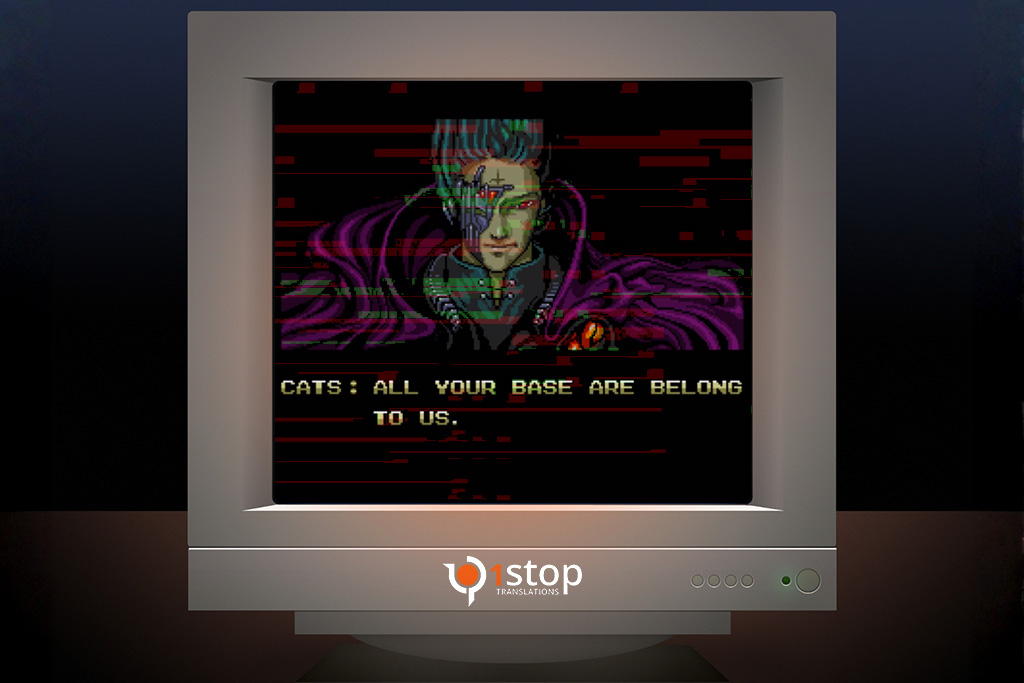
The most legendary example remains Zero Wing (Toaplan, 1989), whose European Mega Drive port gifted the world the immortal line “All your base are belong to us“, a catastrophic mistranslation produced without native-speaker oversight that became one of the internet’s earliest viral memes. Amusing in retrospect. Commercially and reputationally damaging at the time.
In Call of Duty: Modern Warfare 2, the Japanese version famously mistranslated the line “Remember, no Russian” (meaning “do not speak Russian”) as “Kill them, they are Russians”. The error confused players about the mission’s core premise and drew criticism for breaking immersion. The issue was later corrected in the remastered version.
Mario Party 8 shows that localisation can fail inside the same language. Game Developer reported that Nintendo UK recalled copies after an offensive term, harmless in some contexts but abusive in British English, appeared in the script. That meant retail disruption, replacement work and public embarrassment — all from one unchecked word.
Football Manager 2005 is a harder commercial lesson. China Daily reported that the game was banned in China after disputed territories were represented as separate countries. For global launches, that is the costliest LQA failure: lost market access.
Smaller indie titles face a starker version of the same problem. With localisation budgets already thin and LQA often the first line item cut, countless Steam releases have shipped with broken UI elements, inconsistent terminology and culturally tone-deaf content in their non-English builds.
That damage surfaces almost immediately in user reviews, and no patch cycle can fully repair it once an algorithm has registered the early negativity. Sadly, some of the best video game localisation examples in the indie space are remembered for what went wrong on launch day.
The pattern is consistent: skipped or under-resourced localisation QA creates problems that are expensive to fix, slow to recover from and entirely preventable.
The infamous Zero Wing failure displayed on a vintage CRT screen: a classic example of how skipping video game localisation QA can cause lasting commercial damage.
How to Build a Game Localisation QA Checklist
If you are asking how to prepare a video game for localisation, start before the final sprint. The most useful checklist is practical, shared and owned by production. For small teams and indie developers, it also prevents a painful choice between shipping late and shipping a visibly weaker version.
These five steps represent the foundation of sound localisation QA best practices:
Lock your strings before handover. Any changes to source text after the localisation process begins create version-control chaos and introduce untested content into your localised builds. Freeze the copy first.
Provide context for every string. Screenshots, character descriptions, tone notes and maximum character counts should accompany your string files as standard. Ambiguity at this stage compounds into costly rework downstream.
Build and share a style guide and glossary from day one. Consistent terminology is the backbone of immersive game localisation. Define your proper nouns, invented vocabulary and character voices before your linguists begin.
Give your LQA team access to a playable build. Cheat codes, level skips and debug modes are essential working tools. A tester who cannot trigger the content cannot test it.
Design your UI for text expansion from the outset. Plan for up to 40% more characters than your English strings require. Retrofitting UI for localisation after the fact is one of the most expensive corrections in game development, and one of the easiest to avoid.
A robust Localisation Quality Assurance (LQA) checklist is essential for streamlining your video game’s global release and avoiding costly downstream delays.
Why In-Game Live Checks Are the Ultimate Safety Net
Out-of-context testing will always give you a partial picture. A linguist reviewing strings in a spreadsheet, however experienced, cannot see how a translated line reads when it appears over a burning cityscape at the climax of Act Three.
They cannot feel the tonal dissonance when a technically correct menu label looks bizarrely formal beside the gritty aesthetic of your game world. They cannot catch the tooltip that wraps unexpectedly on a console UI, or the dialogue line that fires without audio sync because the character count went unchecked.
Our In-Game Live Checks service is built on an entirely different philosophy. Our specialist linguists review every localised element inside the live game environment, across every platform your title targets: console, PC and mobile.
They play, explore, test edge cases and stress the UI. They surface not only linguistic errors but also UI breakages, cultural missteps and contextual inconsistencies that no automated pipeline would ever flag.
What sets this apart from any standard localisation QA offering is one critical distinction: our In-Game Linguistic Review service does not operate as a standalone service appended to the end of a generic workflow. It is a core, integrated component of our Red Pill Framework, 1Stop Translations’ proprietary methodology for what we define as evolution-grade localisation.
The Red Pill Framework unifies linguistic quality assurance, functional quality assurance, cultural adaptation and live in-build testing into a single modular system, calibrated to your studio’s exact pipeline rather than an off-the-shelf process.
It is human-centric by design, ISO-certified at every stage and built around a single conviction: localisation is a craft, not a commodity. This is what other video game localisation companies cannot replicate, because the framework, and the philosophy behind it, are ours.
This is the layer of quality assurance that separates a polished international release from an embarrassing post-launch patch cycle. When you are evaluating video game translation services and comparing video game localisation companies, the defining question is straightforward: do their linguists work inside your game or outside it?
Do not let a poor translation undo years of development. Contact our LQA experts and let’s talk about your global launch.
When brilliant game design meets global audiences. There is a particular kind of pressure that surrounds a carefully crafted indie game the moment it steps beyond its home market.
6-minutes read
When a studio pours genuine craft into a game’s personality, its humour, its rhythm, its sense of self, the risk of losing that in translation is not theoretical. It is very real.
The job of a localisation partner is not to rewrite a game, but to act as a clear mirror: reflecting the original brilliance into other languages with the same fidelity and the same warmth. This is the story of how we approached that responsibility for Big Hops, and what happened when we got it right.
The Client and the Masterpiece: Luckshot Games’ Big Hops
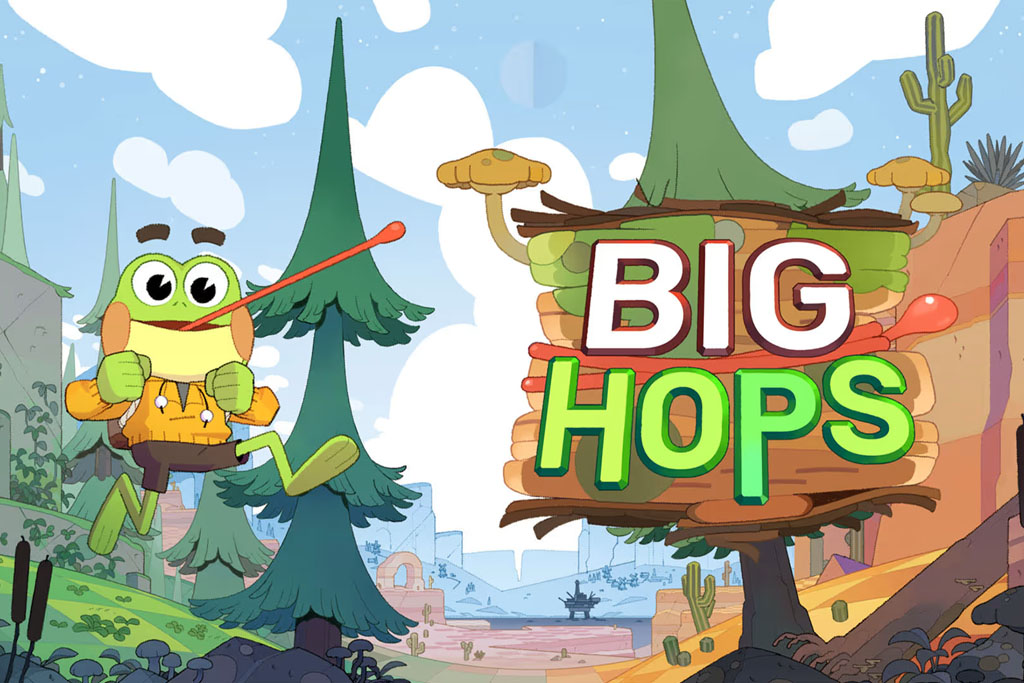
Luckshot Games is an independent studio with a clear artistic voice. Big Hops, released in January 2025 on Steam, PlayStation 5, and Nintendo Switch, is a physics-based 3D platformer centred on Hop, a friendly frog kidnapped from his forest home by a mischievous spirit named Diss. To find his way back to his family, Hop must traverse three distinct worlds: the Red Desert, the Open Ocean, and the Shattered Mountain, rebuilding a broken Airship along the way.
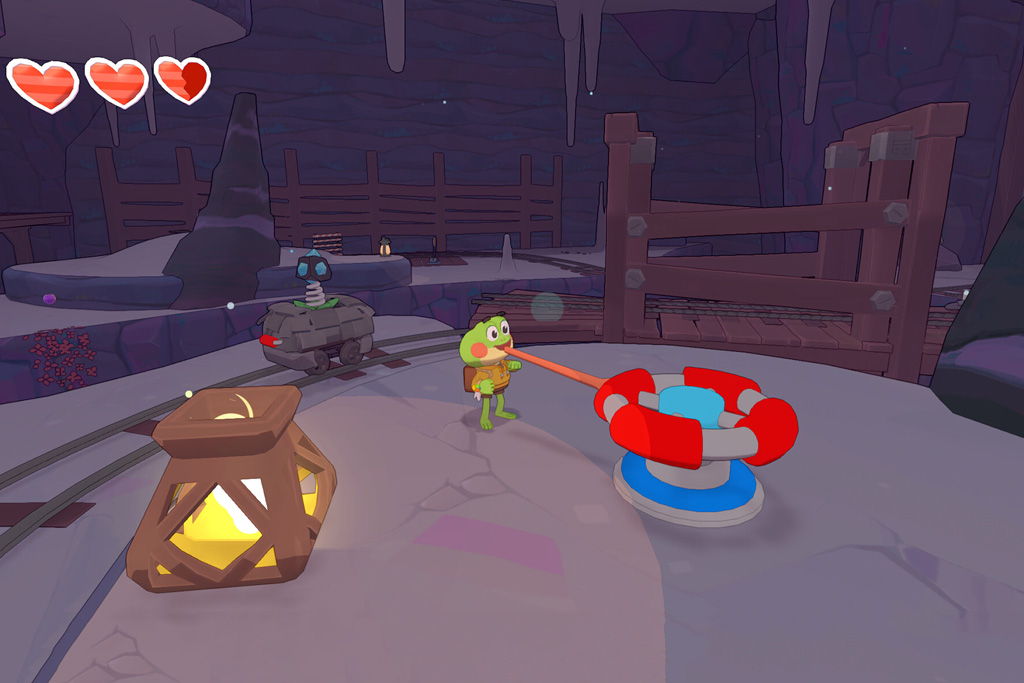
What distinguishes Big Hops from the wider field of platformers is not simply its premise, but the depth of its movement system. Hop’s tongue mechanic opens up an unusually expressive range of interactions, including grabbing, swinging and solving environmental puzzles, all of which feed into a fluid, momentum-driven gameplay loop that critics singled out as one of the game’s standout qualities.
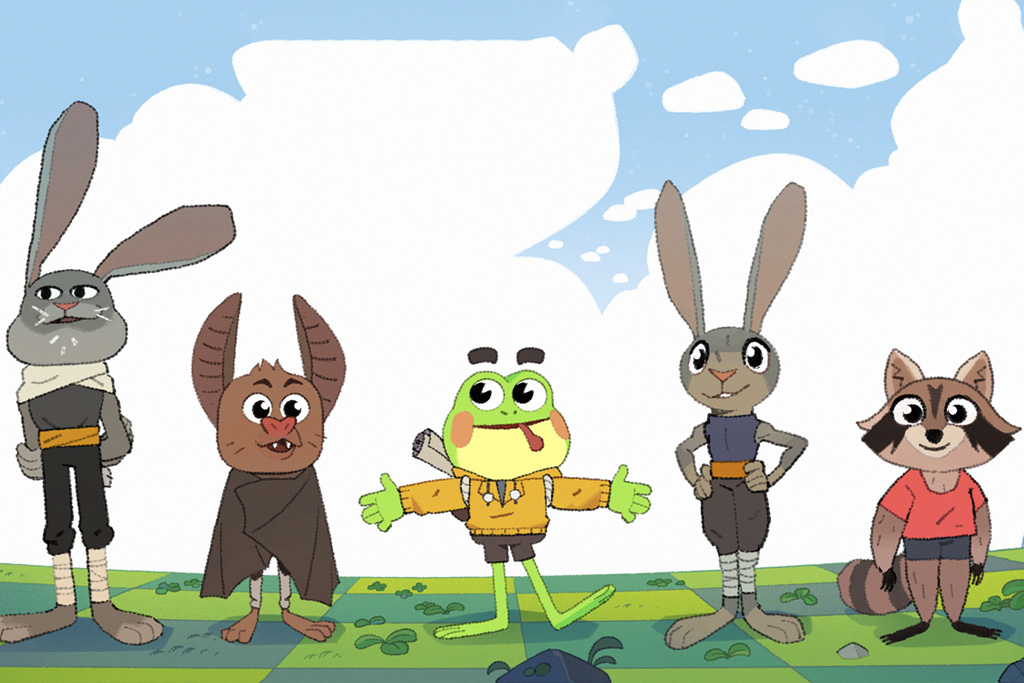
The characters Hop encounters on his journey, including rabbits, raccoons, gulls, otters and bats, are designed with genuine charm, featuring original artwork by Steven Sugar, and carry dialogue that is witty, warm, and distinctly human in its comedic timing.
When Big Hops arrived at our door, its quality was never in question. The challenge, as it always is with personality-driven titles, was one of preservation. How do you carry that native charm across four linguistically and culturally distinct markets without diluting what makes the game special?
The Challenge: Reworking Humour Without Altering the Soul
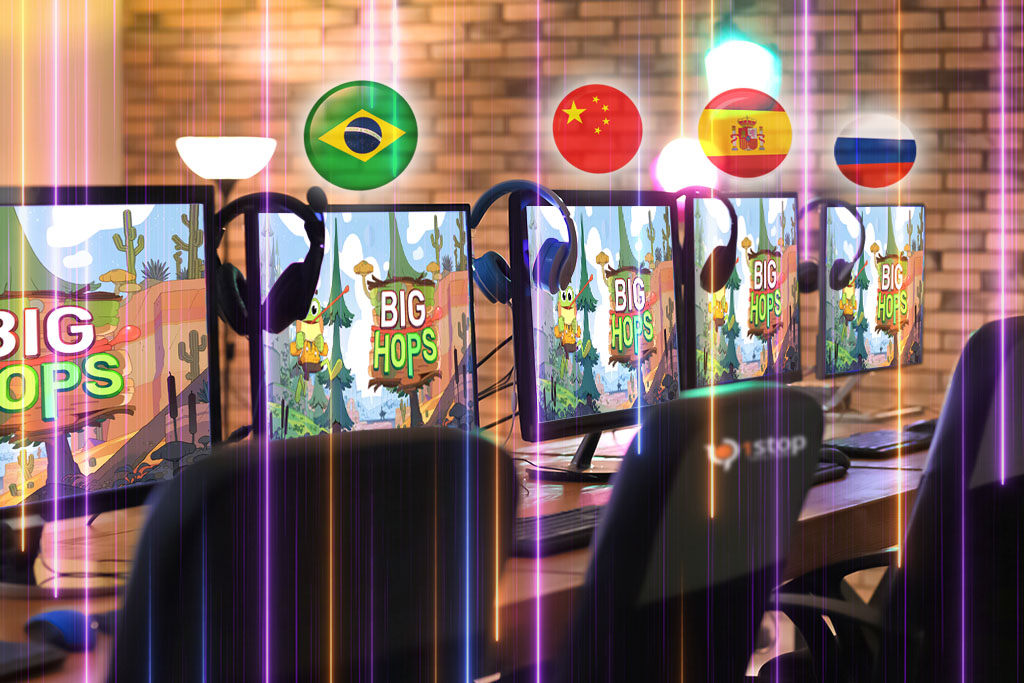
The four target languages for this project were Spanish, Brazilian Portuguese, Chinese, and Russian, each representing not just a linguistic shift, but also a distinct cultural context with its own comedic sensibilities, idiomatic rhythms, and expectations of character voice.
Big Hops leans heavily on personality. Hop’s dialogue is not decorative; it carries the emotional core of the game: the banter, the timing, the gentle absurdity of a frog navigating an extraordinary world with cheerful determination.
A literal translation of that material would have been a quiet disaster. Not wrong, exactly, but flat. The kind of flatness that accumulates over hours of play and leaves an international reviewer with a nagging sense that something is slightly off, even if they cannot articulate why. That disconnect is enough to shift a score, and with it, a game’s commercial trajectory in a given market.
The project required something more disciplined: a culturally respectful adaptation that honoured the developer’s original intent whilst making every joke land, every character feel real, and every line of UI text sit naturally in its context. That is a very different brief from standard translation, and it demands a very different kind of team.
The vibrant cast of Big Hops. For these characters, successful cultural adaptation means ensuring every joke, banter, and quirk lands perfectly across international markets.
The Partnership: Seamless Culturalisation as an Extension of the Studio
When studios work with 1Stop Translations, the relationship is not transactional. We do not receive a script, disappear for a few weeks, and return with a localised file. What we bring to a project like Big Hops is something closer to creative collaboration: the kind of working dynamic that only produces excellent results when there is genuine respect for the source material on both sides.
In practice, that meant several things operating simultaneously.
Our specialist linguists, with deep roots in their respective languages and cultural contexts and a genuine passion for gaming, approached the script not as text to be translated, but as a voice to be authentically understood.
Idioms were not substituted mechanically; they were rebuilt from the ground up so that they carried the same comedic energy in Spanish, Brazilian Portuguese, Chinese, and Russian as they did in the original English.
Puns that relied on specific phonetic or cultural associations in one language were reconstructed with locally resonant equivalents that preserved the rhythm and the payoff. Slang was handled with particular care: regional authenticity without anachronism; naturalness without alienation.
Gameplay from Luckshot Games’ Big Hops: deep game culturalisation ensures that Hop’s unique personality and the game’s comedic energy translate seamlessly for players worldwide.
Game culturalisation of this kind is slow, considered work. It involves asking repeatedly: does this sound like something Hop would say? Is this the version of this moment that an international player, one who has never played the English original, would find equally delightful?
Throughout, the guiding principle remained the same: we were not here to impose our interpretation on Big Hops. We were here to serve Luckshot Games’ vision and to ensure that players in Madrid, São Paulo, Shanghai, and Moscow experienced the game with the same sense of joy and clarity as players in London or New York.
The Result: A Shared Triumph and a 78 Metacritic Scorer
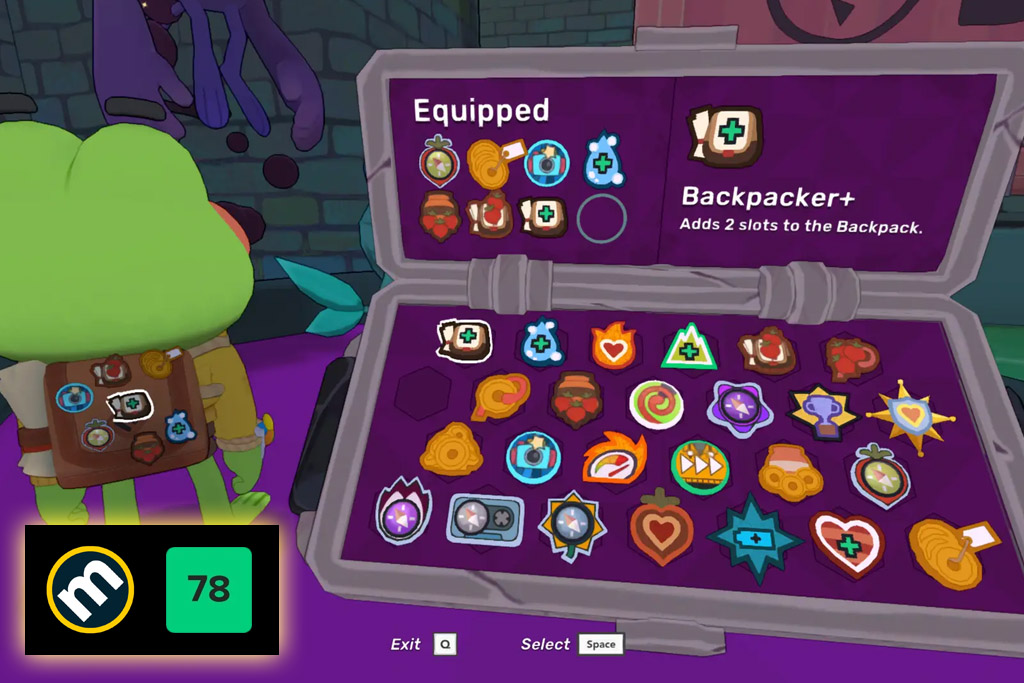
Big Hops achieved a Metacritic score of 78 out of 100, a critically acclaimed result that reflects, above all, the quality of what Luckshot Games built. That score belongs to the studio. To the design decisions, the movement system, the character work, the vision.
We want to be clear about that, because misattributing credit is not something we have any interest in doing.
What we can say is this: that score was secured globally. The international release did not suffer the kind of localisation-driven review deflation that quietly damages so many indie titles in non-English markets, where critics pick up on tonal inconsistencies, stilted dialogue, or UI friction and reflect that in their assessments, often without explicitly attributing it to translation quality.
By ensuring that reviewers in Spanish-, Brazilian Portuguese-, Chinese- and Russian-speaking markets experienced Big Hops with the same comedic clarity, the same character warmth, and the same mechanical confidence as English-speaking critics, the meticulous game culturalisation we provided helped protect the game’s global review average and, with it, its commercial potential across those markets.
That is what a genuinely attentive localisation partner contributes to global gaming growth. Not visibility. Not noise. A clean signal, the developer’s original signal, reaching every market intact.
Meticulous video game localisation and culturalisation protect the global review average by eliminating text friction and delivering the developer’s original comedic tone directly to international players.
Let Your Game’s Quality Speak Every Language
Our role is to ensure the world experiences it exactly as you intended: without compromise, without dilution, and without the kind of cultural friction that quietly undermines a game’s international reception.
Big Hops travelled well. Your game can too.
If you’re planning an international release and you need a video game localisation partner who treats your game’s voice as seriously as you do, let’s talk. Tell us about your project and we’ll tell you exactly how we’d approach it.
The global video game market has surpassed $200 billion in annual revenue, yet a staggering number of international launches still collapse under the weight of broken immersion, tone-deaf dialogue, and UI strings that overflow into nothing.
4-minutes read
Negative player reviews spread fast. A single poorly localised release can haemorrhage months of commercial momentum overnight, particularly in markets where cultural resonance is everything.
Evolution-grade localisation is defined as a fully integrated, culturally adaptive process that goes far beyond word-for-word conversion, instead engineering every element of a game’s language, humour, lore, and interface to feel completely native to its target audience, delivered through a modular, scalable framework backed by elite human expertise.
That is precisely the standard 1Stop Translations has built into the Red Pill Framework: a paradigm shift away from transactional, one-size-fits-all video game translation services and towards a human-centric ecosystem engineered to eliminate operational bottlenecks and conquer global markets with genuine, native immersion.
Beyond Literal Text: Why True Video Game Culturalisation Demands a Strategic Partner
The single biggest mistake studios make is treating their game script as if it were a legal document: a static block of text to be processed and returned. In reality, a line of in-game dialogue carries weight: it has rhythm, personality, subtext, and cultural DNA. If it is fed into a generic workflow, what comes back may be technically accurate but emotionally hollow.
Video game culturalisation is the discipline that closes that gap. It means adapting idioms so they land with the same comedic punch in Brazilian Portuguese as they do in English. It means reworking lore references that would confuse a German audience without diluting the world-building for everyone else. It means ensuring UI/UX boundaries are respected across every string, so buttons don’t break and menus don’t overflow.
This is a fundamentally different craft from standard translation, and it demands a fundamentally different kind of partner.
Consider the distinction clearly:
Standard Translation
Evolution-Grade Culturalisation
Word-for-word text conversion
Semantic and cultural adaptation
Delivered by generalist translators
Led by specialist gaming linguists
Text treated as static content
Text treated as living narrative
No engagement with UI/UX constraints
Full UI/UX boundary compliance
Single-pass workflow
Iterative review and LQA cycles
Supplier-client transaction
Long-term strategic partnership
For publishers scaling across multiple territories simultaneously, or for indie developers pursuing a global Steam launch, the gap between these two columns is the gap between a review-bombed release and a word-of-mouth success.
A localisation partner should be embedded in your pipeline, not appended to the end of it.
The Human-Centric Heart of the Red Pill Framework
At the core of everything we do is a conviction that has never wavered: outstanding video game localisation is a human craft. It is not a commodity. It is not a pipeline to be expedited with shortcuts.
Every professional linguist in our network is, first and foremost, a passionate gamer. They understand mechanical context: why a combat tutorial speaks differently from a narrative cutscene, why a character’s distinct voice cannot be flattened by generic phrasing, why community slang evolves and demands constant cultural vigilance.
That depth of understanding is what allows our team to protect the soul of your game, whatever the language.
1Stop Translations’ Red Pill Framework: human expertise at the core of evolution-grade game localisation.
The Red Pill Framework is built around a modular architecture that allows us to calibrate our service to your studio’s exact needs, without ever compromising on quality control. A lean indie team with a tight development cycle and a AAA publisher managing enterprise-level pipelines across twelve languages will have very different operational requirements. Our framework scales fluidly to meet both. We configure the workflow around you, not the other way around.
Dedicated project managers provide a single point of contact throughout the entire process. Processes certified to ISO 9001, ISO 17100 and ISO 18587 ensure traceable quality and secure, auditable workflows at every stage.
Bespoke technical integrations (custom connectors that slot directly into your existing development environment) mean your team doesn’t need to change how they work. We adapt to your pipeline; your pipeline doesn’t adapt to us.
This is what separates a strategic partner from a video game translation company that simply processes strings.
Securing Immersion: Integrating Elite Video Game LQA and FQA Services
Even the most culturally precise adaptation can unravel at the technical integration stage. Text overflows, truncated strings, misaligned UI elements, and regional compliance failures are not cosmetic issues; they are the launch-day disasters that fuel one-star reviews and emergency day-one patches.
This is why the Red Pill Framework integrates rigorous linguistic and functional validation as standard, not as an optional add-on.
What is the difference between gaming LQA and FQA in localisation?
Video Game LQA (Linguistic Quality Assurance) focuses on the accuracy, tone, consistency, and cultural appropriateness of all localised text within the built game environment. It is the process of verifying that every adapted string behaves correctly in context, reads naturally, maintains character voice, and aligns with the game’s established glossary and style guide.
Video Game FQA (Functional Quality Assurance) addresses the technical integrity of the localised build itself. It checks for UI breaks, text overflows, button label truncations, audio sync issues, and any regional compliance requirements that must be satisfied before submission to platform holders.
Securing flawless player immersion: integrated LQA and FQA services ensure linguistic precision and technical stability work in perfect harmony.
Both disciplines are essential. Neither can substitute for the other.
The integration of Video Game LQA Services and Video Game FQA Services within the same framework ensures that linguistic precision and technical stability are never treated as separate concerns. They are validated together by people who understand both.
The World Doesn’t Wait for a Subpar Launch
Breaking into international markets does not have to mean operational headaches, creative compromises, or sleepless nights before a global release date. The Red Pill Framework was built to make that process predictable, scalable and genuinely fit for purpose, both for indie studios protecting their narrative heart and for publishers who need the technical rigour to match their global ambitions.
Your next global launch is already in motion. The question is whether your localisation pipeline is built to match its ambitions or whether you’ll be patching the gaps after the reviews are in.
Get in touch for a live demonstration of the Red Pill Framework and see how it can be configured around your studio’s exact workflow. Alternatively, meet us directly at Gamescom 2026. Book a session, bring your pipeline, and we’ll map out exactly where evolution-grade localisation fits in.
We are proud to announce that 1Stop Translations is an official Silver Sponsor of Digital Dragons 2026, one of Europe’s largest B2B conferences for the games industry, held annually at the ICE Krakow Congress Centre.
6-minutes read
Now in its 15th edition, Digital Dragons Conference is a venue for business networking, knowledge transfer, and the showcasing of independent studios. Organised by Krakow Technology Park, it is a comprehensive ecosystem supporting the games industry at a local, national, and international level. This year’s event promises to be the most ambitious yet, and we are thrilled to be part of it.
This year’s programme features high-profile speakers including Guy Richards, Director of ID@Xbox, and CD Projekt co-founder Michał Kiciński, a reflection of the calibre of conversation taking place in Krakow. For studios at every stage of development, from indie teams to global publishers, Digital Dragons is where connections are made and deals are signed.
Meet 1Stop Translations at Digital Dragons 2026
Our team will be on-site for the full duration of the conference, and we warmly invite attendees to visit the 1Stop Translations booth to discover how we help studios achieve what we call “Global-Ready” status.
Whether you are an independent developer preparing your debut title for international markets or a major publisher planning a simultaneous worldwide launch, our end-to-end localisation services are designed to support you at every stage of the journey. Our core service offering includes:
Localisation & Culturalisation: Ensuring your content resonates authentically with local audiences, not just linguistically but culturally.
LQA & FQA: Rigorous linguistic and functional quality assurance to guarantee a polished, seamless player experience across all supported languages.
Specialist Consultancy: Strategic localisation guidance tailored to your title, your market, and your goals.
We work with games of all sizes and genres, and our team brings genuine passion for the medium to every project we take on.
Let’s Talk in Krakow
Digital Dragons 2026 represents a unique opportunity to sit down face-to-face and discuss your localisation strategy in detail. If you are attending the conference, we would love to connect, whether at our booth, during the networking sessions, or over a coffee in the Business Networking Zone.
Ready to take your game global? Visit us at Digital Dragons 2026, or get in touch in advance at to schedule a meeting.
The rules of global publishing have changed. A game launched today is not released in one country; it is born simultaneously into dozens of markets, each with its own cultural codes, linguistic nuances and player expectations.
6-minutes read
Code may be universal, but culture emphatically is not. Bridging that gap — from a game’s source strings to a player’s experience — is precisely where 1Stop Translations operates.
With two decades of expertise and an in-house network of more than 20,000 specialist linguists, we have become the video game localisation agency of choice for the full spectrum of the industry: from AAA publishers navigating complex, multi-platform launches to indie devs who need a creative partner that cares as deeply about their game’s identity as they do.
Beyond Translation: What Are Game Localisation and Cultural Adaptation?
Video game localisation is the bespoke process of adapting a game’s entire linguistic and cultural identity for a new market. Unlike simple translation, which moves text from one language to another, localisation encompasses UI restructuring, date and currency formatting, the modification of colour symbolism — red signals luck in China but danger in Western markets — and the re-engineering of humour so that a joke that lands in Los Angeles also lands in Lyon. This is what the industry calls cultural adaptation, and it is where the real craft lies.
Consider a character whose name is a pun in English. A direct translation is worthless; the meaning collapses. What is required is transcreation: the reconstruction of meaning and tone from the ground up in the target language.
When 1Stop Translations approaches a new project, our linguists are briefed not just on vocabulary, but on the game’s narrative architecture, character relationships and the emotional beats the developer intends to hit. We understand the subtext, not just the text.
This distinction matters enormously when comparing video game localisation companies. Agencies that treat games as documents to be translated produce work that players immediately sense as foreign. Our bespoke language services treat every game as a cultural artefact deserving of a custom-fit solution: one that makes a player in Warsaw or Osaka feel that the game was made for them.
True localisation: crafting a custom-fit experience that resonates with every culture, ensuring players worldwide feel right at home.
Our Bespoke Video Game Localisation Process: Quality Without Compromise
What are the biggest challenges in game localisation? In our experience, they cluster around three pressure points: technical integration, creative fidelity and quality assurance at scale.
Our video game localisation process is designed to address all three simultaneously. It begins with a structured asset audit, cataloguing every string, UI element and embedded graphic that will require adaptation. From there, our Project Managers assign specialist linguists with direct experience in the relevant genre, whether that is sci-fi, platformer or RPG.
The linguistic phase integrates seamlessly with the client’s build pipeline. We work within leading localisation platforms and game engines, ensuring that translated strings fit their containers without truncation or overflow — a technical discipline that generic translation agencies routinely overlook.
Internally, every deliverable passes through our Linguistic Quality Assurance (LQA) protocol: an independent review layer that tests the content not only for grammatical accuracy but also for immersion. Does it feel like a native-language game, or does it feel translated?
This commitment to precision is what separates our video game localisation services from the competition. Quality is not just a promise; it is enforced through our ISO 9001, ISO 17100, and ISO 18587 certifications.
Case Study: Preserving Creative Identity in Big Hops
The game’s entire personality rests on warmth, wit and a cast of charming animal characters designed with genuine affection. For an indie title like this, voice is everything. Lose the humour and you lose the game.
1Stop Translations localised Big Hops into Spanish, Brazilian Portuguese, Chinese and Russian. Each of these markets carries distinct cultural attitudes towards anthropomorphic characters, childhood adventure narratives and comedic tone.
Our transcreation process for Big Hops treats every indie project as a premium engagement, protecting the developer’s creative vision across Spanish, Brazilian Portuguese, Chinese, and Russian markets.
Our linguists became genuine creative partners, carefully transcreating puns and character-specific speech patterns so that Hop’s personality resonated with the same warmth in São Paulo as in the English original.
Why is cultural adaptation important in video games? Big Hops makes the answer tangible. Small games do not receive less care from our team. Every indie project is treated as a premium engagement, because a great game deserves to be experienced as its creators intended, in every language and by every player.
Case Study: Strategic Global Reach for Sliding Hero
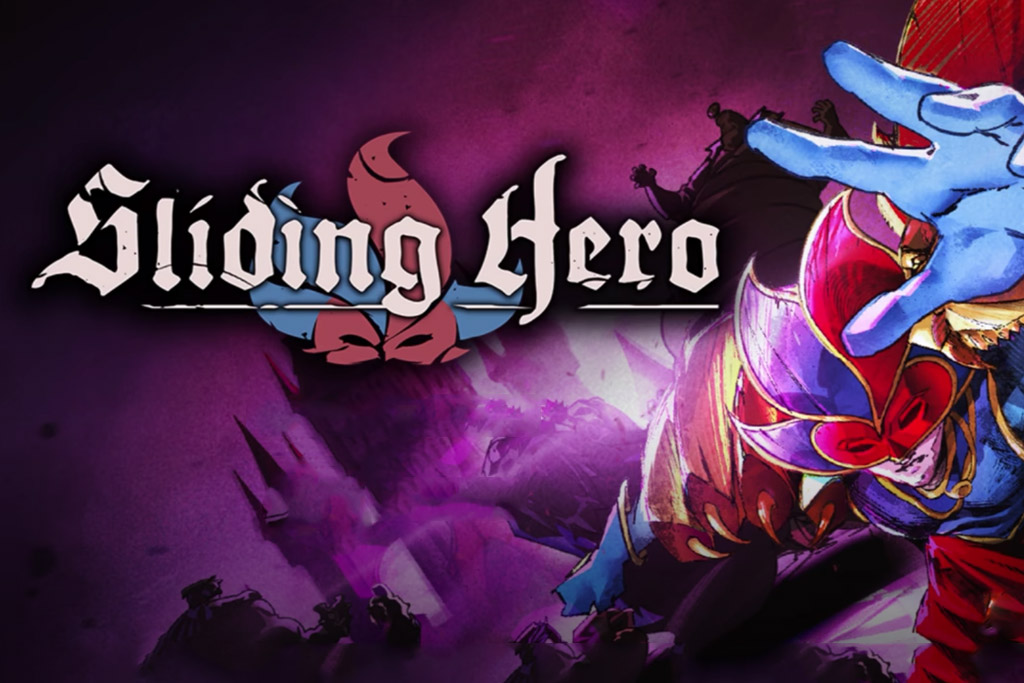
Silent Chicken’s atmospheric puzzle-adventure Sliding Hero needed to conquer international markets without the budget of a major publisher. For a studio of this size, every localisation decision had to be strategic. Spending equally across all languages was not viable; the approach had to be targeted.
We implemented a dual-tier localisation strategy designed to maximise both discoverability and player immersion across priority markets.
Storefront Dominance: The Sliding Hero Steam Store page was expertly adapted into Spanish, French, Chinese, Japanese and Korean. By ensuring that the game’s storefront appeared in native searches and spoke directly to local players at the point of discovery, we maximised top-of-funnel visibility across five of the world’s most competitive gaming markets.
Deep Immersion: In-game content received complete, high-fidelity localisation into Spanish and French for the two markets identified as the strongest commercial priorities. Players in these markets experienced the full narrative arc of Sliding Hero in their native language, with none of the immersion-breaking friction that even minor localisation errors can introduce.
Strategic localisation for Sliding Hero: maximising discoverability and player immersion through a targeted, dual-tier approach to global markets.
This targeted strategy helped Sliding Hero connect immediately with diverse global audiences. Prioritising store-level visibility across five languages while delivering full in-game localisation in the two highest-priority territories proved to be the decisive multiplier for the game’s international adoption.
Wishlist growth in these markets accelerated meaningfully, demonstrating a core truth of indie game localisation services: it is not about doing everything; it is about doing the right things brilliantly.
At 1Stop Translations, we have done the hard work at every scale: from the strategic, market-targeted approach we built for Sliding Hero to the transcreation-led creative partnership that brought Big Hops to life in four new languages. We carry the expertise, methodology and genuine passion for games that separate a specialist video game localisation agency from a generalist translation provider.
If you are preparing a global launch, we are ready to talk. Level Up your next project: contact us today for a bespoke consultation, and let’s build something the world will play.
Launching an indie game in English only in 2026 is no longer a bold creative choice; it is a commercial misstep. We have officially entered the era of the end of “English-only” by default.
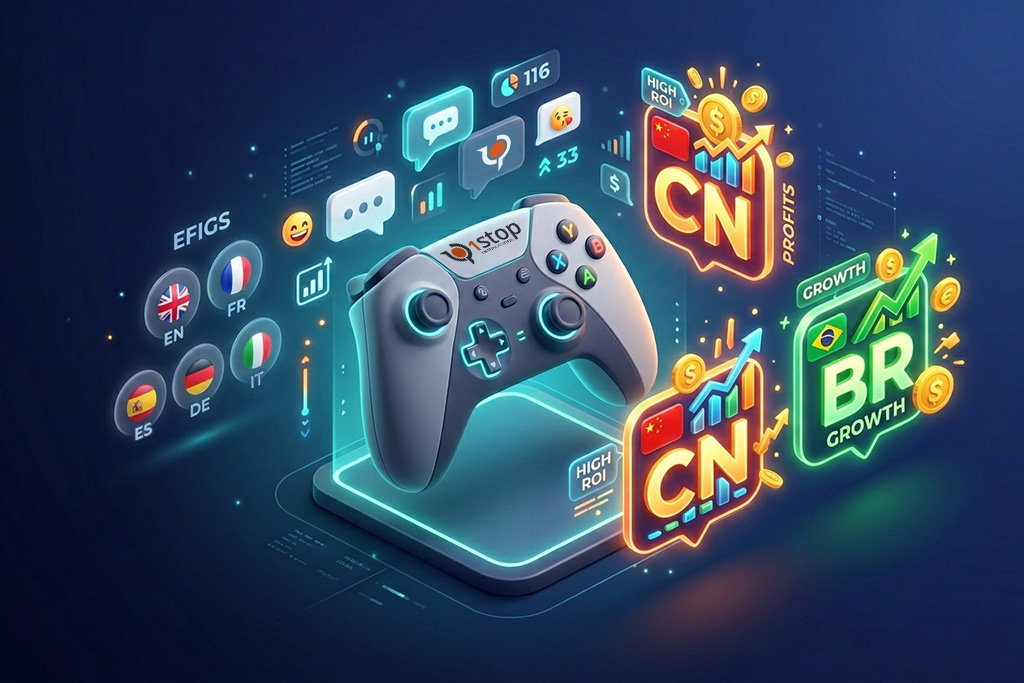
For two decades, the industry defaulted to EFIGS (English, French, Italian, German and Spanish) as its global distribution shortlist. It made sense in 2005, and it made less sense in 2015. In 2026, it is actively costing developers money.
The updated gold standard for any indie developer with global ambitions is EFIGS + BR/CN: adding Brazilian Portuguese and Simplified Chinese to the mix. Better still, for studios with tighter budgets, a CN-first or BR-first strategy can outperform the full EFIGS slate on pure return.
Here is the core hypothesis: localisation is not a sunk cost. It is a revenue multiplier that unlocks the roughly 60% of Steam’s player base that English alone cannot reach. The maths is clear, and the case studies are compelling. Let’s look at both.
The Data Reality Check: Steam Market Share (2025–2026)
To understand why the EFIGS + BR/CN model is superior, we have to look at the math. The traditional obsession with Western Europe often leads developers to over-invest in regions that are stagnant, while ignoring where the actual players are.
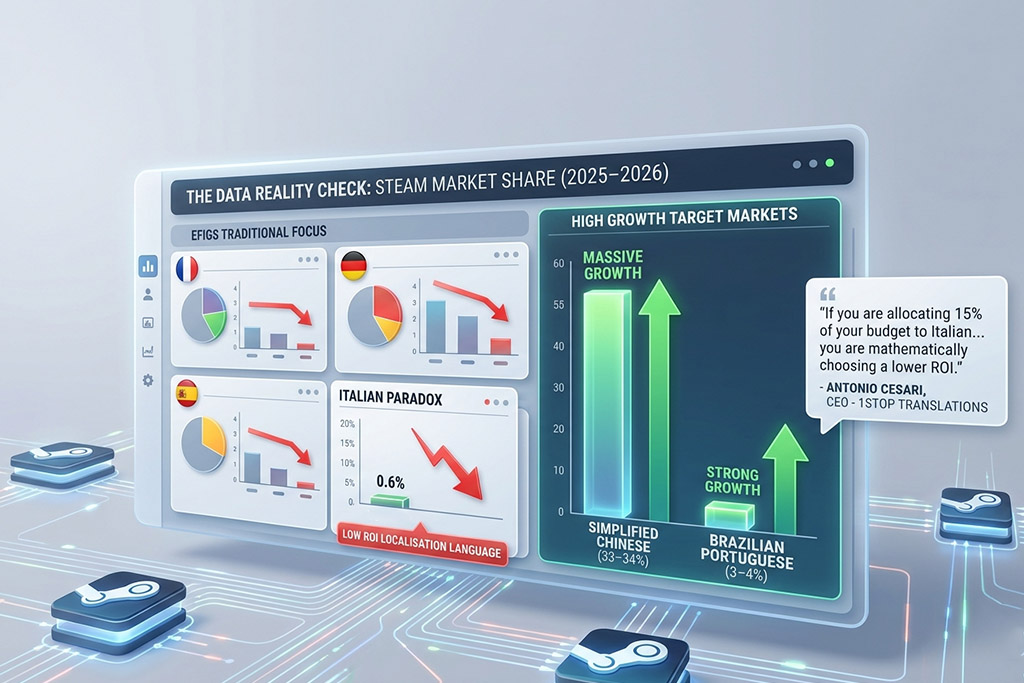
This is what we call the Italian Paradox. Italian has been a cornerstone of EFIGS since the early CD-ROM era. By modern Steam metrics, however, it is one of the lowest-ROI localisation languages on the platform. At approximately 0.6% market share and in decline, developers are spending real money to reach a shrinking audience.
“If you are allocating 15% of your localisation budget to Italian (roughly 0.6% of Steam’s user base) while ignoring Brazilian Portuguese (roughly 3–4%), you are not missing a ‘secondary’ market, you are mathematically choosing a lower return on investment.”– Antonio Cesari, CEO, 1Stop Translations
A comparison of Steam’s 2026 language distribution. While traditional European languages show a steady decline, Simplified Chinese and Brazilian Portuguese offer the strongest growth opportunities for indie developers.
The data suggests that any indie developer asking, Which languages should I localise my indie game into first? should start with this table, and then do the uncomfortable but necessary work of challenging assumptions inherited from larger studios with very different cost structures.
Case Study: The “IndieARK” Pivot for Vampire Survivors
Theory is useful. Proof is better. Few case studies in recent indie history illustrate the cost of a localisation barrier, and the value of breaking through it, more clearly than Vampire Survivors.
When Vampire Survivors went viral in the West, it looked as though the story had already been written: a game built almost entirely by one person, sold for under £3, achieved record-breaking Early Access numbers, earned BAFTA nominations, and launched a mobile port with millions of downloads. It had already crossed milestones most solo developers can only dream of.
But mainland China presented a different picture. Despite the scale of the potential audience, the game struggled to build deeper cultural traction there. The reasons were not related to gameplay; the bullet-heaven formula travels well. The problem lay in everything surrounding the game: the language, the cultural framing, and the lack of a strategy for the platforms where Chinese players actually discover new titles.
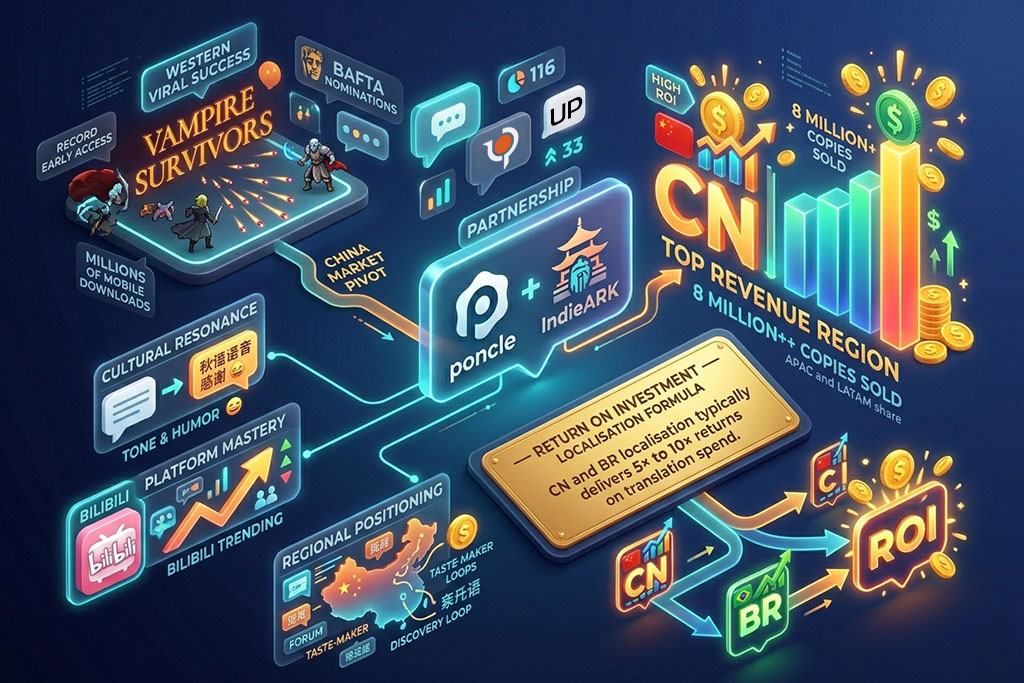
Luca Galante’s response was smart, not expensive. Instead of building an in-house international team, which would have been impractical even for a successful solo studio, poncle partnered with IndieARK, a publisher specialising in bringing Western indie titles to the Chinese market. What IndieARK provided went far beyond straightforward translation:
Cultural resonance: they localised the tone, humour and in-game flavour text, the subtle elements that make a game feel native rather than simply translated.
Platform expertise: they supported the cultural marketing engine needed to gain traction on Bilibili, China’s leading video and streaming platform, somewhat comparable to being picked up by a major Twitch creator, but more algorithmic and community-driven.
Regional positioning: they handled the framing and presentation needed for the Chinese indie gaming community, which has its own tastemakers, forums and discovery loops, separate from Steam’s Western-facing ecosystem.
The “Vampire Survivors” Localisation Formula: proof that cultural resonance equals revenue. Through strategic partnerships and platform-specific marketing, this indie hit unlocked the massive potential of the Chinese and LATAM markets.
The result was not a modest uplift. Following the formal Simplified Chinese localisation and regional marketing push, China became one of Vampire Survivors’ top revenue-generating regions.
By 2025, the game had surpassed 8 million copies sold on Steam, with APAC and LATAM markets contributing a meaningful share of its long-tail revenue, the kind of sustained income that helps keep a studio solvent between projects.
For successful indie titles with strong gameplay loops, CN and BR localisation can typically deliver returns of 5x to 10x on translation spend.
Why This Video Game Localisation Model Works for a First Launch
The most common objection indie developers raise against the EFIGS + BR/CN model is budget, though it is often framed as a strategic concern.
Indie agility is the advantage here, not the limitation. A three-person studio does not need to replicate a AAA localisation pipeline. It needs to make one or two high-impact language decisions early, ideally before the wishlist campaign and certainly before the store page goes live.
Prioritising Simplified Chinese and Brazilian Portuguese over French or Italian is not necessarily a bigger project. In many cases, it is the same budget, simply allocated more effectively.
This is also where the right strategic partner becomes decisive. In markets such as mainland China, blind translation, dropping string files into a localisation tool and calling the job done, does not unlock the market.
The Chinese indie gaming audience is discerning, taste-driven and highly networked through platforms such as Bilibili, Douyin and specialist community forums, each with its own discovery logic.
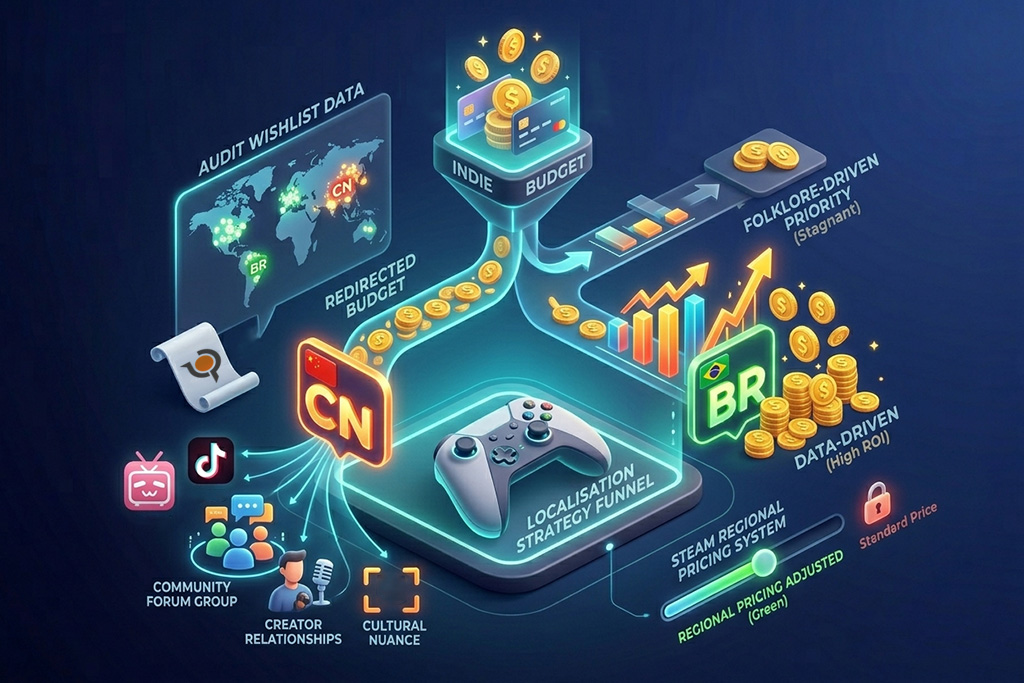
Success for a “first launch” isn’t about having a AAA budget, it’s about indie agility. This model illustrates the shift from folklore-driven priorities to a data-driven approach, redirecting investment towards high-ROI markets like China and Brazil.
Reaching that audience requires a partner with real local presence: relationships with Chinese content creators, an understanding of the framing that resonates with the community, and experience navigating the cultural nuances that shape player response.
The third level behind the EFIGS + BR/CN model is Steam’s regional pricing system. Localising into Brazilian Portuguese and Simplified Chinese without adjusting your Steam pricing for those regions is like unlocking a door and then putting a barrier in front of it.
For an indie developer launching a first or second title, the practical framework is straightforward: audit your current wishlist data by region before finalising your video game localisation budget.
The EFIGS + BR/CN model provides a framework for making that decision based on evidence rather than industry folklore.
Final Thoughts: Data Over Tradition
Video game localisation is no longer an optional extra bolted on to a finished game. In 2026, it is a core go-to-market strategy for any indie developer with global ambitions.
As the journeys of Vampire Survivors and Dave the Diver suggest, the difference between a cult success and a multi-million-copy hit is rarely just the game itself. More often, it comes down to which markets you choose to enter, when you enter them, and how much cultural investment you make.
The action point is simple: open your Steam developer dashboard and review your wishlist data by region. Identify the language you are currently neglecting, the one linked to a meaningful cluster of wishlists but no localisation support. That gap may be your next highest-ROI investment.
If you need a partner to close it, that is exactly what 1Stop Translations is here to do: bring the video game sector expertise needed to make localisation count, rather than simply exist.
It’s a scenario we see all too often in the indie development space and among mid-tier publishers: the “Invisible Game” syndrome.
9 minutes – read
You have poured your heart, soul, and budget into creating an incredible title. You understood the assignment, investing heavily in professional Video Game localisation so players worldwide can enjoy your UI, dialogue, and lore in their native tongue. Yet your global sales remain stagnant. Why? Because you overlooked app store localisation.
Having a game flawlessly translated into 15 languages means nothing if your storefront is only available in English. This disconnect is where App Store Optimisation and International ASO act as the critical bridge between simply having a great game and actually selling it globally.
Localising not just your in-game content, but your entire digital storefront, from metadata to screenshots, is the definitive strategy for boosting SEO performance, dominating algorithms, and driving organic discovery across diverse global regions.
Why Localise Your Steam and App Store Pages? Beyond Basic Game Translations
It’s the great paradox of modern game publishing: developers often localise the game client into 25 languages but leave the storefront entirely in English.
This partial localisation approach is one of the most common and costly oversights in the industry. It essentially locks your product behind a linguistic paywall before the user even has a chance to hit the “Download” or “Buy” button.
The Pitfall of the “Direct Translation”
Why must game localisation extend to the storefront? Because player discovery begins in the search bar. However, applying a literal translation is a guaranteed way to sabotage your international organic reach.
A direct translation of a video game’s description simply will not rank on Google Play, the App Store, or Steam in highly competitive markets. When a German, Japanese, or Brazilian player searches for a new game, they use region-specific slang, colloquialisms, and highly localised search terms.
When a player in Seoul searches for a “horror co-op” (공포 협동), and your Steam Page only accounts for English keywords, your game won’t even appear in the results. This leads to a massive hit to your Steam Visibility, as the platform’s algorithm assumes your game is irrelevant to that specific demographic.
If your metadata lacks proper keyword research in those foreign languages, your game will not surface in their queries.
Moving beyond basic translation to culturalised content ensures your game ranks higher on Steam and the App Store, driving organic reach and boosting wishlist conversions across every territory.
Culturalisation vs Localisation in Gaming
To achieve true global discovery, developers must understand the critical difference between Culturalisation vs Localisation in gaming.
Localisation in gaming focuses on translating text, adapting audio, and converting technical formats (currency, date) for a new region.
Culturalisation goes deeper, adapting content, storylines, symbols, character designs, and themes to align with the cultural expectations, consumer habits, and emotional triggers of a specific demographic to fit local cultural norms, sensitivities, and values, ensuring it resonates authentically and avoids offence.
Failing to culturalise metadata can hinder visibility, a game with American-centric references might flop in Asia if not adapted. Trusted resources such as Valve’s Steamworks documentation on localisation highlight this, emphasising how adapted pages boost engagement.
In a marketplace where thousands of games are released monthly, algorithms favour relevance. If your storefront copy does not resonate with local search habits, platforms will de-prioritize your game.
By extending game localisation to store pages, you build trust, players see a tailored experience from the first click, improving wishlist conversion rates and overall sales.
The Global ASO Blueprint: Technical Strategies to Dominate Discovery Algorithms
Mastering ASO for global markets strategy requires moving away from generic translations and adopting a highly technical, SEO-driven approach for every region you target.
It’s not just about human readers anymore, it’s about how discovery algorithms and generative AI engines process your data.
Technical Checklist: 4 Essential Best Practices for Localised Store Metadata
To truly optimise for global markets, publishers must implement strict App Store metadata localisation best practices. This involves a meticulous adaptation of every storefront element:
Titles and Subtitles: Never assume your game’s title resonates the same way globally. While the brand name may remain intact, the subtitle or trailing keywords must be highly localised.
Short Descriptions: This is your elevator pitch. It must be adapted to feature high-volume, low-competition local keywords.
Long Descriptions: Structure these for readability and SEO. Use localised headings, bullet points, and keywords naturally woven into the narrative.
Screenshots and Trailers: Visuals are language, too. A screenshot featuring complex English UI should be replaced with an image showing the UI in the target user’s language.
Generative Engine Optimisation (GEO) and AI Discovery
The search landscape is shifting rapidly towards Generative Engine Optimisation (GEO) and Answer Engine Optimisation (AEO). AI-driven search engines (such as Google’s AI Overviews)) and platform-specific algorithms (such as the Steam Discovery Queue) now read and synthesise storefront metadata to recommend games directly to users.
Structured, localised metadata helps these AI engines “understand” exactly what your game is, what genre it belongs to, and who would enjoy it in their native language.
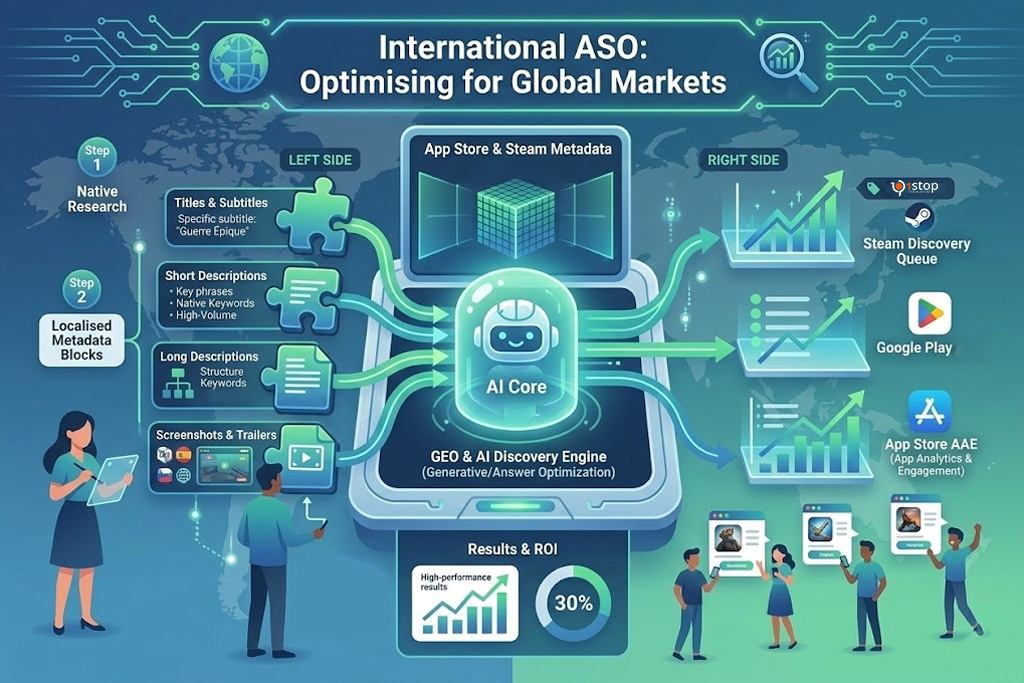
Optimising for international markets is no longer just about language; it’s about algorithm alignment. By combining native research with structured metadata, you can ensure your title is prioritised by the Steam Discovery Queue and AI-driven search engines, turning global reach into measurable ROI.
How to Localise Steam Store Page: A Step-by-Step Guide
To ensure your game is optimised for both human users and generative search engines, follow these critical steps:
Step 1 – Conduct Native Keyword Research: Don’t assume English terms translate directly. In Japan, gamers might search for “cozy puzzle game” as “リラックスパズル” rather than a word-for-word equivalent. Use native speakers to identify long-tail queries that match user intent.
Step 2 –Optimise Metadata: For Steam Page Optimisation, integrate these keywords into your short description, about section, and tags. Steam’s tag system is powerful; select specific ones like “Metroidvania” over broad “Adventure” to enhance discoverability.
Step 3 – Localise the Capsule Art: Update your capsule images and promotional graphics to feature the title or tagline in the local language.
Step 4 – Adapt the “About This Game” Section: Structure this with clear H2s and bullet points. AI overviews love bulleted lists, making it easier for answer engines to pull your game as a top result.
Step 5 – Update Announcements: If you post patch notes or event news, localise those announcements to maintain engagement in foreign markets.
Case Study: Steam SEO in South Korea
Consider the highly lucrative South Korean gaming market. A Western publisher released a dark fantasy RPG and directly translated their English primary keyword, “Gritty Dungeon Crawler.” The literal Korean translation yielded a term that local gamers never actually type into the Steam search bar.
When the publisher pivoted to a culturally nuanced strategy, they discovered that South Korean players searched for specific genre amalgamations and gameplay descriptors unique to their gaming culture.
By rewriting the short description and tags to match these regional search behaviours, organic impressions skyrocketed. The literal translation failed because it lacked context; the localised SEO succeeded because it spoke the players’ language, both literally and algorithmically.
A study by Adjust notes that localised ASO boosts downloads by tailoring to regional behaviours, proving the ROI.
Real-World Examples: Lessons from Phasmophobia and Demonologist
To truly grasp the ROI of storefront localisation, we need only look at the current competitive landscape of co-op psychological horror games on Steam. Two massive hits in this genre, Phasmophobia and Demonologist, provide a perfect study in contrast regarding Steam Page Optimisation.
Both titles are incredibly popular, and both commendably support 25 in-game languages. However, their approaches to the storefront differ significantly, directly impacting their international reach and wishlist conversion rate.
Don’t leave your global discovery to viral luck. While Phasmophobia relied on influencer momentum, Demonologist gained a competitive edge through strategic Steam Page Optimisation (ASO).
The Phasmophobia Risk: Viral Luck vs. Strategic ASO
Phasmophobia is one of the most succesfull indie horror titles of the past two years. It features deep in-game localisation, ensuring players from Tokyo to Rome can navigate the ghost-hunting equipment. Yet, for a long time, its Steam store page remained strictly in English.
While the game’s massive viral success via influencers propelled its global sales, relying on English-only metadata leaves a tremendous amount of organic, search-driven discovery on the table. For an indie developer without the viral luck of Phasmophobia, this approach is an unacceptable risk to revenue and long-term discoverability. It is a failure of strategy.
The Demonologist Advantage: Data-Driven Dominance
Demonologist, entering an already saturated market, took a more strategic approach. Alongside its 25 in-game languages, it actively localises its Steam store pages. For example, the Italian Steam page for Demonologist features a fully localised description, adapted promotional phrasing, and targeted Italian keywords.
The impact? Steam visibility increases exponentially. When an Italian user searches for specific horror co-op terms in their native language, Demonologist has a significantly higher chance of surfacing organically in the Discovery Queue compared to a game with an English-only page.
The Ultimate Formula: Trust + ASO = Skyrocketing Conversion Rates
This brings us to the core marketing truth of digital storefronts: Localisation equals Trust, and Trust equals Conversion. When a user lands on your App Store or Steam page and sees meticulously crafted copy in their native language, it signals quality. It reassures them that the in-game experience will be equally polished.
This psychological comfort drastically reduces bounce rates and serves as the ultimate catalyst for increasing your wishlist conversions and driving digital sales uplift.
This marketing angle underscores localisation as a key partner in video game sales, delivering ROI through optimised digital store performance on Steam, Google Play, and the App Store.
Conclusion: Global Discovery is a Choice, Not an Accident
In the modern gaming market, being a “hidden gem” is a failure of marketing, not a badge of honour. As a developer or publisher, you have the power to decide whether your game remains confined to a single corner of the globe or becomes a worldwide success.
Game Localisation is the first step, but International ASO and Steam Page Optimisation are what carry you across the finish line. By treating your storefront as a dynamic, localised asset, you improve your Steam Visibility, skyrocket your wishlist conversion rate, and ultimately drive the sales your hard work deserves.
At 1Stop Translations, we bring expertise in over 100 languages to the table. We aren’t just a translation company; we are your strategic partner in the global gaming ecosystem. You build the worlds, let us build the gateway that invites players across the globe into them.
As a result, video game localisation emerges as a key tool in creating a feeling among all gamers that they have been acknowledged and accepted, irrespective of their physical, gender and cultural differences.
9 minutes – read
Integrating DEI translations (Diversity, Equity, and Inclusion) is no longer a peripheral “nice-to-have” and no longer seems to be a corporate buzzword.
With over 3 billion people playing games globally, an important demographic needs special features for accessibility to effectively participate in digitally constructed worlds.
For the Localisation Manager and the Localisation Leads, the challenge lies in embedding inclusivity at the very core of the localisation pipeline.
This article acts as a comprehensive guide to help you navigate the intricacies of inclusive content translation, and ensures your titles are not just translated, but accessible as well.
Why does Accessibility and DEI Matter in Video Game Localisation?
The drive towards inclusive gaming stems from a powerful combination of ethical arguments and market realities. From a business perspective, the “purple dollar” (the financial expenditure of people with disabilities) represents a significant market opportunity that is often under-served.
Additionally, where the title emphasises the need for accessibility localisation in games, it opens the doors for millions of players who might not otherwise be included. Moreover, by focusing on ensuring there is diversity, equity and inclusion, there will be an improved brand reputation and therefore a loyal following.
Regulatory Pressure and Industry Standards
Additionally, apart from the ethical considerations, there are increasing regulatory and platform-based influences. A case in point is legislative developments such as the European Accessibility Act and the CVAA in the United States.
Even the leading platforms, such as Xbox and PlayStation, have introduced strict guidelines on accessibility, which must be adhered to by game developers to attain featured status. The leading industry associations, such as the IGDA (International Game Developers Association), are now treating inclusive localisation as a competitive prerequisite and not as a bonus feature.
Defining Accessibility in the Gaming Context
On a practical level, accessibility in localisation will involve a number of key elements which need to be addressed in the actual translation process, including:
Subtitles & Captioning: This goes beyond dialogue. It includes SDH (Subtitles for the Deaf and Hard of Hearing), which takes into consideration timing, readability, and localisation of idioms without direct equivalents.
Audio Descriptions (AD): The audio description of cinematic cutscenes and the narrated UX for visually impaired players requires a script that is both descriptive and fits within the scene pacing.
UI/UX Text Localisation: Also, the facilitation of user interfaces to be screen-reader friendly, with text legible on screen even when their size or contrast is adjusted.
Input Remapping & Tutorials: Localised descriptions for control remapping and help menus are necessary for players that use adaptive controllers.
By prioritising DEI Translations, developers can meet strict regulatory requirements like the EAA while building long-term brand loyalty within under-served gaming communities.
DEI Translations versus Traditional TEP
While the standard TEP (Translate, Edit, Proof) process focuses on linguistic accuracy, DEI translations add a layer of cultural and social sensitivity. This includes:
Cultural sensitivity reviews: A way to identify potential tropes or offensive imagery, which can vary across different regions.
Inclusive Language Glossaries: Providing living, breathing documents that define how to handle non-binary pronouns or sensitive terminology.
Lived-Experience Input: This would involve testing by native speakers who have disabilities that are native to the region in which the software is to be distributed, providing valuable feedback on the accuracy and functionality of the localised experience.
The multi-disciplinary approach reduces rework, preserves player voice, and prevents costly post-launch remediation.
Adapting Content: From Inclusive Scripts to Accessible UI
Execution is strategy meeting reality. To provide premium gaming translation services, a provider must understand the technical nuances of how content is used. This is where inclusive content translation moves from theory to technical implementation.
Visual and Audio Rendering
Adapting SDH from subtitles is a specialised skill. SDH differs from standard subtitles because it’s there to make sure to convey the atmosphere with non-speech information such as the creaking of a door, an ominous swell of music, or muffled shouting. Export burnable captions and separate timed files: SRT/ TTML to pipelines.
1Stop Translations underlines that all these cues need to be localised: a “thud” in English can have quite a different feel and dimension when translated into Japanese or Brazilian Portuguese, for example. Similarly, Audio Descriptions (AD) have to be crafted so the proper narrative “beats” are heard without conflicting with important dialogue.
Linguistic Nuance and Gender Neutrality
One of the biggest challenges encountered with regard to grammatical gender in any game within the category of DEI video games is that, in a language like Spanish, French, or Polish, the verb and adjective agree with subject gender.
To address the variety of player brands that the games might have within localisation, it is necessary to think creatively about linguistic solutions that ensure dialogue appears neutral with respect to gender without compromising the normal flow of conversation.
Localisers should use inclusive language glossaries and raise awareness for locales where neutral language is not available, including proposing UI changes and/or alternatives for micro-copy. This level of nuance is what differentiates between an inclusive translation and just another generic translation.
Bridging the gap between inclusive storytelling and technical accessibility to ensure every player, on every platform, feels seen and heard.
User Interface (UI) Challenges
The technical implications of game localisation can conflict with the needs of accessibility. For instance, if a “dyslexia-friendly font” is used or “high-contrast mode” is enabled, more screen space is often required. An increase of 30% or more in English text can result from using European languages like German or Italian.
Expert video game localisation services help avoid this by planning the expansion of texts during the design stage through the effective use of “string wrapping,” ensuring that the texts are easily readable on all screens ranging from smartphone screens to 4K screens.
Mobile versus Console differences: The mobile version requires larger touch targets, as well as integrating captions and accommodating system-level screen readers. The experience may include game narration or controller remapping in the console version.
Best Practices for Implementation of DEI Translations in Video Games
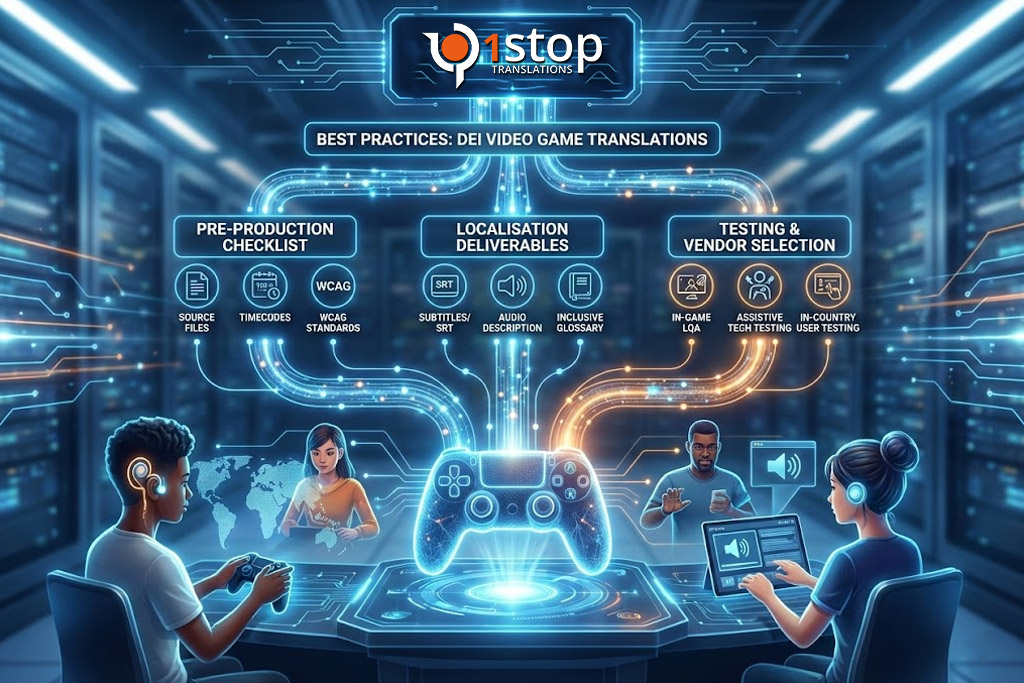
A scalable localisation partner must also represent process depth in terms of language support, accessibility knowledge, and in-country testing support. We already publish advice on video game workflows.
Pre-production Checklist
The following should be passed to your localisation team before translating the first string:
Source files with contextual details: Consider including screenshots and videos showing the UI in action.
Timecodes: This feature is vital to ensure proper synchronisation with subtitle and audio description cues.
Accessibility requirements: If appropriate, reference specific accessibility standards such as the WCAG (Web Content Accessibility Guidelines). Include information such as character limitations or right-to-left flags.
Localisation deliverables to request from vendors
Localised subtitles + Burnable Captions, each one having its own SRT/TTML file.
Audio description scripts and VO source-ready.
Localised UI strings with context notes, as well as accessibility-related tags such as “screen reader label” or “short label”
Inclusive Language Glossary and DEI notes per locale.
Accessibility QA report with remediation recommendations and priority fixes.
Testing Checklist
In-game LQA with full builds (timing, overlap, truncation).
In-country user tests, including gamers with disabilities (lived experience feedback rather than QA).
From inclusive glossaries to assistive tech testing, a robust approach to DEI Translations ensures that your game is accessible, respectful, and culturally resonant for players across the globe.
Testing and Vendor Selection
The final bridge to inclusivity is testing. This comprises:
Assistive Tech Testing: Testing how the screen reader interacts with localised strings on mobile and console.
In-Country User Testing: Playing with people with disabilities within the target country.
When choosing a vendor, ask about their particular experience with regards to video game localisation. Request case studies to prove their management of accessibility projects and ask about their ISO qualifications.
A partner with extensive experience across multiple industries as well as specialisations in console and mobile game development, as seen with 1Stop Translations, would be best suited to satisfy the transparency and technical expertise now demanded with DEI projects of this calibre.
Long-term: Integrated AD tracks, UX redesigns for persistent accessibility (responsive UIs, native screen narration), ongoing in-country DEI review panels.
Micro-copy and Phrasing Examples
Inclusive wording means thinking differently. For instance, instead of the literal translation of “Master / Slave”, like in some older technology, it is better to think in terms of “Primary / Secondary”. Instead of posing the question, “Are you a boy or a girl?”, one should think, “Choose your appearance.”
The reality is, keeping the player’s voice consistent and respectful, no matter which of over 100 languages we’re talking about, is what helps build a global community.
Conclusion: Inclusivity as a Partnership
True inclusivity in the digital age demands more than just a vendor, it demands a strategic partner who understands that video game translations is an act of empathy as much as it is an act of technology.
By incorporating DEI translations into your pipeline, not only are you satisfying a checklist, but you’re making sure your game is an inclusive space for all your players, no matter where they are or how they interact with the world.
We at 1Stop Translations leverage the latest technologies and linguistic expertise to successfully overcome the challenges of modern localisation. This is whether you’re launching an indie mobile title or a global AAA video-game blockbuster.
Ready to take your content to the next level of inclusivity?Contact us to find out how our teams of experts can take your next project to the next level of excellence with our top-notch DEI localisation services.
In the era of AAA blockbusters and sprawling live-service ecosystems, the stakes for video game localisation have never been higher. For massive open-world RPGs or competitive multiplayer platforms, the days of treating translation as a post-production afterthought are long gone. Today, a “one-off” translation approach for large-scale projects is a recipe for delayed releases, budget blowouts, and disjointed player experiences.
7 minutes – read
To launch simultaneously across multiple territories without compromising quality, studios require bespoke, integrated workflows. It’s about more than just converting text, it is about engineering a pipeline that supports continuous delivery, cultural nuance and technical stability. Optimising these workflows results in faster time-to-market, a consistent player experience that drives retention, and significantly lower rework costs.
Below, we detail the best practices for structuring a high-performance linguistic localisation workflow, designed for the rigorous demands of the modern gaming industry.
Build a scalable localisation foundation: kits, assets & terminology
The difference between a seamless launch and a “crunch-time” crisis often lies in the groundwork. For large-scale projects, you must establish a Scalable Localisation Foundation before a single word is translated. This prevents the costly “churn and burn” of reworking assets later in development.
The Localisation Kit (L10n Kit)
Your Localisation Kit is the blueprint for your vendors. A robust kit reduces query volume and ensures accuracy from day one. It should include:
String Extraction Guidelines: Clear instructions on how text is pulled from the code.
Contextual Assets: Screenshots of UI menus, character bios and inventory items.
Engine Integration Notes: Specifics on how the Unity, Unreal, or proprietary engine handles text imports.
Platform Constraints: Character limits for PlayStation, Xbox, Nintendo Switch and mobile notification bars.
Source Asset Management & String Engineering
To maintain a “Single Source of Truth,” integration with version control systems (like Git or Perforce) is essential. We recommend a dedicated branch strategy for localisation to prevent merge conflicts with core development.
Furthermore, String Engineering is critical for game localisation readiness:
Stable String IDs: Never key off the source text; use unique, immutable IDs.
Avoid Concatenation: Do not build sentences with code (e.g., “Player” + “hit” + “Monster”). Grammar varies wildly across languages; this breaks immersion in German, French, and Japanese.
Hard Limits & Expansion: UI fields must account for text expansion (up to 40% for German/Russian) and support bi-directional text for Arabic or Hebrew.
ICU Formatting: Use standard placeholder syntax for variables (dates, numbers, gender) to allow linguists to reorder them grammatically.
A robust localisation foundation is the key to avoiding “crunch-time” crises and ensuring a seamless global launch.
Translation Memory (TM) & Glossaries
Efficiency in translations for the video game industry relies on data reuse.
Structured TMs: Build separate Translation Memories for UI, Dialogue and Marketing to prevent tone contamination. This ensures consistency across sequels and DLCs.
Termbases (Glossaries): Define “Do Not Translate” (DNT) lists for proprietary terms, weapon names, or spell names to ensure IP protection.
Style Guides: detailed tone guides per locale, specifying the register (formal/informal) and cultural notes.
Tools & Integrations: Utilise Computer-Assisted Translation (CAT) tools that support deep TM leverage. Connecting a Translation Management System (TMS) directly to your repository (CI/CD) allows for automated string hand-offs, justifying the investment by drastically reducing administrative overheads and accelerating turnaround times.
Scaling teams and quality at pace: workflows, MTPE & LQA
Once the foundation is set, the challenge shifts to throughput. How do you process millions of words while maintaining the “soul” of the game? The answer lies in orchestrating your human talent and technology effectively.
Vendor Selection & Team Models
For large-scale projects, a hybrid approach often works best.
Centralised PM vs. Distributed: A centralised Project Manager (PM) is vital to act as the bridge between developers and linguists.
Specialist Linguists: Avoid generalists for narrative-heavy games. Use fantasy experts for RPGs or military experts for shooters.
In-House Reviewers: Having internal Language Leads to audit vendor output ensures the brand voice remains intact.
Workflow Orchestration
Localisation should run in parallel workstreams. Dialogue, UI, Subtitles and Audio Scripts should have distinct pipelines. Aligning localisation sprints with development sprints allows for “sim-ship” (simultaneous shipment).
Machine Translation + Post-Editing (MTPE)
As a premier video game translation company, we understand the nuance of AI. MTPE is a powerful tool for scaling, but it must be applied strategically:
When to use: Ideal for bulk text, item descriptions, or pre-localisation for early Beta builds to test UI functionality.
Risk Mitigation: Never use raw MT for creative dialogue or marketing copy.
Quality Thresholds: expert human post-editors must review all MT output to ensure it meets the “human quality” standard required for player immersion.
From expert human post-editing to functional LQA, a robust localisation framework ensures your game’s narrative remains intact.
Localisation Quality Assurance (LQA)
Quality assurance is the safety net.
Linguistic QA: Checking for grammar, spelling, and tone.
Functional QA: Checking for text overflows, broken tags, and unlocalised assets.
In-Context Testing: There is no substitute for playing the game. LQA testers must verify text within the game build to catch context errors (e.g., “Chest” translated as human anatomy instead of a box).
Bug Triage: Establish a clear severity ranking (Class A: Crash/Blocker, Class B: Meaning error, Class C: Cosmetic) to prioritise fixes before launch.
Audio & VO Pipelines
For dubbed titles, the script workflow is complex. Scripts must include strict timing constraints for lip-sync and detailed direction notes (mood, intensity). Integrating voice assets back into the build requires a rigorous file naming convention to match the localised string IDs.
Security & IP Handling
Leaks can ruin a marketing campaign. Ensure your video game localisation services provider adheres to strict NDAs, uses secure file transfer protocols (SFTP), and limits access to early builds via IP whitelisting.
Continuous localisation post-launch: patches, DLC, player feedback & GEO/AEO
Modern games are living services. The workflow does not end at version 1.0; it transitions into a continuous cycle of improvement and content delivery.
The Continuous Localisation Pipeline
For Live Service games, you need a pipeline capable of handling small, frequent updates (Hotfixes).
Automation: Automate the extraction and import process for every build. This reduces the risk of human error during weekly patches.
Version Control: meticulous versioning of strings ensures that an update to the “Battle Pass” doesn’t revert previous text fixes.
Navigating the complexities of DLC content, player feedback loops, and evolving search engine requirements in the modern gaming landscape.
Handling DLC & Seasonal Content
DLCs often introduce new themes. Update your Glossaries and Style Guides to reflect these changes. Reuse your existing Translation Memory to keep costs down and consistency up. Seasonal content (e.g., Lunar New Year events) requires specific cultural sensitivity checks to ensure the content resonates with the target demographic.
Player Feedback Loop & Analytics
Your community is your best LQA team.
Crowdtesting & Bug Reports: Monitor local forums and Discord channels for translation errors reported by players.
Telemetry: Use data to prioritise fixes. If 80% of your revenue comes from South Korea, prioritise the Korean LQA pass for the next patch.
Store Presence, ASO & AEO/GEO
Visibility in search engines and app stores is governed by Localisation. This is where SEO meets AEO (Answer Engine Optimisation) and GEO (Generative Engine Optimisation).
Localised Store Pages: Translate keywords, descriptions, and even screenshots (showing localised UI) to maximise conversion rates.
AEO & AI Friendliness: When writing updates, FAQs, or patch notes on your official site/wiki, structure the content with clear H-tags, short summaries and bullet points. This helps AI Overviews (like Google’s AI Overviews or ChatGPT search) parse and present your game as the authoritative answer for queries like “Game X release date in Brazil” or “Game Y patch notes German.”
Schema Markup: Implement schema.org markup on your multilingual pages to help search engines understand the regional context of your content.
Crisis Management
In the event of a regulatory change (e.g., loot box laws in Belgium or China), you need a “Crisis Workflow” capable of pushing legal text updates across all territories within hours, not days.
FAQ
What is included in a video game localisation kit? A localisation kit typically includes extracted string files (with stable IDs), context screenshots/video, UI character limits, style guides and tone notes, a glossary/termbase, translation memory (TM) export, file-format and engine integration instructions, build/version notes, contact details for queries, and QA/test-account access for in-context checks.
How do you handle localisation for voiceover and lip-sync? Scripts are adapted (not just translated) for timing and mouth movement, with phonetic notes and syllable-aware phrasing. We supply time-coded scripts, direction briefs, casting guidance per locale, sample recordings, and in-studio review. Final VO goes through in-context QA (lip-sync/ADR checks) before integration.
How do you keep localisation consistent across updates and DLC? Maintain centralised TMs, up-to-date glossaries and style guides, and a TMS that syncs with your version control. Use modular TMs per module/season, automated extraction/import pipelines, regression LQA on updates, and clear changelogs so translators reuse approved terminology and tone consistently.
What turnaround times and SLAs can I expect for large-scale projects? Timelines depend on language count, content type and QA depth. Typical expectations: hotfix/localised patches, 24–72 hours (prepped TMs); regular DLC/major releases, weeks to months. SLAs should cover response times, TM leverage targets, QA pass rates and delivery windows, tailored per project after scope review.
Optimising localisation for large-scale video games is a balance of art and engineering. It requires a robust technical foundation, an agile team structure and a forward-thinking approach to post-launch support and search visibility. By implementing these workflows, you ensure that your game is not just translated, but truly culturally adapted for a global audience.
Ready to scale your game’s global reach?
Don’t let inefficient workflows slow down your release. Contact us today for a bespoke project assessment, or explore our comprehensive Video Game Localisation Services to see how we can support your next AAA title.