Tag: video game culturalisation

1Stop Translations Announced as Silver Sponsor of Digital Dragons 2026

1Stop Translations Announced as Silver Sponsor of Digital Dragons 2026

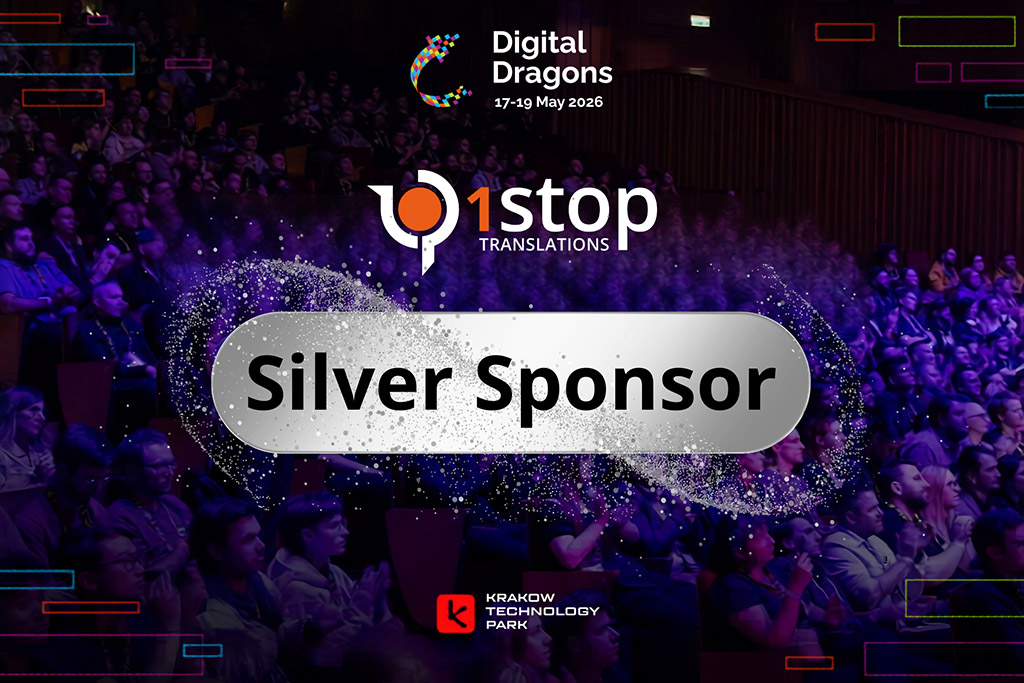
We are proud to announce that 1Stop Translations is an official Silver Sponsor of Digital Dragons 2026, one of Europe’s largest B2B conferences for the games industry, held annually at the ICE Krakow Congress Centre.

6-minutes read

Now in its 15th edition, Digital Dragons Conference is a venue for business networking, knowledge transfer, and the showcasing of independent studios. Organised by Krakow Technology Park, it is a comprehensive ecosystem supporting the games industry at a local, national, and international level. This year’s event promises to be the most ambitious yet, and we are thrilled to be part of it.

1Stop Translations Announced as Silver Sponsor of Digital Dragons 2026

Why Digital Dragons?

At 1Stop Translations, we have always believed that great games deserve a global audience. Digital Dragons is where that belief comes to life. The conference brings together developers, publishers, investors, marketing professionals, and technical teams from across the industry, precisely the people we work with every day to break down language and cultural barriers.

This year’s programme features high-profile speakers including Guy Richards, Director of ID@Xbox, and CD Projekt co-founder Michał Kiciński, a reflection of the calibre of conversation taking place in Krakow. For studios at every stage of development, from indie teams to global publishers, Digital Dragons is where connections are made and deals are signed.

Meet 1Stop Translations at Digital Dragons 2026

Our team will be on-site for the full duration of the conference, and we warmly invite attendees to visit the 1Stop Translations booth to discover how we help studios achieve what we call “Global-Ready” status.

Whether you are an independent developer preparing your debut title for international markets or a major publisher planning a simultaneous worldwide launch, our end-to-end localisation services are designed to support you at every stage of the journey. Our core service offering includes:

  • Localisation & Culturalisation: Ensuring your content resonates authentically with local audiences, not just linguistically but culturally.
  • LQA & FQA: Rigorous linguistic and functional quality assurance to guarantee a polished, seamless player experience across all supported languages.
  • Specialist Consultancy: Strategic localisation guidance tailored to your title, your market, and your goals.

We work with games of all sizes and genres, and our team brings genuine passion for the medium to every project we take on.

Let’s Talk in Krakow

Digital Dragons 2026 represents a unique opportunity to sit down face-to-face and discuss your localisation strategy in detail. If you are attending the conference, we would love to connect, whether at our booth, during the networking sessions, or over a coffee in the Business Networking Zone.

Ready to take your game global? Visit us at Digital Dragons 2026, or get in touch in advance at to schedule a meeting.

See you in Krakow. 🐉


Need a quote? Click here

Level Up: How 1Stop Translations Conquered the Global Video Game Localisation Market

Level Up: How 1Stop Translations Conquered the Global Video Game Localisation Market

The rules of global publishing have changed. A game launched today is not released in one country; it is born simultaneously into dozens of markets, each with its own cultural codes, linguistic nuances and player expectations.

6-minutes read

Code may be universal, but culture emphatically is not. Bridging that gap — from a game’s source strings to a player’s experience — is precisely where 1Stop Translations operates.

With two decades of expertise and an in-house network of more than 20,000 specialist linguists, we have become the video game localisation agency of choice for the full spectrum of the industry: from AAA publishers navigating complex, multi-platform launches to indie devs who need a creative partner that cares as deeply about their game’s identity as they do.

Level Up: How 1Stop Translations Conquered the Global Video Game Localisation Market

Beyond Translation: What Are Game Localisation and Cultural Adaptation?

Video game localisation is the bespoke process of adapting a game’s entire linguistic and cultural identity for a new market. Unlike simple translation, which moves text from one language to another, localisation encompasses UI restructuring, date and currency formatting, the modification of colour symbolism — red signals luck in China but danger in Western markets — and the re-engineering of humour so that a joke that lands in Los Angeles also lands in Lyon. This is what the industry calls cultural adaptation, and it is where the real craft lies.

Consider a character whose name is a pun in English. A direct translation is worthless; the meaning collapses. What is required is transcreation: the reconstruction of meaning and tone from the ground up in the target language.

When 1Stop Translations approaches a new project, our linguists are briefed not just on vocabulary, but on the game’s narrative architecture, character relationships and the emotional beats the developer intends to hit. We understand the subtext, not just the text.

This distinction matters enormously when comparing video game localisation companies. Agencies that treat games as documents to be translated produce work that players immediately sense as foreign. Our bespoke language services treat every game as a cultural artefact deserving of a custom-fit solution: one that makes a player in Warsaw or Osaka feel that the game was made for them.

Beyond Translation: What Are Game Localisation and Cultural Adaptation? - 1Stop Translations
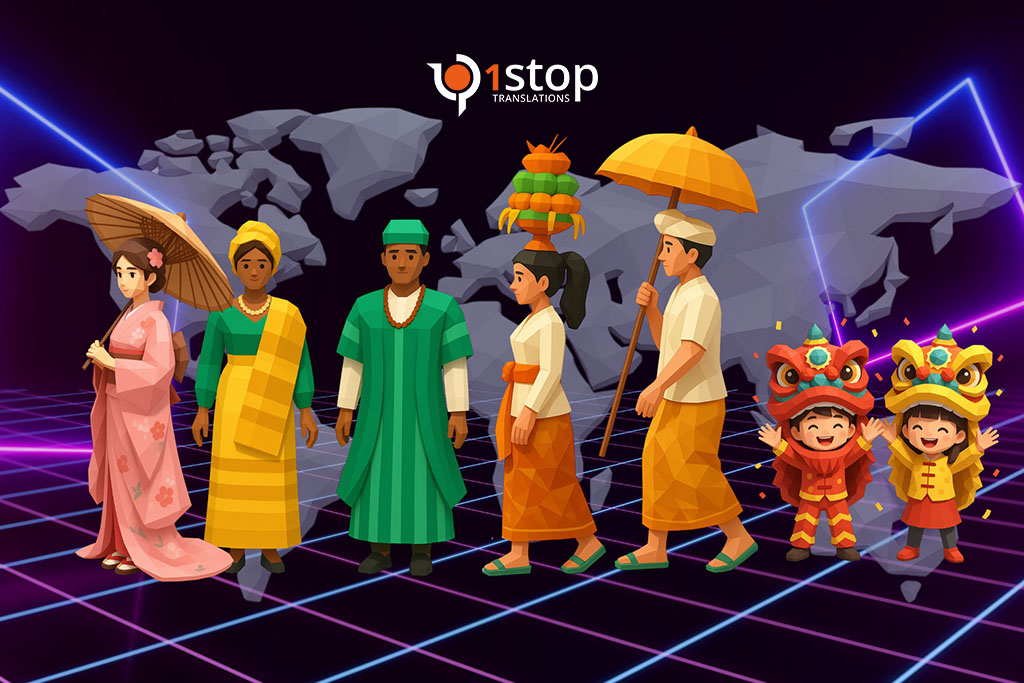
True localisation: crafting a custom-fit experience that resonates with every culture, ensuring players worldwide feel right at home.

Our Bespoke Video Game Localisation Process: Quality Without Compromise

What are the biggest challenges in game localisation? In our experience, they cluster around three pressure points: technical integration, creative fidelity and quality assurance at scale.

Our video game localisation process is designed to address all three simultaneously. It begins with a structured asset audit, cataloguing every string, UI element and embedded graphic that will require adaptation. From there, our Project Managers assign specialist linguists with direct experience in the relevant genre, whether that is sci-fi, platformer or RPG.

The linguistic phase integrates seamlessly with the client’s build pipeline. We work within leading localisation platforms and game engines, ensuring that translated strings fit their containers without truncation or overflow — a technical discipline that generic translation agencies routinely overlook.

Internally, every deliverable passes through our Linguistic Quality Assurance (LQA) protocol: an independent review layer that tests the content not only for grammatical accuracy but also for immersion. Does it feel like a native-language game, or does it feel translated?

This commitment to precision is what separates our video game localisation services from the competition. Quality is not just a promise; it is enforced through our ISO 9001, ISO 17100, and ISO 18587 certifications.

Case Study: Preserving Creative Identity in Big Hops

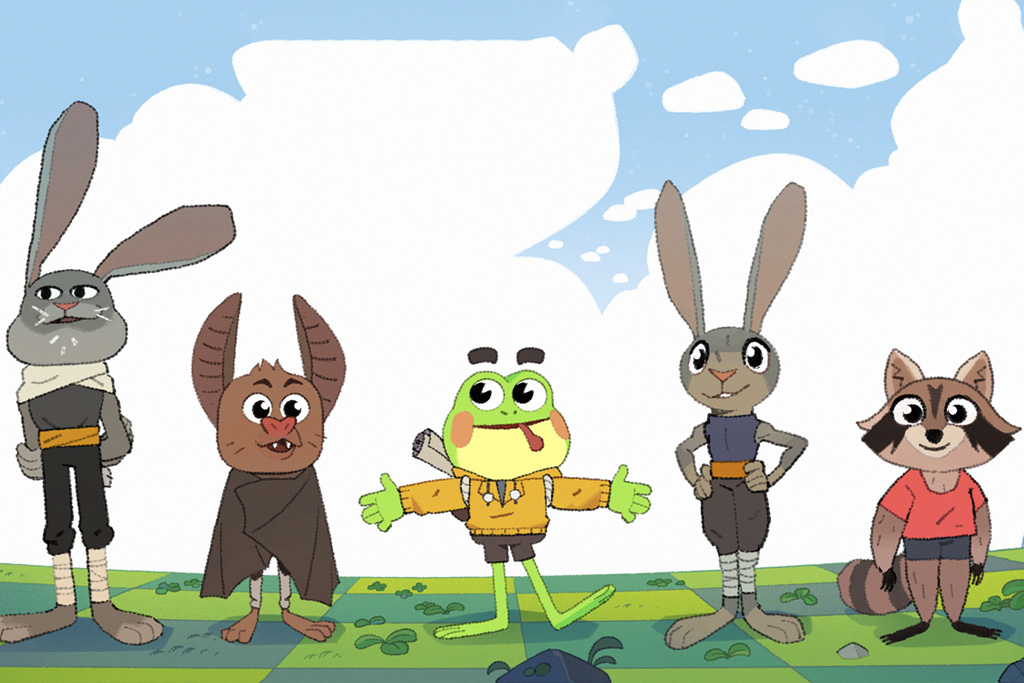
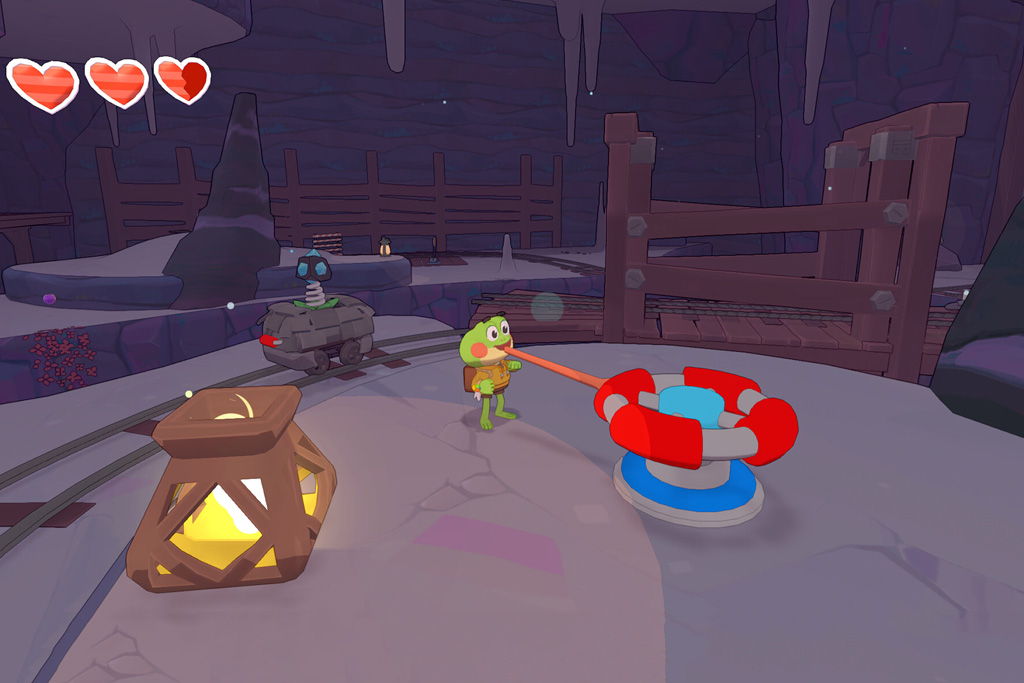
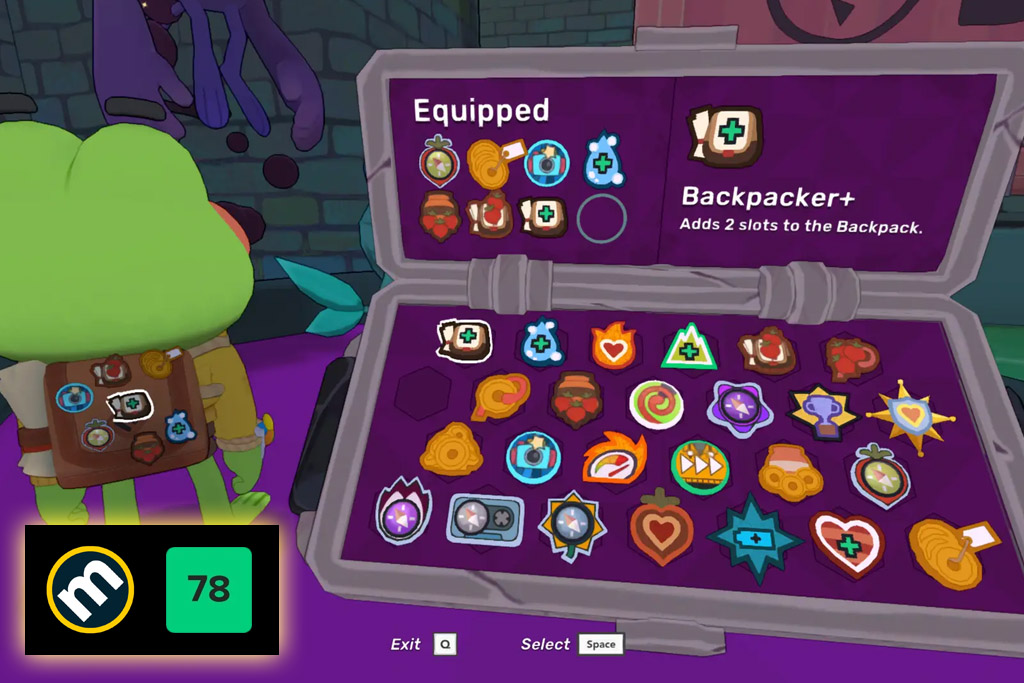
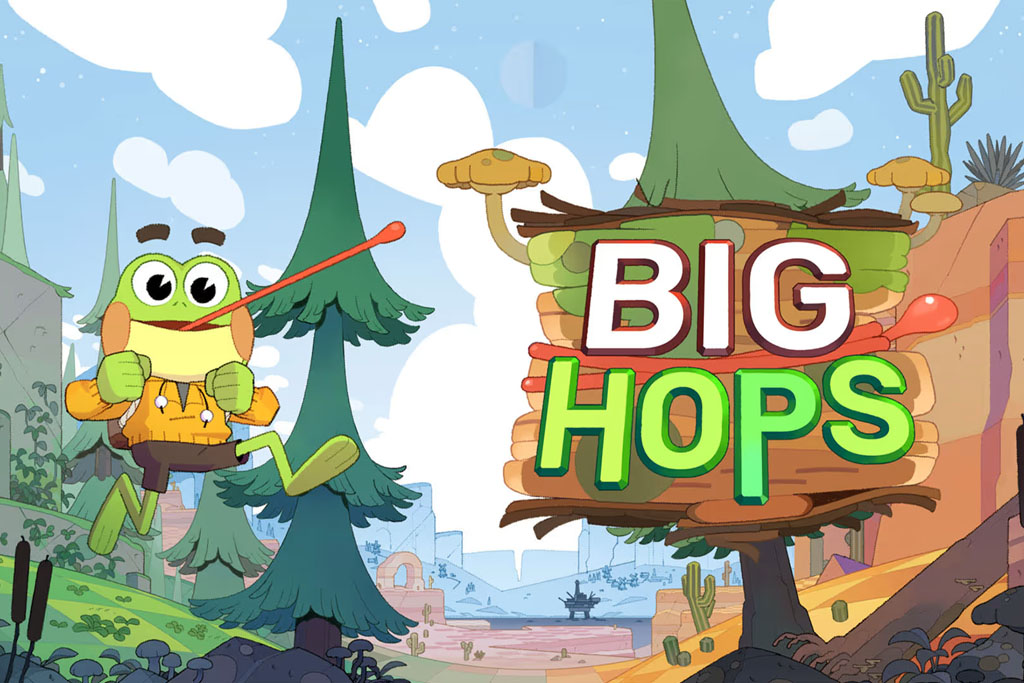
Released in January 2025 on Steam, Nintendo Switch, and PlayStation 5, Big Hops follows Hop, a friendly frog on an emotionally rich adventure across the Red Desert, the Open Ocean and the Shattered Mountain.

The game’s entire personality rests on warmth, wit and a cast of charming animal characters designed with genuine affection. For an indie title like this, voice is everything. Lose the humour and you lose the game.

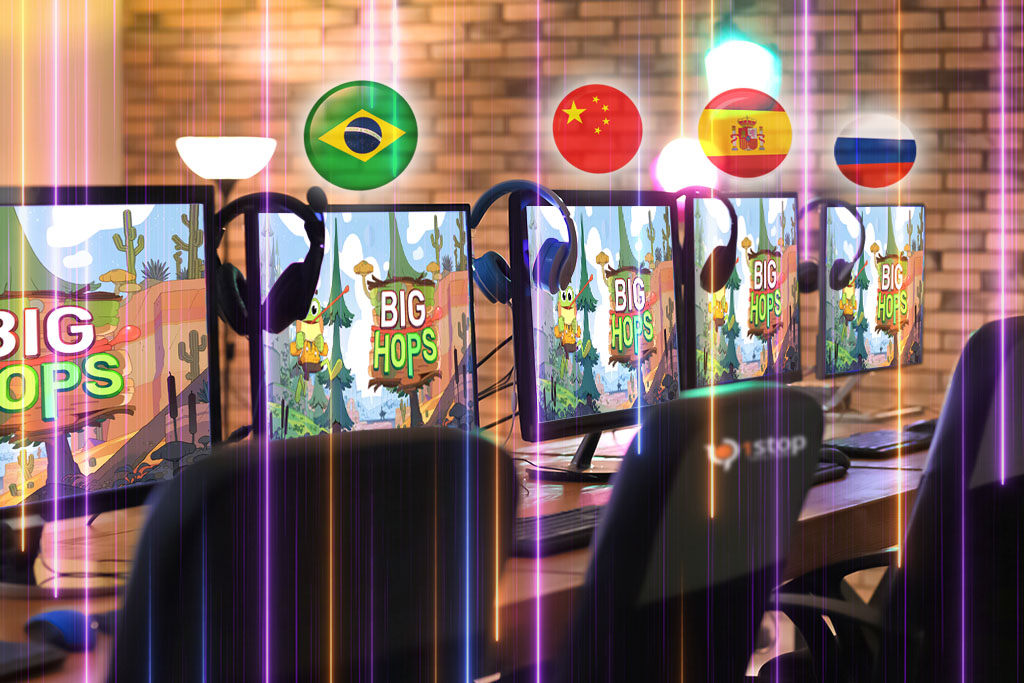
1Stop Translations localised Big Hops into Spanish, Brazilian Portuguese, Chinese and Russian. Each of these markets carries distinct cultural attitudes towards anthropomorphic characters, childhood adventure narratives and comedic tone.

Case Study: Preserving Creative Identity in Big Hops - 1Stop Translations
Our transcreation process for Big Hops treats every indie project as a premium engagement, protecting the developer’s creative vision across Spanish, Brazilian Portuguese, Chinese, and Russian markets.

Our linguists became genuine creative partners, carefully transcreating puns and character-specific speech patterns so that Hop’s personality resonated with the same warmth in São Paulo as in the English original.

Why is cultural adaptation important in video games? Big Hops makes the answer tangible. Small games do not receive less care from our team. Every indie project is treated as a premium engagement, because a great game deserves to be experienced as its creators intended, in every language and by every player.

Case Study: Strategic Global Reach for Sliding Hero

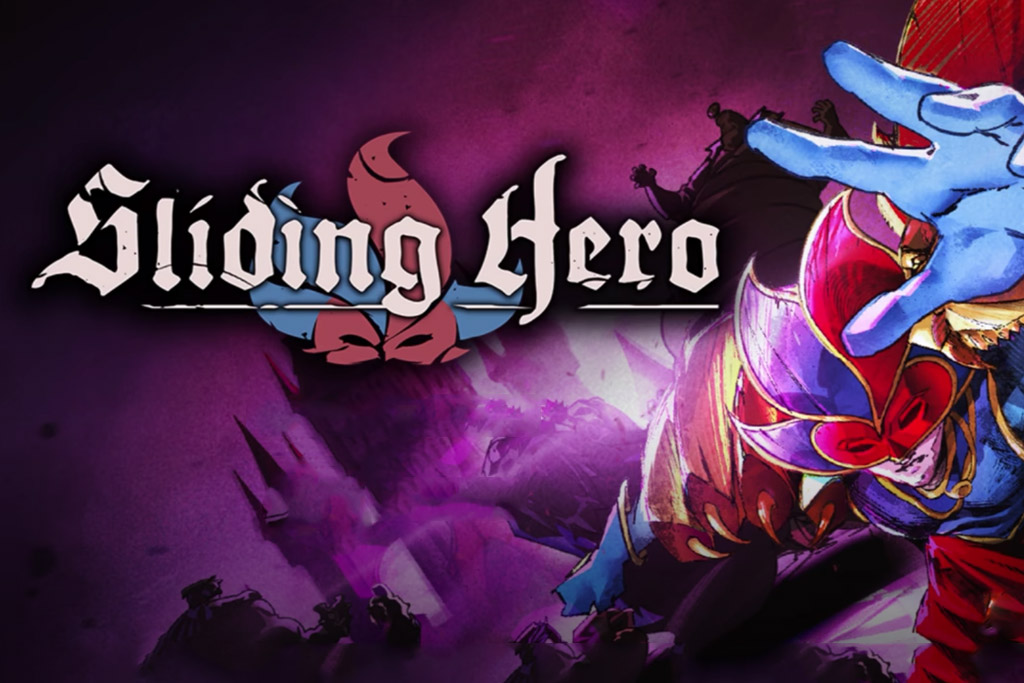
Silent Chicken’s atmospheric puzzle-adventure Sliding Hero needed to conquer international markets without the budget of a major publisher. For a studio of this size, every localisation decision had to be strategic. Spending equally across all languages was not viable; the approach had to be targeted.

We implemented a dual-tier localisation strategy designed to maximise both discoverability and player immersion across priority markets.

  • Storefront Dominance: The Sliding Hero Steam Store page was expertly adapted into Spanish, French, Chinese, Japanese and Korean. By ensuring that the game’s storefront appeared in native searches and spoke directly to local players at the point of discovery, we maximised top-of-funnel visibility across five of the world’s most competitive gaming markets.
  • Deep Immersion: In-game content received complete, high-fidelity localisation into Spanish and French for the two markets identified as the strongest commercial priorities. Players in these markets experienced the full narrative arc of Sliding Hero in their native language, with none of the immersion-breaking friction that even minor localisation errors can introduce.
Case Study: Strategic Global Reach for Sliding Hero - 1Stop Translations
Strategic localisation for Sliding Hero: maximising discoverability and player immersion through a targeted, dual-tier approach to global markets.

This targeted strategy helped Sliding Hero connect immediately with diverse global audiences. Prioritising store-level visibility across five languages while delivering full in-game localisation in the two highest-priority territories proved to be the decisive multiplier for the game’s international adoption.

Wishlist growth in these markets accelerated meaningfully, demonstrating a core truth of indie game localisation services: it is not about doing everything; it is about doing the right things brilliantly.

Your Global Launch, Perfected

The global video game market does not wait, and it does not forgive half-measures. Players recognise immediately when a localisation has been done without care, and they talk about it. By contrast, when a game feels native, it earns loyalty, reviews, and revenue that transcend borders.

At 1Stop Translations, we have done the hard work at every scale: from the strategic, market-targeted approach we built for Sliding Hero to the transcreation-led creative partnership that brought Big Hops to life in four new languages. We carry the expertise, methodology and genuine passion for games that separate a specialist video game localisation agency from a generalist translation provider.

If you are preparing a global launch, we are ready to talk. Level Up your next project: contact us today for a bespoke consultation, and let’s build something the world will play.


Need a quote? Click here
The ROI of “EFIGS + BR/CN” in Video Game Localisation Services - 1Stop Translations

The ROI of “EFIGS + BR/CN” in Video Game Localisation Services

Launching an indie game in English only in 2026 is no longer a bold creative choice; it is a commercial misstep. We have officially entered the era of the end of “English-only” by default.

8-minutes read

Valve confirmed at GDC 2025 that Simplified Chinese had surpassed English as the most-used primary language on the platform. That was not a Chinese New Year spike. It was the new normal.

For two decades, the industry defaulted to EFIGS (English, French, Italian, German and Spanish) as its global distribution shortlist. It made sense in 2005, and it made less sense in 2015. In 2026, it is actively costing developers money.

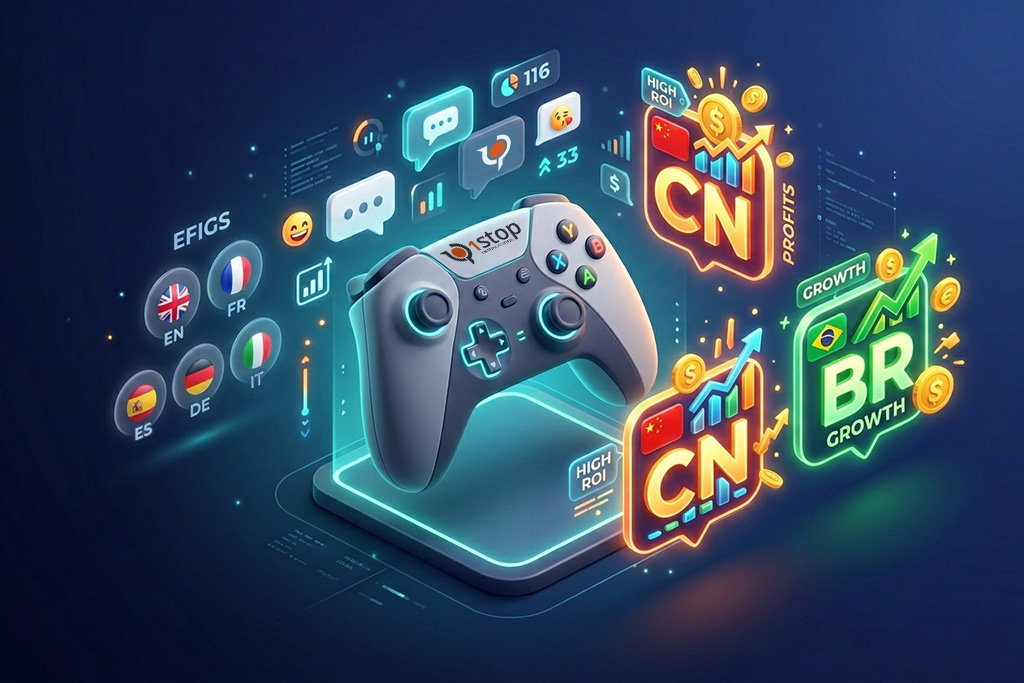
The updated gold standard for any indie developer with global ambitions is EFIGS + BR/CN: adding Brazilian Portuguese and Simplified Chinese to the mix. Better still, for studios with tighter budgets, a CN-first or BR-first strategy can outperform the full EFIGS slate on pure return.

Here is the core hypothesis: localisation is not a sunk cost. It is a revenue multiplier that unlocks the roughly 60% of Steam’s player base that English alone cannot reach. The maths is clear, and the case studies are compelling. Let’s look at both.

The ROI of “EFIGS + BR/CN” in Video Game Localisation Services - 1Stop Translations

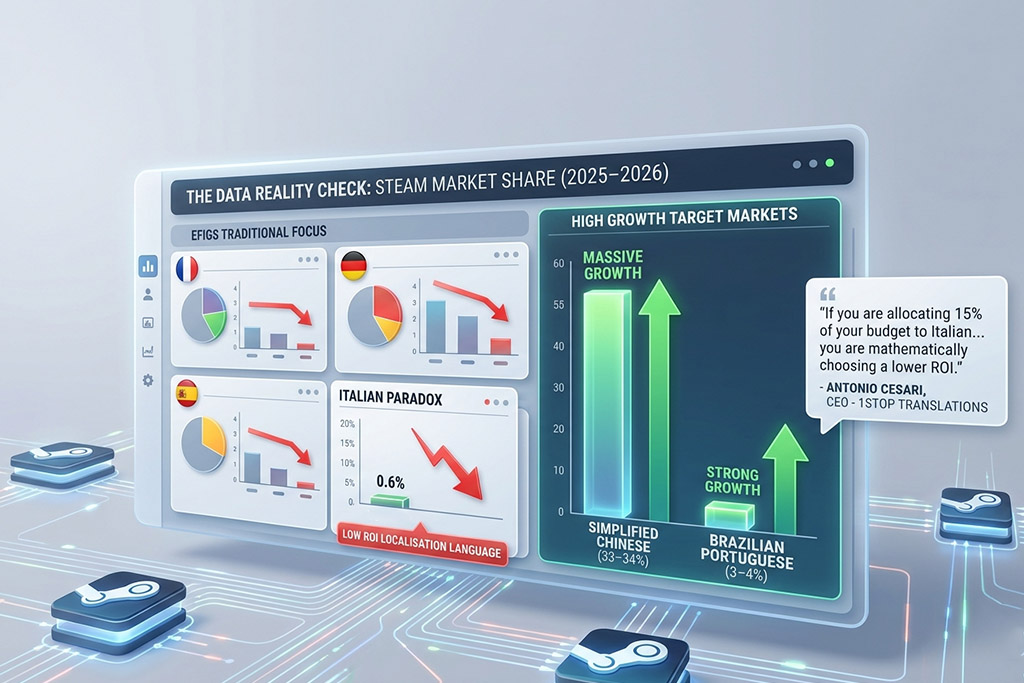
The Data Reality Check: Steam Market Share (2025–2026)

To understand why the EFIGS + BR/CN model is superior, we have to look at the math. The traditional obsession with Western Europe often leads developers to over-invest in regions that are stagnant, while ignoring where the actual players are.

According to the Steam Hardware & Software Survey (February 2026), language distribution has reached a tipping point. Here is the data:

Language Est. Steam Share (2025–2026) Trend vs. 2023 EFIGS Inclusion
Simplified Chinese ~33–34% ↑ Massive growth No (add to EFIGS)
English ~33% → Stable Yes (baseline)
Russian ~8–9% → Stable No
Spanish ~4–5% ↓ Slight decline Yes (part of EFIGS)
Brazilian Portuguese ~3–4% ↑ Strong growth No (add to EFIGS)
German ~2–3% → Flat Yes (part of EFIGS)
French ~2% ↓ Declining Yes (part of EFIGS)
Italian ~0.6% ↓ Declining Yes (part of EFIGS)

This is what we call the Italian Paradox. Italian has been a cornerstone of EFIGS since the early CD-ROM era. By modern Steam metrics, however, it is one of the lowest-ROI localisation languages on the platform. At approximately 0.6% market share and in decline, developers are spending real money to reach a shrinking audience.

“If you are allocating 15% of your localisation budget to Italian (roughly 0.6% of Steam’s user base) while ignoring Brazilian Portuguese (roughly 3–4%), you are not missing a ‘secondary’ market, you are mathematically choosing a lower return on investment.”Antonio Cesari, CEO, 1Stop Translations

The Data Reality Check: Steam Market Share (2025–2026) - 1Stop Tranlsations
A comparison of Steam’s 2026 language distribution. While traditional European languages show a steady decline, Simplified Chinese and Brazilian Portuguese offer the strongest growth opportunities for indie developers.

The data suggests that any indie developer asking, Which languages should I localise my indie game into first? should start with this table, and then do the uncomfortable but necessary work of challenging assumptions inherited from larger studios with very different cost structures.

Case Study: The “IndieARK” Pivot for Vampire Survivors

Theory is useful. Proof is better. Few case studies in recent indie history illustrate the cost of a localisation barrier, and the value of breaking through it, more clearly than Vampire Survivors.

When Vampire Survivors went viral in the West, it looked as though the story had already been written: a game built almost entirely by one person, sold for under £3, achieved record-breaking Early Access numbers, earned BAFTA nominations, and launched a mobile port with millions of downloads. It had already crossed milestones most solo developers can only dream of.

But mainland China presented a different picture. Despite the scale of the potential audience, the game struggled to build deeper cultural traction there. The reasons were not related to gameplay; the bullet-heaven formula travels well. The problem lay in everything surrounding the game: the language, the cultural framing, and the lack of a strategy for the platforms where Chinese players actually discover new titles.

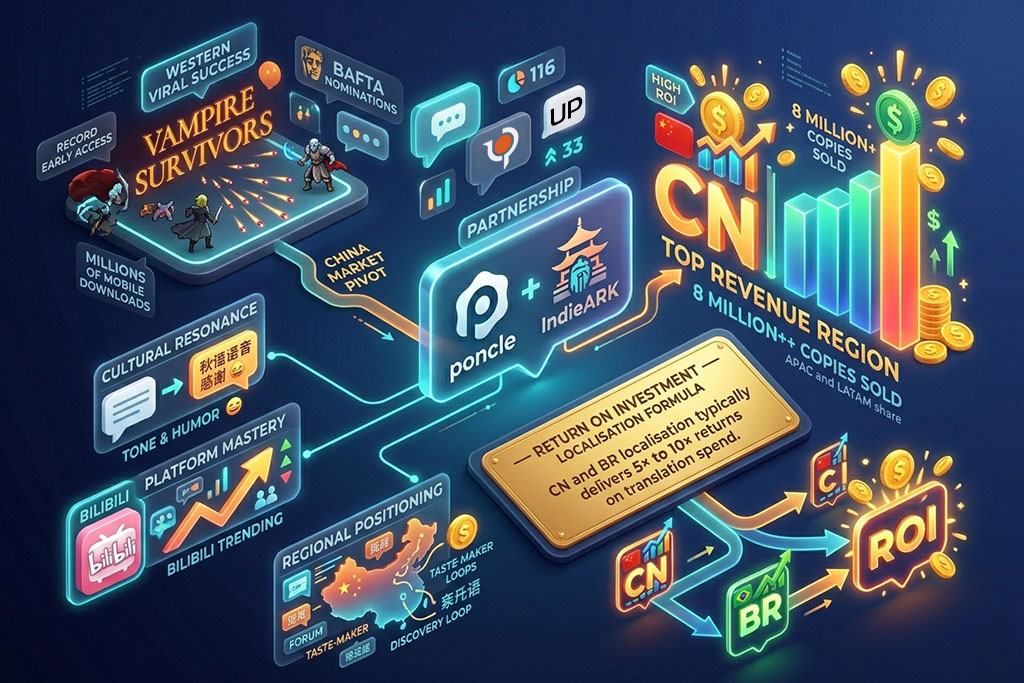
Luca Galante’s response was smart, not expensive. Instead of building an in-house international team, which would have been impractical even for a successful solo studio, poncle partnered with IndieARK, a publisher specialising in bringing Western indie titles to the Chinese market. What IndieARK provided went far beyond straightforward translation:

  • Cultural resonance: they localised the tone, humour and in-game flavour text, the subtle elements that make a game feel native rather than simply translated.
  • Platform expertise: they supported the cultural marketing engine needed to gain traction on Bilibili, China’s leading video and streaming platform, somewhat comparable to being picked up by a major Twitch creator, but more algorithmic and community-driven.
  • Regional positioning: they handled the framing and presentation needed for the Chinese indie gaming community, which has its own tastemakers, forums and discovery loops, separate from Steam’s Western-facing ecosystem.
Case Study: The "IndieARK" Pivot for Vampire Survivors - 1Stop Tranlsations
The “Vampire Survivors” Localisation Formula: proof that cultural resonance equals revenue. Through strategic partnerships and platform-specific marketing, this indie hit unlocked the massive potential of the Chinese and LATAM markets.

The result was not a modest uplift. Following the formal Simplified Chinese localisation and regional marketing push, China became one of Vampire Survivors’ top revenue-generating regions.

By 2025, the game had surpassed 8 million copies sold on Steam, with APAC and LATAM markets contributing a meaningful share of its long-tail revenue, the kind of sustained income that helps keep a studio solvent between projects.

This pattern can be seen across the indie market. The creator of Dave the Diver has spoken publicly about the importance of target video game localisation in the title’s success.

ROI (Return On Investment – Localisation Formula

ROI=(Regional Revenue GrowthLocalisation Cost)Localisation Cost×100ROI = \frac{(\text{Regional Revenue Growth} – \text{Localisation Cost})}{\text{Localisation Cost}} \times 100

For successful indie titles with strong gameplay loops, CN and BR localisation can typically deliver returns of 5x to 10x on translation spend.

Why This Video Game Localisation Model Works for a First Launch

The most common objection indie developers raise against the EFIGS + BR/CN model is budget, though it is often framed as a strategic concern.

Indie agility is the advantage here, not the limitation. A three-person studio does not need to replicate a AAA localisation pipeline. It needs to make one or two high-impact language decisions early, ideally before the wishlist campaign and certainly before the store page goes live.

Prioritising Simplified Chinese and Brazilian Portuguese over French or Italian is not necessarily a bigger project. In many cases, it is the same budget, simply allocated more effectively.

This is also where the right strategic partner becomes decisive. In markets such as mainland China, blind translation, dropping string files into a localisation tool and calling the job done, does not unlock the market.

The Chinese indie gaming audience is discerning, taste-driven and highly networked through platforms such as Bilibili, Douyin and specialist community forums, each with its own discovery logic.

Why This Video Game Localisation Model Works for a First Launch - 1Stop Translations
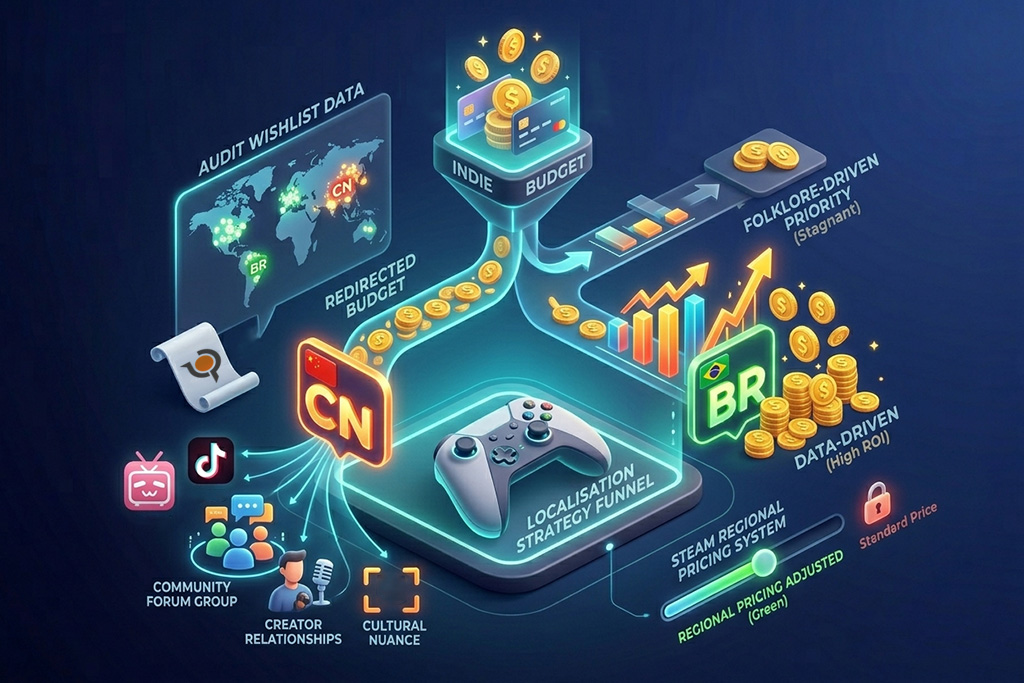
Success for a “first launch” isn’t about having a AAA budget, it’s about indie agility. This model illustrates the shift from folklore-driven priorities to a data-driven approach, redirecting investment towards high-ROI markets like China and Brazil.

Reaching that audience requires a partner with real local presence: relationships with Chinese content creators, an understanding of the framing that resonates with the community, and experience navigating the cultural nuances that shape player response.

The third level behind the EFIGS + BR/CN model is Steam’s regional pricing system. Localising into Brazilian Portuguese and Simplified Chinese without adjusting your Steam pricing for those regions is like unlocking a door and then putting a barrier in front of it.

For an indie developer launching a first or second title, the practical framework is straightforward: audit your current wishlist data by region before finalising your video game localisation budget.

The EFIGS + BR/CN model provides a framework for making that decision based on evidence rather than industry folklore.

Final Thoughts: Data Over Tradition

Video game localisation is no longer an optional extra bolted on to a finished game. In 2026, it is a core go-to-market strategy for any indie developer with global ambitions.

As the journeys of Vampire Survivors and Dave the Diver suggest, the difference between a cult success and a multi-million-copy hit is rarely just the game itself. More often, it comes down to which markets you choose to enter, when you enter them, and how much cultural investment you make.

The action point is simple: open your Steam developer dashboard and review your wishlist data by region. Identify the language you are currently neglecting, the one linked to a meaningful cluster of wishlists but no localisation support. That gap may be your next highest-ROI investment.

If you need a partner to close it, that is exactly what 1Stop Translations is here to do: bring the video game sector expertise needed to make localisation count, rather than simply exist.

Ready to audit your localisation strategy?

Talk to our video game localisation specialists. We will help you identify which languages, BR, CN or beyond, offer the highest ROI for your specific title and genre.


Need a quote? Click here
Get a Free and Fast Quote for Your Project, Crypto Payments accepted. Click Here!