DEI Translations: Making Digital Content Inclusive Across Languages
As a result, video game localisation emerges as a key tool in creating a feeling among all gamers that they have been acknowledged and accepted, irrespective of their physical, gender and cultural differences.
9 minutes – read
Integrating DEI translations (Diversity, Equity, and Inclusion) is no longer a peripheral “nice-to-have” and no longer seems to be a corporate buzzword.
With over 3 billion people playing games globally, an important demographic needs special features for accessibility to effectively participate in digitally constructed worlds.
For the Localisation Manager and the Localisation Leads, the challenge lies in embedding inclusivity at the very core of the localisation pipeline.
This article acts as a comprehensive guide to help you navigate the intricacies of inclusive content translation, and ensures your titles are not just translated, but accessible as well.
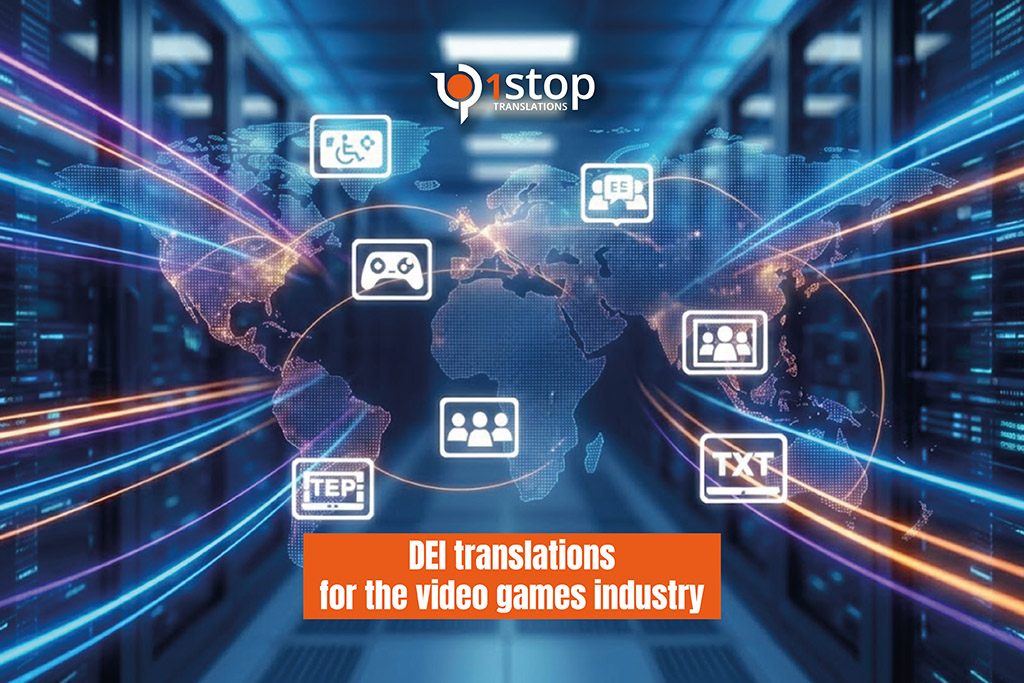
Why does Accessibility and DEI Matter in Video Game Localisation?
The drive towards inclusive gaming stems from a powerful combination of ethical arguments and market realities. From a business perspective, the “purple dollar” (the financial expenditure of people with disabilities) represents a significant market opportunity that is often under-served.
Additionally, where the title emphasises the need for accessibility localisation in games, it opens the doors for millions of players who might not otherwise be included. Moreover, by focusing on ensuring there is diversity, equity and inclusion, there will be an improved brand reputation and therefore a loyal following.
Regulatory Pressure and Industry Standards
Additionally, apart from the ethical considerations, there are increasing regulatory and platform-based influences. A case in point is legislative developments such as the European Accessibility Act and the CVAA in the United States.
Even the leading platforms, such as Xbox and PlayStation, have introduced strict guidelines on accessibility, which must be adhered to by game developers to attain featured status. The leading industry associations, such as the IGDA (International Game Developers Association), are now treating inclusive localisation as a competitive prerequisite and not as a bonus feature.
Defining Accessibility in the Gaming Context
On a practical level, accessibility in localisation will involve a number of key elements which need to be addressed in the actual translation process, including:
- Subtitles & Captioning: This goes beyond dialogue. It includes SDH (Subtitles for the Deaf and Hard of Hearing), which takes into consideration timing, readability, and localisation of idioms without direct equivalents.
- Audio Descriptions (AD): The audio description of cinematic cutscenes and the narrated UX for visually impaired players requires a script that is both descriptive and fits within the scene pacing.
- UI/UX Text Localisation: Also, the facilitation of user interfaces to be screen-reader friendly, with text legible on screen even when their size or contrast is adjusted.
- Input Remapping & Tutorials: Localised descriptions for control remapping and help menus are necessary for players that use adaptive controllers.
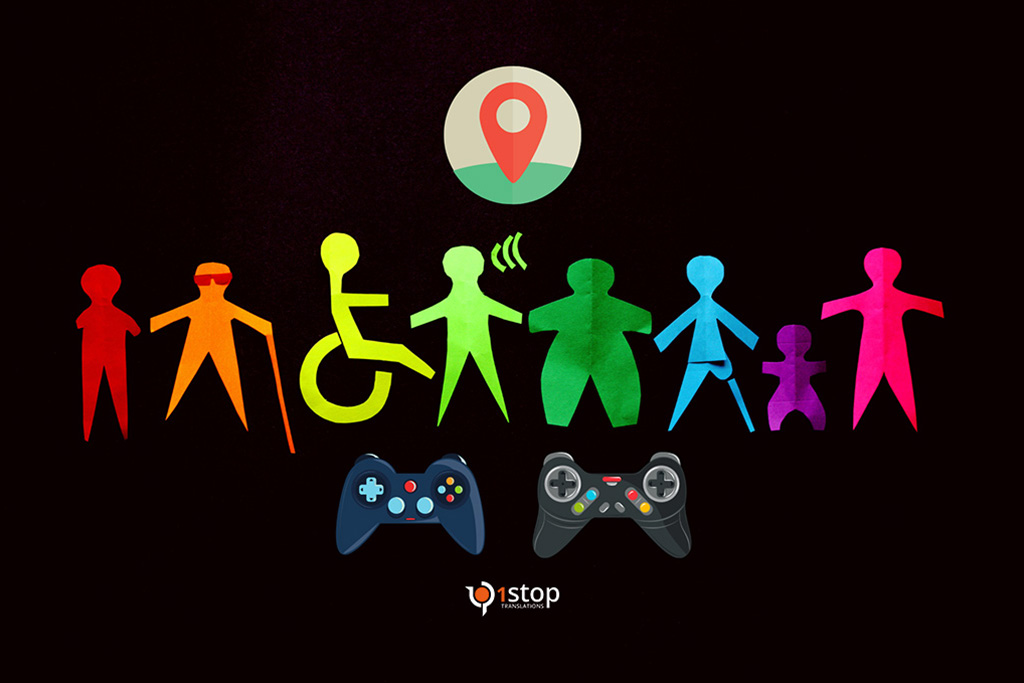
DEI Translations versus Traditional TEP
While the standard TEP (Translate, Edit, Proof) process focuses on linguistic accuracy, DEI translations add a layer of cultural and social sensitivity. This includes:
- Cultural sensitivity reviews: A way to identify potential tropes or offensive imagery, which can vary across different regions.
- Inclusive Language Glossaries: Providing living, breathing documents that define how to handle non-binary pronouns or sensitive terminology.
- Lived-Experience Input: This would involve testing by native speakers who have disabilities that are native to the region in which the software is to be distributed, providing valuable feedback on the accuracy and functionality of the localised experience.
The multi-disciplinary approach reduces rework, preserves player voice, and prevents costly post-launch remediation.
Resources on the intersection of localisation and accessibility from academic and industry perspectives include Videogame Localisation and Accessibility: Fun for All review that explores user-centred methods.
Adapting Content: From Inclusive Scripts to Accessible UI
Execution is strategy meeting reality. To provide premium gaming translation services, a provider must understand the technical nuances of how content is used. This is where inclusive content translation moves from theory to technical implementation.
Visual and Audio Rendering
Adapting SDH from subtitles is a specialised skill. SDH differs from standard subtitles because it’s there to make sure to convey the atmosphere with non-speech information such as the creaking of a door, an ominous swell of music, or muffled shouting. Export burnable captions and separate timed files: SRT/ TTML to pipelines.
1Stop Translations underlines that all these cues need to be localised: a “thud” in English can have quite a different feel and dimension when translated into Japanese or Brazilian Portuguese, for example. Similarly, Audio Descriptions (AD) have to be crafted so the proper narrative “beats” are heard without conflicting with important dialogue.
Linguistic Nuance and Gender Neutrality
One of the biggest challenges encountered with regard to grammatical gender in any game within the category of DEI video games is that, in a language like Spanish, French, or Polish, the verb and adjective agree with subject gender.
To address the variety of player brands that the games might have within localisation, it is necessary to think creatively about linguistic solutions that ensure dialogue appears neutral with respect to gender without compromising the normal flow of conversation.
Localisers should use inclusive language glossaries and raise awareness for locales where neutral language is not available, including proposing UI changes and/or alternatives for micro-copy. This level of nuance is what differentiates between an inclusive translation and just another generic translation.
User Interface (UI) Challenges
The technical implications of game localisation can conflict with the needs of accessibility. For instance, if a “dyslexia-friendly font” is used or “high-contrast mode” is enabled, more screen space is often required. An increase of 30% or more in English text can result from using European languages like German or Italian.
Expert video game localisation services help avoid this by planning the expansion of texts during the design stage through the effective use of “string wrapping,” ensuring that the texts are easily readable on all screens ranging from smartphone screens to 4K screens.
Mobile versus Console differences: The mobile version requires larger touch targets, as well as integrating captions and accommodating system-level screen readers. The experience may include game narration or controller remapping in the console version.
Best Practices for Implementation of DEI Translations in Video Games
A scalable localisation partner must also represent process depth in terms of language support, accessibility knowledge, and in-country testing support. We already publish advice on video game workflows.
Pre-production Checklist
The following should be passed to your localisation team before translating the first string:
- Source files with contextual details: Consider including screenshots and videos showing the UI in action.
- Timecodes: This feature is vital to ensure proper synchronisation with subtitle and audio description cues.
- Accessibility requirements: If appropriate, reference specific accessibility standards such as the WCAG (Web Content Accessibility Guidelines). Include information such as character limitations or right-to-left flags.
Localisation deliverables to request from vendors
- Localised subtitles + Burnable Captions, each one having its own SRT/TTML file.
- Audio description scripts and VO source-ready.
- Localised UI strings with context notes, as well as accessibility-related tags such as “screen reader label” or “short label”
- Inclusive Language Glossary and DEI notes per locale.
- Accessibility QA report with remediation recommendations and priority fixes.
Testing Checklist
- In-game LQA with full builds (timing, overlap, truncation).
- Assistive tech testing: screen readers on supported platforms, caption rendering, controller remap curves.
- In-country user tests, including gamers with disabilities (lived experience feedback rather than QA).
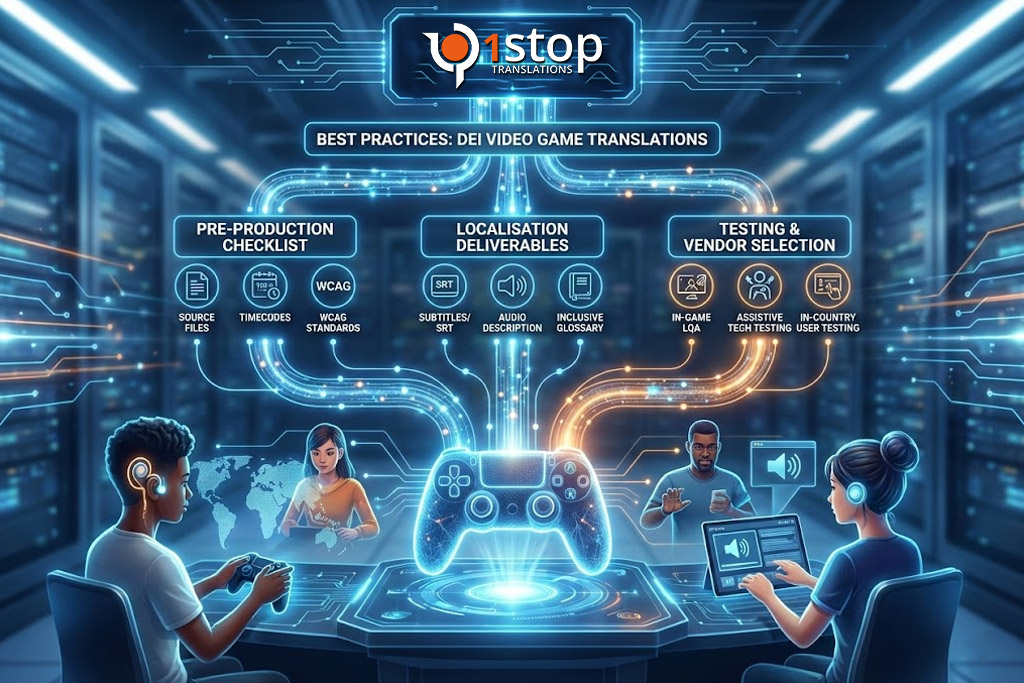
Testing and Vendor Selection
The final bridge to inclusivity is testing. This comprises:
- Assistive Tech Testing: Testing how the screen reader interacts with localised strings on mobile and console.
- In-Country User Testing: Playing with people with disabilities within the target country.
When choosing a vendor, ask about their particular experience with regards to video game localisation. Request case studies to prove their management of accessibility projects and ask about their ISO qualifications.
A partner with extensive experience across multiple industries as well as specialisations in console and mobile game development, as seen with 1Stop Translations, would be best suited to satisfy the transparency and technical expertise now demanded with DEI projects of this calibre.
Quick wins vs. long-term strategies
- Quick wins: accurate SDH subtitles, clear UI labels, enabling subtitles before the first cinematic, and captioning toggleability.
- Long-term: Integrated AD tracks, UX redesigns for persistent accessibility (responsive UIs, native screen narration), ongoing in-country DEI review panels.
Micro-copy and Phrasing Examples
Inclusive wording means thinking differently. For instance, instead of the literal translation of “Master / Slave”, like in some older technology, it is better to think in terms of “Primary / Secondary”. Instead of posing the question, “Are you a boy or a girl?”, one should think, “Choose your appearance.”
The reality is, keeping the player’s voice consistent and respectful, no matter which of over 100 languages we’re talking about, is what helps build a global community.
Conclusion: Inclusivity as a Partnership
True inclusivity in the digital age demands more than just a vendor, it demands a strategic partner who understands that video game translations is an act of empathy as much as it is an act of technology.
By incorporating DEI translations into your pipeline, not only are you satisfying a checklist, but you’re making sure your game is an inclusive space for all your players, no matter where they are or how they interact with the world.
We at 1Stop Translations leverage the latest technologies and linguistic expertise to successfully overcome the challenges of modern localisation. This is whether you’re launching an indie mobile title or a global AAA video-game blockbuster.
Ready to take your content to the next level of inclusivity? Contact us to find out how our teams of experts can take your next project to the next level of excellence with our top-notch DEI localisation services.
Need a quote? Click here