
The ROI of “EFIGS + BR/CN” in Video Game Localisation Services
Launching an indie game in English only in 2026 is no longer a bold creative choice; it is a commercial misstep. We have officially entered the era of the end of “English-only” by default.
8-minutes read
Valve confirmed at GDC 2025 that Simplified Chinese had surpassed English as the most-used primary language on the platform. That was not a Chinese New Year spike. It was the new normal.
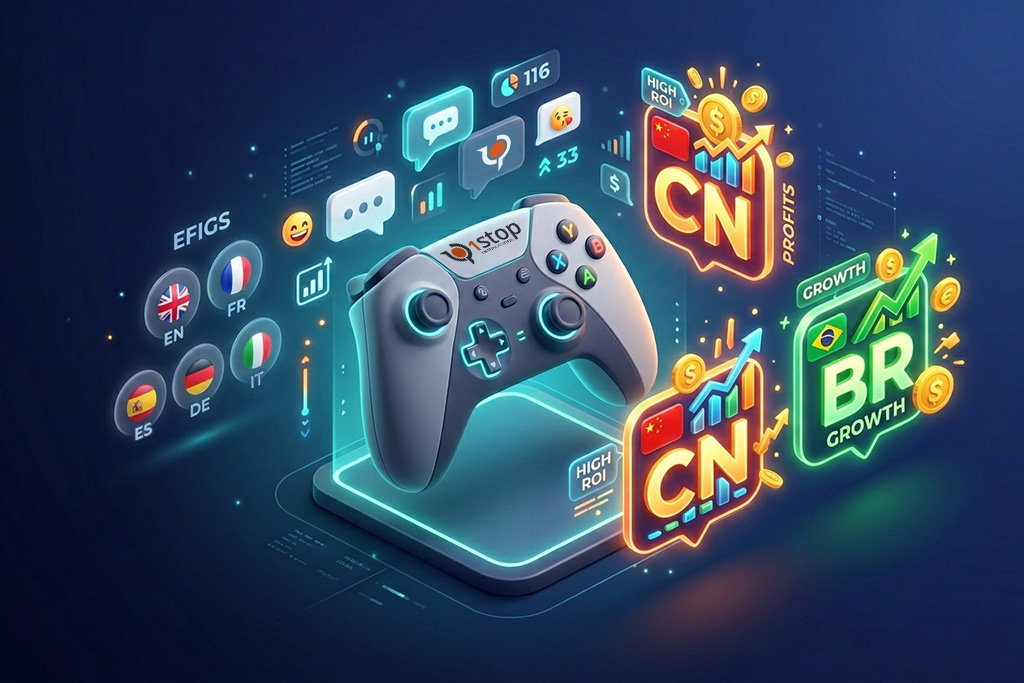
For two decades, the industry defaulted to EFIGS (English, French, Italian, German and Spanish) as its global distribution shortlist. It made sense in 2005, and it made less sense in 2015. In 2026, it is actively costing developers money.
The updated gold standard for any indie developer with global ambitions is EFIGS + BR/CN: adding Brazilian Portuguese and Simplified Chinese to the mix. Better still, for studios with tighter budgets, a CN-first or BR-first strategy can outperform the full EFIGS slate on pure return.
Here is the core hypothesis: localisation is not a sunk cost. It is a revenue multiplier that unlocks the roughly 60% of Steam’s player base that English alone cannot reach. The maths is clear, and the case studies are compelling. Let’s look at both.
The Data Reality Check: Steam Market Share (2025–2026)
To understand why the EFIGS + BR/CN model is superior, we have to look at the math. The traditional obsession with Western Europe often leads developers to over-invest in regions that are stagnant, while ignoring where the actual players are.
According to the Steam Hardware & Software Survey (February 2026), language distribution has reached a tipping point. Here is the data:
| Language | Est. Steam Share (2025–2026) | Trend vs. 2023 | EFIGS Inclusion |
|---|---|---|---|
| Simplified Chinese | ~33–34% | ↑ Massive growth | No (add to EFIGS) |
| English | ~33% | → Stable | Yes (baseline) |
| Russian | ~8–9% | → Stable | No |
| Spanish | ~4–5% | ↓ Slight decline | Yes (part of EFIGS) |
| Brazilian Portuguese | ~3–4% | ↑ Strong growth | No (add to EFIGS) |
| German | ~2–3% | → Flat | Yes (part of EFIGS) |
| French | ~2% | ↓ Declining | Yes (part of EFIGS) |
| Italian | ~0.6% | ↓ Declining | Yes (part of EFIGS) |
This is what we call the Italian Paradox. Italian has been a cornerstone of EFIGS since the early CD-ROM era. By modern Steam metrics, however, it is one of the lowest-ROI localisation languages on the platform. At approximately 0.6% market share and in decline, developers are spending real money to reach a shrinking audience.
“If you are allocating 15% of your localisation budget to Italian (roughly 0.6% of Steam’s user base) while ignoring Brazilian Portuguese (roughly 3–4%), you are not missing a ‘secondary’ market, you are mathematically choosing a lower return on investment.”– Antonio Cesari, CEO, 1Stop Translations
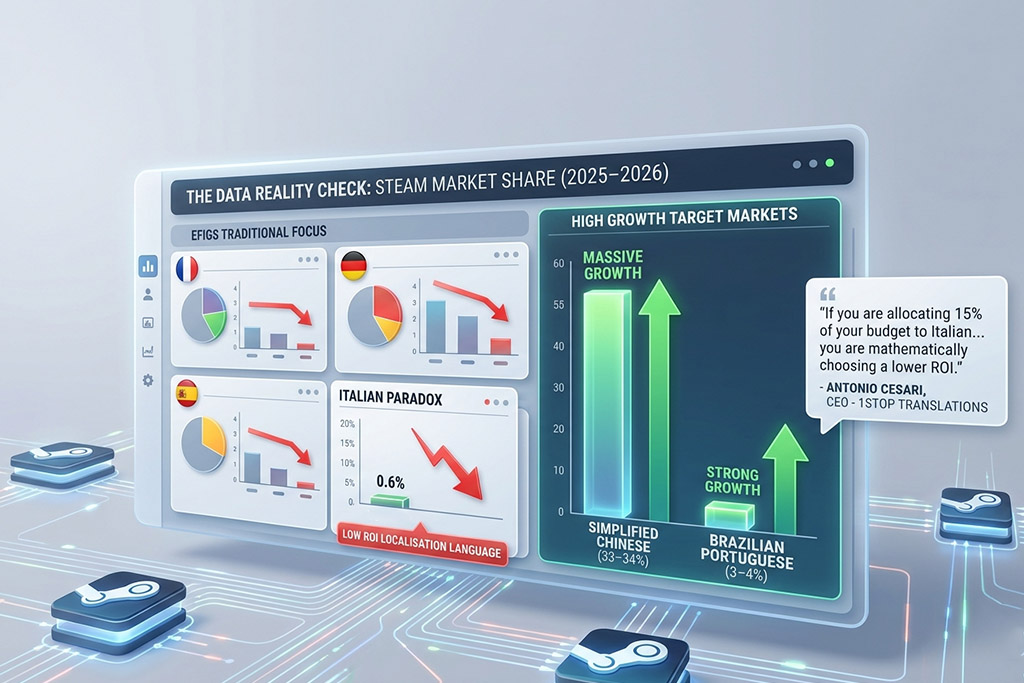
The data suggests that any indie developer asking, Which languages should I localise my indie game into first? should start with this table, and then do the uncomfortable but necessary work of challenging assumptions inherited from larger studios with very different cost structures.
Case Study: The “IndieARK” Pivot for Vampire Survivors
Theory is useful. Proof is better. Few case studies in recent indie history illustrate the cost of a localisation barrier, and the value of breaking through it, more clearly than Vampire Survivors.
When Vampire Survivors went viral in the West, it looked as though the story had already been written: a game built almost entirely by one person, sold for under £3, achieved record-breaking Early Access numbers, earned BAFTA nominations, and launched a mobile port with millions of downloads. It had already crossed milestones most solo developers can only dream of.
But mainland China presented a different picture. Despite the scale of the potential audience, the game struggled to build deeper cultural traction there. The reasons were not related to gameplay; the bullet-heaven formula travels well. The problem lay in everything surrounding the game: the language, the cultural framing, and the lack of a strategy for the platforms where Chinese players actually discover new titles.
Luca Galante’s response was smart, not expensive. Instead of building an in-house international team, which would have been impractical even for a successful solo studio, poncle partnered with IndieARK, a publisher specialising in bringing Western indie titles to the Chinese market. What IndieARK provided went far beyond straightforward translation:
- Cultural resonance: they localised the tone, humour and in-game flavour text, the subtle elements that make a game feel native rather than simply translated.
- Platform expertise: they supported the cultural marketing engine needed to gain traction on Bilibili, China’s leading video and streaming platform, somewhat comparable to being picked up by a major Twitch creator, but more algorithmic and community-driven.
- Regional positioning: they handled the framing and presentation needed for the Chinese indie gaming community, which has its own tastemakers, forums and discovery loops, separate from Steam’s Western-facing ecosystem.
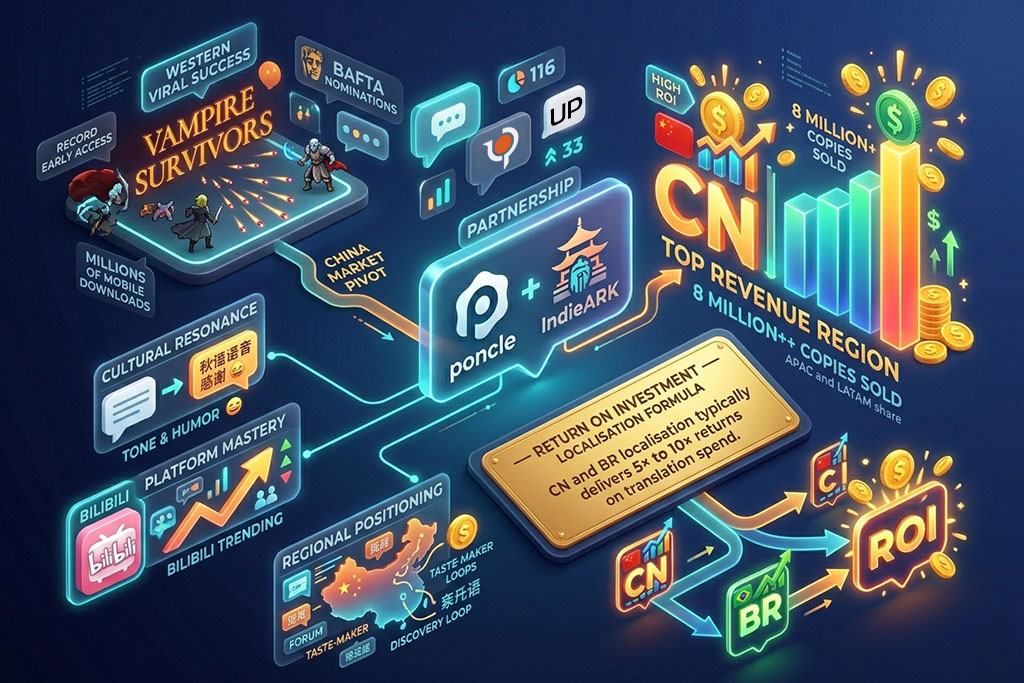
The result was not a modest uplift. Following the formal Simplified Chinese localisation and regional marketing push, China became one of Vampire Survivors’ top revenue-generating regions.
By 2025, the game had surpassed 8 million copies sold on Steam, with APAC and LATAM markets contributing a meaningful share of its long-tail revenue, the kind of sustained income that helps keep a studio solvent between projects.
This pattern can be seen across the indie market. The creator of Dave the Diver has spoken publicly about the importance of target video game localisation in the title’s success.
ROI (Return On Investment – Localisation Formula
For successful indie titles with strong gameplay loops, CN and BR localisation can typically deliver returns of 5x to 10x on translation spend.
Why This Video Game Localisation Model Works for a First Launch
The most common objection indie developers raise against the EFIGS + BR/CN model is budget, though it is often framed as a strategic concern.
Indie agility is the advantage here, not the limitation. A three-person studio does not need to replicate a AAA localisation pipeline. It needs to make one or two high-impact language decisions early, ideally before the wishlist campaign and certainly before the store page goes live.
Prioritising Simplified Chinese and Brazilian Portuguese over French or Italian is not necessarily a bigger project. In many cases, it is the same budget, simply allocated more effectively.
This is also where the right strategic partner becomes decisive. In markets such as mainland China, blind translation, dropping string files into a localisation tool and calling the job done, does not unlock the market.
The Chinese indie gaming audience is discerning, taste-driven and highly networked through platforms such as Bilibili, Douyin and specialist community forums, each with its own discovery logic.
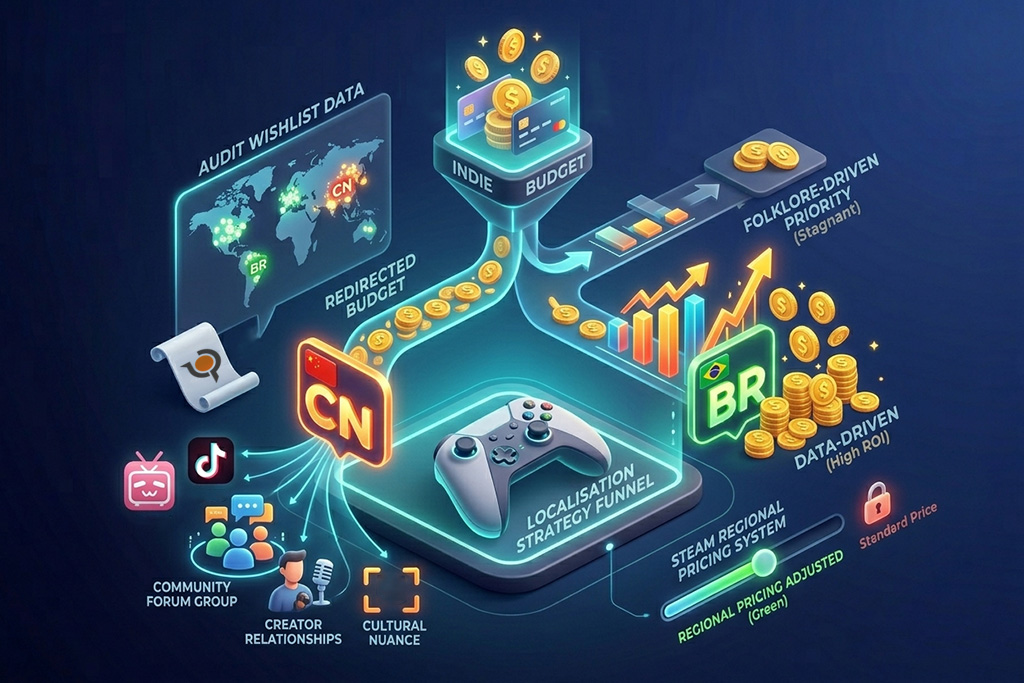
Reaching that audience requires a partner with real local presence: relationships with Chinese content creators, an understanding of the framing that resonates with the community, and experience navigating the cultural nuances that shape player response.
The third level behind the EFIGS + BR/CN model is Steam’s regional pricing system. Localising into Brazilian Portuguese and Simplified Chinese without adjusting your Steam pricing for those regions is like unlocking a door and then putting a barrier in front of it.
For an indie developer launching a first or second title, the practical framework is straightforward: audit your current wishlist data by region before finalising your video game localisation budget.
The EFIGS + BR/CN model provides a framework for making that decision based on evidence rather than industry folklore.
Final Thoughts: Data Over Tradition
Video game localisation is no longer an optional extra bolted on to a finished game. In 2026, it is a core go-to-market strategy for any indie developer with global ambitions.
As the journeys of Vampire Survivors and Dave the Diver suggest, the difference between a cult success and a multi-million-copy hit is rarely just the game itself. More often, it comes down to which markets you choose to enter, when you enter them, and how much cultural investment you make.
The action point is simple: open your Steam developer dashboard and review your wishlist data by region. Identify the language you are currently neglecting, the one linked to a meaningful cluster of wishlists but no localisation support. That gap may be your next highest-ROI investment.
If you need a partner to close it, that is exactly what 1Stop Translations is here to do: bring the video game sector expertise needed to make localisation count, rather than simply exist.
Ready to audit your localisation strategy?
Talk to our video game localisation specialists. We will help you identify which languages, BR, CN or beyond, offer the highest ROI for your specific title and genre.
Need a quote? Click here