Tag: regulations

Estonia marks a turning point in iGaming regulations - 1Stop Translations

Estonia marks a turning point in iGaming regulations

Estonia is a European country that has developed a structured approach to the iGaming sector. Since 2010, the country has implemented a regulatory framework that allows both domestic and foreign operators to offer online gaming and sports betting services to Estonian customers.

4 minutes – read

The iGaming regulations in Estonia are designed to ensure fair competition, consumer protection, and responsible gaming, while also generating revenue for the state.

Estonia’s regulatory framework combines a comparatively low tax rate with an established digital infrastructure, factors that are relevant to operators evaluating new markets, alongside broader considerations such as licensing requirements and compliance obligations.
Estonia marks a turning point in iGaming regulations - 1Stop Translations

A look at the Estonian iGaming industry

The iGaming industry in Estonia has grown steadily over the years, reflecting the increasing demand for, and supply of, online gaming and sports betting products. According to Statista, revenue from online gambling reached USD 190.62 million in 2023, up from USD 134.40 million in 2020. This growth was led by online lotteries, followed by online casinos.

Several factors underpin this trend. One is the shift towards mobile platforms: the widespread use of smartphones and tablets has led to a growing number of users accessing gambling services via mobile applications or websites optimised for mobile use.

A look at the Estonian iGaming industry - 1Stop Translations
The iGaming industry in Estonia reached USD 190.62 million in 2023.

This shift is expected to continue as mobile technology develops further. In parallel, live dealer formats have expanded, using real-time streaming technology to enable interaction between dealers and participants during play. Advancements in live-streaming technology have contributed to the technical quality of these formats.

Estonia’s extensive internet coverage also means that a significant proportion of residents have access to online services, which has supported the expansion of the domestic online betting market.

iGaming regulations and tax structure

Another factor relevant to the sector’s development in Estonia is its legislative framework. The iGaming regulations in Estonia are based on two main acts: the Gambling Act and the Gambling Tax Act.

The Gambling Act defines the types of gambling activities, licensing requirements, supervision and control mechanisms, and sanctions for violations. The Gambling Tax Act sets the tax rates and the allocation of tax revenue.

iGaming operators in Estonia are subject to a 5 per cent tax on net income, one of the lower rates in Europe. Tax revenue is allocated to social and cultural causes, including sport, education, health, and youth programmes.

Following a planned 1 per cent increase in 2024, Estonia’s tax rate remains comparatively low relative to other European jurisdictions, where rates can reach 25 per cent or more. Estonia’s regulatory environment is also shaped by its economic and political stability, its digital infrastructure, and its responsible gaming framework.

Estonia is considered one of the more digitally advanced societies in Europe, with widespread high-speed internet access, e-government services, and an e-residency programme. As an EU and Eurozone member state, it operates within a framework that provides legal certainty and market access.

Estonia has also adopted measures to address problem gambling, including self-exclusion lists, age verification, player protection tools, and awareness campaigns.

Regulatory considerations for market entry

Given the structure of the iGaming industry in Estonia, businesses evaluating expansion into this market need to account for its specific regulatory and linguistic requirements. This is where 1Stop Translations supports operators.

How to take advantage of the growing Estonian iGaming business - 1Stop Translations
Estonia’s iGaming market, examined through a regulatory and communication lens.

1Stop Translations provides iGaming translations, professional translations, and iGaming marketing strategy support for sports betting sites, iGaming platforms, and online casinos.

Our team of native-speaking linguists and subject-matter experts supports the localisation of content for the Estonian market, as well as website, app, and platform optimisation from a user-experience and technical perspective.

For businesses assessing iGaming translations, copywriting, content marketing, SEO, or broader marketing strategy support in relation to the Estonian market, our team is available to discuss requirements. Contact us to find out more.

Disclaimer: This article is provided exclusively for informational, educational, and B2B analytical purposes. It does not constitute legal advice, corporate marketing inducement, commercial solicitation, or an endorsement of gambling activities. All insights are directed strictly at industry professionals examining global regulatory frameworks.


Need a quote? Click here
New regulations for Curacao gaming licence - 1Stop Translations

New regulations for Curacao gaming licence

Curaçao’s emergence as a pivotal hub in the iGaming industry is underscored by its widely recognised Curacao iGaming licence. This small Caribbean island has rapidly become a benchmark for obtaining a gaming licence, offering a blend of regulatory flexibility and business-friendly policies that appeal to operators worldwide.

4 minutes – read

As a result, the Curacao gaming licence has gained prominence, attracting a plethora of iGaming businesses seeking to establish credibility and access international markets.

With recent regulatory changes aimed at enhancing security and transparency, Curacao continues to shape the global iGaming landscape, reinforcing its position as a leading licencing authority.

New regulations for Curacao gaming licence - 1Stop Translations

The evolution of Curacao in the iGaming industry

On 1 September 2023, Curacao approved transformative changes to its gaming legislation, which took effect in November. These changes mark a significant departure from the previous iGaming regulations and gambling law, which were characterised by the issuance of master licences by the state and the subsequent granting of sub-licences by master licence holders.

The new system introduces an application process for new master licences directly from operators, aligning with existing legislation. This shift aims to centralise control and enhance the oversight of the iGaming sector within Curacao.


The evolution of Curacao in the iGaming industry - 1Stop Translations
On 1 September 2023, Curacao approved transformative changes to its gaming legislation

Here are the key changes and differences compared to the previous gambling regulations:

Types of licences

  • Old System – Previously, the Curacao licencing system was based on a master licence and sub-licence structure. A few master licence holders had the authority to grant sub-licences to other gaming operators
  • New System – The reform has eliminated the sub-licence model. Now, the Curacao Gaming Authority (CGA) directly issues a single type of licence to all operators, ensuring uniform standards across the board

Location of companies

  • Old System – Under the old regulations, there was no strict requirement for the physical presence of the company in Curacao
  • New System – The new regulations mandate that companies applying for a Curacao iGaming licence must have a genuine presence in Curacao, which includes having local management and meeting economic substance requirements

Regulatory oversight

  • Old System – The oversight was relatively decentralised, with master licence holders responsible for regulating their sub-licencees
  • New System – The CGA now has centralised control and is the sole regulatory body responsible for oversight, compliance checks, and enforcement of regulations

Player protection and anti-money laundering (AML)

  • Old System – There were fewer stringent measures in place for player protection and AML
  • New System – The new regulations have introduced enhanced player protection policies and stricter AML procedures to align with international standards

Transparency and Fairness

  • Old System – The level of transparency and fairness was not as rigorously enforced
  • New System – The CGA is focused on ensuring that all licenced operators adhere to high standards of transparency and fairness in their gaming operations

What’s new in Curacao gaming licence?

What's new in Curaçao gaming licence? - 1Stop Translations
Embracing change: Curacao’s iGaming reform promises enhanced safety, security, and transparency

The motivations behind the reform of Curacao’s iGaming sector are centred around enhancing the safety, security, and transparency of online gaming.

Consumer protection

The reforms aim to protect consumers by ensuring that operators provide a safe gaming environment. This includes measures to prevent problem gambling and protect vulnerable players.

Greater security

By establishing a robust regulatory framework, the reforms seek to secure the industry against fraudulent activities and cyber threats. The new iGaming regulations also emphasise the importance of protecting player data and ensuring the confidentiality of sensitive information.

Increased transparency

The reforms are designed to increase financial transparency, making it easier to track transactions and prevent money laundering. Additionally, with direct licences, there is clear accountability for operators, who must comply with stringent iGaming regulations and reporting requirements.

Alignment with international standards

The changes are motivated by the desire to align Curacao’s iGaming industry with international standards, enhancing its global reputation and trustworthiness. By raising the bar for regulatory compliance, Curaçao aims to attract more reputable operators and investors to its jurisdiction.

Economic benefits

The requirement for operators to have a local presence is expected to contribute to the local economy through job creation and infrastructure development.

The reasons for the iGaming reform in Curacao

The reasons for the iGaming reform in Curacao - 1Stop Translations
Curacao’s gaming reform elevates standards and promotes responsibility

Overall, the reform is a strategic move to position Curacao as a leading and respected jurisdiction in the global iGaming sector, ensuring that it remains competitive and continues to thrive in a rapidly evolving digital landscape. The amendments to Curacao’s gaming legislation reflect a global trend towards more stringent regulatory measures.

The new independent regulatory body, the Curacao Gaming Authority, replaces the Curacao Gaming Control Board, issuing both B2B and B2C licences. This overhaul addresses concerns about money laundering and aims to boost transparency and responsible gambling practices.

In conclusion, the iGaming sector’s evolution underscores the necessity of adapting to diverse global markets. Effective iGaming translations and localisation strategies are indispensable for marketing and iGaming services, ensuring that operators can engage with customers across different linguistic and cultural landscapes.

For help with this, contact 1Stop Translations. We specialise in the creation of multilingual content and iGaming translations dedicated to the iGaming industry that effectively increase engagement and help you reach a wider audience.


Need a quote? Click here

The new sports betting regulations shaking up Brazil’s iGaming sector - 1Stop Translations

The new sports betting regulations shaking up Brazil’s iGaming sector

When Brazil wrote a new set of sports betting regulations in 2018, this type of gambling was illegal under national law. In late July 2023, that changed, as President da Silva finally turned the bill into law.

4 minutes – read

The new sports betting regulations shaking up Brazil’s iGaming sector - 1Stop Translations

The decision came after a massive match-fixing scandal, in which players were offered up to 20,000 USD to give away penalty kicks and purposefully earn yellow cards. This scandal allowed gamblers to increase their wins on gaming sites. The new gambling regulations are designed to offer legal protection and prevent betting companies from profiting from match-fixing.

The 2018 legislation didn’t have comprehensive regulations, and much of the language used was unclear. This issue has been resolved. More importantly, the amendment now defines how fixed-odds income should be allocated.

Marketing and advertising restrictions

The new law requires gaming operators to encourage responsible gambling in Brazil and prevents bookmakers from acquiring the right to broadcast sports events. Sports betting translations will need to incorporate this requirement, as bookmakers scramble to promote healthier betting habits. The National Council for Advertising Self-Regulation will manage compliance. A self-regulation board will slowly establish gambling regulations governing the ethical standards of sports betting advertising.

The task force was created on 27 July 2023, but sports betting enterprises have already been barred from buying streaming rights for local sporting events. Existing legislation already forbids gambling advertising to promote illegal activities, but the definitions for “responsible gaming habits” have yet to be created. Unlicenced gaming ads will likely be banned in sports betting digital marketing, but it’s still too early for any certainty.

Marketing and advertising restrictions - 1Stop Translations
The new law requires gaming operators to encourage responsible gambling in Brazil

International operators have already started rolling out adverts and sponsorships despite their lack of licences. This has occurred despite the fact that Brazil has already banned businesses from sponsoring teams, competitions, and sporting bodies unless they have established headquarters in Brazil.

Brazil’s sports betting law and taxes

Federal Law No. 13,756/2018 will, for the first time in Brazilian history, allow fixed-odds betting so that bookmakers can share the odds of sporting outcomes. This provisional action will also make gambling a taxable matter. Bookmakers will be required to pay a 18% tax on all Gross Gaming Revenues. The Ministry of Sports’ revenue will increase from 1% to 3%. Licencing costs will also rise exponentially from the previous amount of 22 million R$.

In the past, Brazil’s sports betting regulations have provided few resources to manage a healthy gambling space. Sports betting taxes will fix the problem and will be managed as follows:

  • 2.5% will go to the National Fund for Public Security
  • Sports clubs will receive 1.6%
  • 10% will be funnelled into social security
  • 1% will go to the Ministry of Sports
  • The last 0.8% will be spent on sport initiatives
Brazil’s sports betting law and taxes - 1Stop Translations
Federal Law No. 13,756/2018 will allow fixed-odds betting in Brazil

The gambling regulations will also prevent bookmakers’ staff, athletes, and other influential parties from betting. The Ministry of Finance will oversee sports betting regulations, licencing, and advertising.

A true revolution for the LATAM gambling sector

The new taxation is expected to raise 423 million USD for the Brazilian iGaming sector, but it remains a provisional measure. The government will need to renew it after 60 days. However, the taxes will raise enough funds to punish match-fixing.

Gambling has never been this safe or controlled. The legalisation of fixed-odds sports betting is a game-changer for both sport fans and betting houses. Its revenue potential has been unleashed, and it’s sure to drive massive economic growth.

A true revolution for the LATAM gambling sector - 1Stop Translations
The new taxation is expected to raise 423 million USD for the Brazilian iGaming sector

Sports betting houses are still expecting a more transparent, comprehensive set of laws, which will guide sportsbook translations and marketing material.

Expanding your opportunities

If you offer sports betting services, you’re probably coming to grips with what the new legislation means for your business. You just need to look at the USA to get your answer. Within a year of sports betting legalisation, gaming revenue increased to 41 billion USD. Casinos could expand while unethical, poorly-managed gambling houses went out of business. Competition heated up, and access to gaming grew. Some casinos won, and some lost this challenge. If you offer gambling in Brazil, you’ll have to choose your outcome.

As the government issues licences for offline and online gambling, you will, at last, be able to capture foreign revenue. The sports betting market is expected to rise to 44 billion USD. This sector is experiencing an annual growth rate of almost 10%. Diversifying your audience will build stability and push up profits, so this is the time to update your site and sportsbook translations.

A massive growth spurt is on the way. Brazil’s sports betting market is expected to have an annual growth rate of 33.60%. By 2027, it will reach 2.1 million users. Improved regulations might even give local brands a competitive advantage against offshore operators. The government hasn’t brought action against those operators in the past, but burgeoning taxation could give it the funds to do so.

The laws that govern gambling in Brazil might have been updated, but they’re still incipient. As the months go by, legislation will be tightened and amended. Even so, 2023 is a crucial year for casinos. With a market that just became wide open, sports bookers can finally race ahead.

If you’re ready to benefit from the upcoming revolution, contact us to discuss your content needs.


Do you need help to get started or to further your existing link building strategy? Contact us for a free advice or request a video call with our experts.


Need a quote? Click here

Top 3 online gambling licenses you didn't know - 1Stop Translations

Top 3 online gambling licenses you didn’t know

Securing the right iGaming licence is one of the first regulatory steps for any operator entering the online gambling sector. This overview compares three licensing jurisdictions and their respective requirements.

5 minutes – read

Top 3 online gambling licenses you didn't know - 1Stop Translations

The most established licence in the industry is the Curacao licence, known for its broad international reach and comparatively modest requirements. The licensing landscape includes several other jurisdictions, each with distinct characteristics. Selecting the most suitable option requires careful assessment against specific business objectives.

Having multiple licensing options provides operators with flexibility when structuring their compliance strategy. Different jurisdictions vary in processing times, costs, tax treatment and legal protections, allowing businesses to select a licence aligned with their operational needs, target markets and financial planning.

A choice of licences also allows businesses to adapt as regulatory frameworks and market conditions change across regions.

Fastest and easiest iGaming license: Anjouan

Fastest and easiest iGaming license: Anjouan - 1Stop Translations
Anjouan is generally associated with shorter processing times and lower administrative requirements compared with other jurisdictions.

The Anjouan licence is part of the Union of Comoros, a small African nation, and has been issued since 2005. Its main characteristics include:

  • Processing time: Typically 2–3 weeks, faster than in many other jurisdictions.
  • Administrative requirements: Fewer formalities and reduced documentation compared with other licensing bodies.
  • Cost: Application and maintenance costs are comparatively low.

It should be noted that Anjouan carries less international recognition than other jurisdictions, which is a relevant factor for businesses assessing long-term market credibility.

Kahnawake: online gambling license with zero taxes

Based in the Canadian Mohawk territory, the Kahnawake Gaming Commission has issued licences since 1996 and applies a zero-tax policy on profits. Key characteristics include:

  • Tax treatment: No tax is levied on profits under a Kahnawake licence.
  • Recognition: Kahnawake is recognised by a number of jurisdictions internationally.
  • Regulatory framework: The territory maintains a defined set of gambling regulations covering operational standards and compliance requirements.
Kahnawake: online gambling license with zero taxes - 1Stop Translations
Kahnawake: a zero-tax licensing jurisdiction.

While the application process is more demanding than some alternatives, the tax treatment and level of international recognition are relevant factors for operators evaluating this jurisdiction.

Isle of Man gambling license: top infrastructure and fiscal benefits

The Isle of Man is known for its established legal framework, IT infrastructure and fiscal terms. Key characteristics include:

  • Regulatory standing: The Isle of Man applies defined regulatory standards, which is a relevant factor in jurisdictional due diligence.
  • Infrastructure: The jurisdiction offers established IT infrastructure to support online operations.
  • Fiscal terms: Corporate tax rates are low, with no tax applied to gambling profits.

The application process is more demanding due to stricter requirements, which is a relevant consideration when assessing time-to-market.

Isle of Man gambling license: top infrastructure and fiscal benefits - 1Stop Translations
Isle of Man gambling licence: fiscal considerations.

Supporting iGaming businesses with professional translation services

Obtaining the appropriate licence is one part of market entry. Effective communication with target markets is a further requirement for international operations, which is where iGaming translation services are relevant.

Professional iGaming translations support businesses in addressing the linguistic and regulatory complexity of international markets, ensuring content, from platform copy to legal documentation, is appropriately localised for the target jurisdiction.

Beyond translation, successful market expansion also depends on an understanding of the regulatory requirements applicable in each jurisdiction. This is an area covered by our iGaming services.

From licensing support to translation and digital marketing strategy, our team supports operators throughout the compliance and localisation process.

For further information on our services, please contact us or request a consultation with our team.

Disclaimer: This article is provided exclusively for informational, educational, and B2B analytical purposes. It does not constitute legal advice, corporate marketing inducement, commercial solicitation, or an endorsement of gambling activities. All insights are directed strictly at industry professionals examining global regulatory frameworks.


Need a quote? Click here
New gambling laws in UK: what's new - 1Stop Translations

New gambling laws in UK: what’s new

April 27, 2023, saw the presentation of a long-awaited UK gambling white paper laying out proposed changes to how the iGaming business is regulated.

4 minutes – read

New gambling laws in UK: what's new - 1Stop Translations

If you would like to know more about the new gambling laws and regulations that are outlined in the paper, 1Stop Translations is here with a complete run-down.

The key areas of the paper are as follows:

  • Changes to gaming regulations in the smartphone era
  • Checks and limits suggested by the white paper
  • How online advertising should be handled

Gambling regulations in smartphone era

Given that the gambling white paper is based on a review of laws passed in 2005, it has had to consider the vast changes to iGaming business that have occurred since then.

To put things in context, the smartphone era did not truly begin until 2007, when the iPhone was released. Britain’s iGaming services have undergone significant transformation to adapt to this changing media landscape, and it is only natural that gambling law is modified to catch up.

As part of its recommendations for the iGaming sector, the paper proposes a maximum stake limit for online slot games. The suggested sum is between £2 and £15, although this may change as it is subject to consultation. The idea here is to limit high-stakes gaming, while still ensuring that the gambling law does not spread to an unneeded interference with safer, low-stakes gaming.

Gambling regulations in smartphone era - 1Stop Translations
To put things in context, the smartphone era did not truly begin until 2007, when the iPhone was released

Another proposal concerns deposit limits, which are standard at online casinos and iGaming business sites. Under new gambling laws, deposit limits could potentially become mandatory, or at least set as a default so that the player can choose to opt out (as opposed to current practice in iGaming translations, where players choose to opt in).

Still another aspect of gambling in the smartphone era is the matter of account verification. The paper concludes that current systems are effective but suffer from a few weaknesses in terms of matching the holder of a given account to the payment details.

This problem could lead to compliance issues that could directly affect iGaming translations. The paper makes a vague statement about future discussions on how such risks can be mitigated with new regulations and technologies.

New gambling white paper: checks and limits

One of the conclusions reached by the white paper is that evidence points to an association between specific aspects of online gambling and an elevated risk of harm: in other words, that the online form of gambling has the potential to be more harmful to players than gambling in physical betting shops, casinos and other traditional outlets.

While the white paper acknowledges the widely-held principle that members of the public should have the freedom to choose how to spend their money, even if their choices might be unwise or even dangerous, it also recommends a series of risk checks that can help to make it safer to gamble online.

New gambling white paper: checks and limits - 1Stop translations
The paper suggests that, if a player loses a certain amount on gambling then they will be subject to unintrusive checks

The paper suggests that, if a player loses a certain amount on gambling (a net loss of £125 within a single day or £500 over the course of a month are put forward as moderate amounts) then they will be subject to unintrusive checks. More detailed checks will commence at higher loss levels (£1,000 within a day or £1,000 across 90 days are the proposed numbers).

Gamblers still have the freedom to continue playing and potentially losing; under these proposed gambling regulations, the checks would merely offer the player advice and guidance, rather than actively prevent them from continuing. Another proposal is that younger players in the iGaming sector, those aged from 18 to 24, be subject to enhanced checks at lower thresholds.

Gambling advertising, marketing and sponsorship

The gambling white paper flags up potential issues with online adverts for iGaming services. It warns that such promotions could encourage excessive gambling among people who have already developed unhealthy habits regarding online casinos; they may also attract minors under 18 who are too young to play at such sites under gambling law.

The two primary areas for reform identified by the paper are direct marketing and bonus offers. Direct marketing is tailored towards specific individuals whose browsing habits indicate an interest in online gambling, and so can potentially affect people with gambling addictions.

Offers of welcome bonuses and free bets, meanwhile, can be misleading; the paper announces that the Gambling Commission will review such offers to ensure that they are presented responsibly, and will also strengthen the role of consent in direct marketing, giving users more room to opt out of such adverts.

Gambling advertising, marketing and sponsorship - 1Stop translations
The gambling white paper flags up potential issues with online adverts for iGaming services

The thrust of the new or revised gambling regulations relating to adverts is that these promotions will make a greater effort to avoid appealing to vulnerable people and children. To give an example, the Premier League has agreed to withdraw gambling logos from players’ shirts as of the end of the 2025/2026 season precisely because of its appeal to younger people.

The paper announces that the DCMS Online Advertising Programme is reviewing the matter with a particular focus on the role of online platforms in the dissemination of adverts for iGaming services.

Conclusion

As you can see, the iGaming sector is a fast-changing place, and new gambling laws can be a challenge. At 1Stop Translations, we pride ourselves on keeping ahead of the curve and ensuring that our clients receive completely up-to-date advice on all forms of iGaming localisations. Call our agency now, find out more about our services and get your content localised!

Did you like the article? Contact us to let us know what you thought.


Do you need help to get started or to further your existing link building strategy? Contact us for a free advice or request a video call with our experts.


Need a quote? Click here

New gambling regulations in 2023 for Italy, Hungary, and Sweden - 1Stop Translations

New gambling regulations in 2023 for Italy, Hungary, and Sweden

Online gambling has always been strictly licensed all over the world. Global authorities have issued regulations for everything, from software development to marketing, so iGaming localisation can be a complicated task.

4 minutes – read

New gambling regulations in 2023 for Italy, Hungary, and Sweden - 1Stop Translations
New gambling regulations in 2023 for Italy, Hungary, and Sweden

Every iteration of your business must comply with the regulations of its location. Europe’s online gaming industry offers enormous promise, but that doesn’t make it easy to navigate. The continent might be considered a single state in economic terms, yet every EU nation has its own casino legislations.

Fortunately, the world is gradually developing a clearer and more accessible regulatory environment for gambling operators. Let’s take a look at three EU countries who are changing the law.

Italy extends online gambling licences in the iGaming sector

Gambling addiction is a serious problem amongst Italian players; therefore, the authorities are paring back the sector. Italy has always had strict regulations for sports wagers and online gambling, but the government is shaking up its approach to make room for the iGaming sector. Licenses will be extended until December 2023.

Parliament has also extended remote gaming, betting, and bingo licenses until the close of 2024, making this the perfect time for iGaming localisation. As you reassess the Italian leg of your casino, you’ll need to fit into the local licensing regime, which has only 40 licenses on offer. Still, Italians are enthusiastic gamers, so all those iGaming translations and licenses are well worth seeking out.

Italy extends online gambling licences in the iGaming sector - 1Stop Translations
Gambling addiction is a serious problem amongst Italian players; therefore, the authorities are paring back the sector

Online gambling law in Hungary

Hungary’s iGaming sector requires all online and land-based casinos to hold a concession licence. The government has cleared room for online sports betting operators to enter the market in the European Economic Area.

Its new 2022 gambling act relies on a multi-licensing model controlled by the Supervisory Authority of Regulatory Affairs. Applicants are required to have a minimum of five years’ experience in a different EEA nation, so you might have to wait a few years before launching your localisation project.

Hungary’s new regulation widens the market for iGaming content services. Casinos can now find provisions for a wider array of games, including horserace betting and online cards. Sports betting operators can at last find an audience on Hungarian soil. The new licence covers a five-year period, but the small print has yet to be finalised. Operators can expect a more comprehensive set of regulations in the coming months, but they can begin iterating their localisation strategy.

New gambling regulations in Sweden

In 2022 Sweden’s government proposed a robust new gambling regulation to protect gamers and create a more sustainable gaming industry. Online casino licences and software licences will be available from July 2023. Regulators will be issuing an initial batch of 70 licences as it bolsters the laws against advertising as an unlicensed operator.

The government has also removed the need for permits for entertainment games like LANs and pinball. If you’re in the midst of your iGaming translations, bear in mind that it’s against the law for foreign casinos to advertise to Swedish gamers. That adds a significant challenge to your localisation efforts, but you can overcome it by leaning into your global advertising campaign.

New gambling regulations in Sweden - 1Stop Translations
In 2022 Sweden’s government proposed a robust new gambling regulation to protect gamers and create a more sustainable gaming industry

How to localise your online casino by jurisdiction

Jurisdictions are some of the most important and far-reaching components of the localisation process. Handle them poorly, and you could end up with a hefty fine or even have your entire enterprise shut down. Online gaming environments are required to fit in with the licensing requirements and regulations of the country they’re operating in, which is no easy task. It requires an in-depth grasp of local laws, which are rarely static.

Your localisation process must reassess the market every time a regulation is added. This is an infinite process that should be handled by someone who is proficient in both the practice of law and the applications for licensing.

Every operator needs to study the market they’re about to enter. Fail to achieve that, and you might spend a fortune launching in a jurisdiction that’s too expensive to operate in. Before you even consider an offshore launch, you’ll need to assess all the costs involved in licensing. You can make the process easier by keeping a pack of frequently-required documents for licensing authorities. That way, you can scale faster and more efficiently.

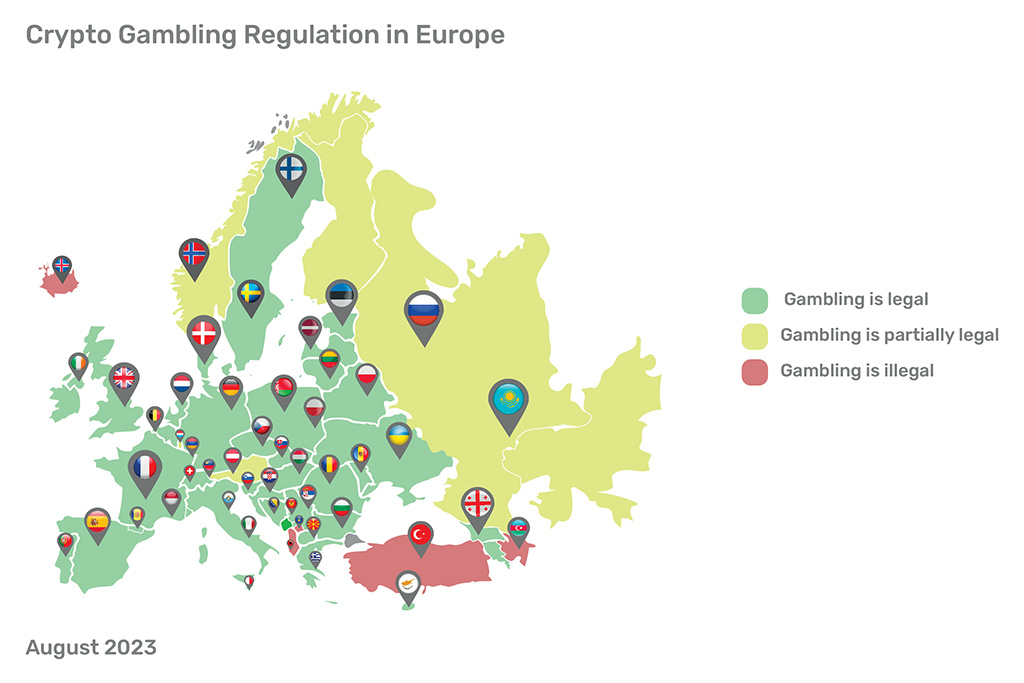
Crypto Gambling Regulations in Europe
Credit: casinosblockchain.io

Choosing your localisation options

Some locations are easier to localise than others. The liberal laws of the UK, Gibraltar, and Costa Rica are primed for casino owners who have never localised before. They have regulatory bodies who can answer your questions and an easy tax environment to adapt to. If you’ve never launched on foreign soil before, it might be best to hire a professional company to handle your iGaming content services on your behalf.

Europe is home to several different gambling jurisdictions, and not all of them are EU members. Some countries operate independently, so your localisation needs to be handled one country at a time. 2022 was a significant year for digital casinos. Nations all across the EU created new legislative bills and regulations to open up the sector to foreign operators while still cutting down on addictive gaming.

Did you like the article? Contact us to let us know what you thought.


Do you need help to get started or to further your existing link building strategy? Contact us for a free advice or request a video call with our experts.


Need a quote? Click here

Get a Free and Fast Quote for Your Project, Crypto Payments accepted. Click Here!